





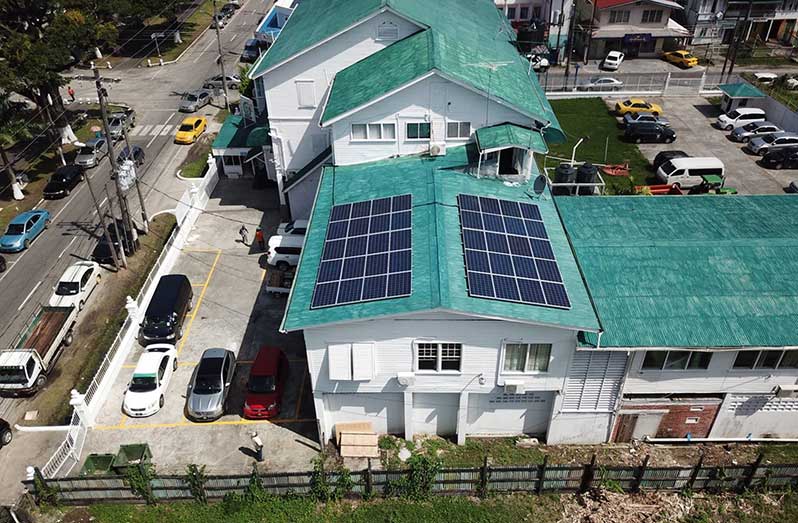
THE Government is exploring additional incentives, including possible solar rebates and other fiscal measures, to encourage more Guyanese households to generate renewable energy and further reduce their electricity costs, President Dr. Irfaan Ali has disclosed.
The move could build on the National Grid-Connected Solar Programme, which is already targeting 5,000 households in its initial phase, and allows homeowners to generate electricity for their own use and feed excess power into the national grid.
During a recent sit-down interview with News Room, President Ali said the Government is examining different models as it looks for ways to incentivise household-level renewable energy generation.
“We are also now looking at different ideas and models,” the President said, pointing to approaches used internationally.
“You know, some countries have the rebate programme on solar; the grid tie-in programme. So, there are a number of other initiatives that we are looking at to incentivise the household at the household level that will bring them even further savings and create other fiscal incentives for them to be self-generating, but in a renewable way,” Ali said.
The President did not provide details on the value of any potential rebate or additional fiscal incentives, eligibility requirements, or when those measures could be introduced.
However, Guyana has already started laying the groundwork for greater household participation in renewable-energy generation through the National Grid-Connected Solar Programme.
The Guyana Energy Agency (GEA) announced earlier this year that the initial phase of the programme is targeting 5,000 homes, with the initiative designed to allow households to generate their own electricity, while reducing their dependence on the national grid, and lowering monthly electricity bills.
Under the programme, solar panels generate electricity during daylight hours for use within the home, while additional electricity required by the household can still be supplied by the Guyana Power and Light Inc. (GPL).
Where a household generates more electricity than it requires, that excess power can be fed into the national grid. Homeowners can then receive credits through the billing mechanism, and, depending on the amount of electricity generated and consumed, could receive payments for excess generation.
The system utilises bi-directional meters, which allow electricity to flow both to and from the grid. According to information previously released by the Department of Public Information, GPL has established a fast-tracked approval process for participants, with the bi-directional meters being provided at no additional cost to customers.
Financing arrangements have also been developed to improve household access to the programme.
The GEA has partnered with local financial institutions, including commercial banks and the New Building Society, with estimated monthly financing payments ranging from $7,000 to $26,000, depending on the arrangement.
GEA Chief Executive Officer, DrMahender Sharma had previously explained that a five-kilowatt solar system, estimated to cost approximately $1.2 million, could generate electricity valued at roughly $28,000 per month, helping households offset their electricity costs.
President Ali’s latest comments now signal that the Government is considering going further by examining additional incentives that could make household investment in renewable energy more attractive.
He linked the approach to the administration’s wider commitment to reduce household electricity costs while ensuring that Guyana continues to advance its renewable-energy targets.
The proposed incentives, once developed, could therefore complement the existing grid-connected programme by addressing one of the major considerations for households seeking to install solar systems — the upfront cost of making the investment.
Ali, however, made clear that the additional measures remain under consideration, with the Government still examining the models that could be adopted.





