






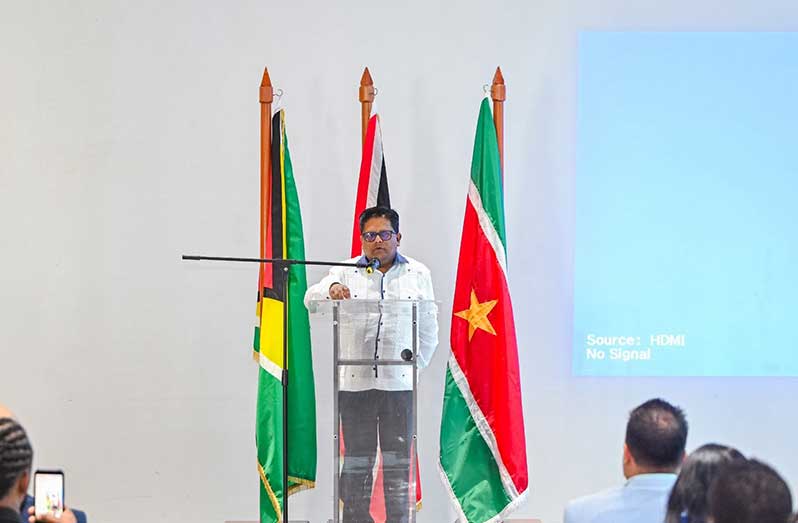
SENIOR Minister within the Office of the President with responsibility for Finance, Dr Ashni Singh, has noted that Guyana is positioning itself to become a major regional industrial hub through an ambitious programme of energy, transport and industrial development projects set to transform the country’s economic landscape.
The finance minister was at the time delivering remarks during a trade and investment mission here during which he spoke on Guyana’s development agenda, noting that the government is pursuing a series of large-scale projects designed to unlock new industrial opportunities and support economic diversification beyond oil production.
Dr Singh pointed to the country’s gas-to-energy initiative as a key component of that transformation, noting that Guyana has already landed its first offshore gas pipeline and is constructing a 300-megawatt gas-fired power plant at Wales, West Bank Demerara.
“We have a major industrial development underway currently,” Dr Singh said.
He went on to explain that the Wales project is expected to support a range of downstream industries, including natural gas liquids (NGL) processing and potential fertiliser production.
He revealed that plans are also advancing for a second gas pipeline that will land at the mouth of the Berbice River, alongside the development of another major industrial complex.
According to the Minister, the Berbice development is expected to facilitate additional electricity generation, fertiliser production and other industrial activities.
Additionally, authorities are moving ahead with plans to strengthen transport links to northern Brazil, a development that could significantly enhance Guyana’s role as a gateway for regional trade and commerce.
“I mention all of these things to put into perspective the scale of the infrastructure development and the industrial and manufacturing possibilities that will be unlocked as a result of all of this being built,” Singh said.
Beyond energy and industrial projects, he told the investment mission that the government is investing heavily in roads, bridges, ports, housing, healthcare facilities, schools and water infrastructure as part of a broader national development strategy.
These investments, he said, are intended to create the conditions necessary for sustained economic growth while supporting the expansion of non-oil sectors.
Against this backdrop, he disclosed that the government’s objective is not only to maximise the benefits of Guyana’s oil and gas resources but also to build a globally competitive economy capable of generating long-term prosperity.
“We have every intention to harvest [our oil resources] in the most aggressive way possible in pursuit of our national development objectives, but we will aggressively promote and facilitate the realisation of a fully competitive non-oil economy,” he said.



