–unlawful disclosure of registry information could attract three years’ imprisonment
A NEW provision in the Sexual Offences (Amendment) Bill 2026 would make it a criminal offence to fail to report suspected sexual offences against children and vulnerable adults, with offenders facing a $250,000 fine, or two years in prison. The measure, contained in a proposed Section 86A of the Act, is among several reforms designed to strengthen protections for vulnerable persons and improve the handling of sexual offence cases.
The sweeping amendments were tabled in the National Assembly last Friday. The proposed Sexual Offences (Amendment) Bill 2026 seeks to strengthen protections for children and vulnerable adults through a series of new provisions, including mandatory reporting requirements, expanded witness protections and the establishment of a National Sex Offender Database.
One of the most significant changes is the insertion of a new Section 86A into the Sexual Offences Act, creating a legal duty for employees of both State and non-State institutions to report suspected sexual offences.
Under the proposed section, an employee who works with children and has a reasonable suspicion that an offence under the Act has been committed against a child must submit a written report to the officer in charge of the nearest police station.
Similar obligations would apply to employees who work with vulnerable adults and suspect that a sexual offence has been committed against a person in their care.
The proposed law defines a vulnerable adult as a person with a disability as defined under the Persons with Disabilities Act.
Special provisions have also been included for Indigenous communities where no police station exists. In such instances, reports may be made to the Toshao of the Amerindian village or community, or the Toshao of the nearest Amerindian village or community.
Failure to comply with the reporting requirement would constitute an offence. According to the bill, any person who fails to make the required report would be liable on summary conviction to a fine of $250,000 or imprisonment for two years.
The mandatory reporting requirement forms part of a broader effort to strengthen the response to sexual offences and improve the protection of victims.
Another major feature of the legislation is the insertion of a new Part IXA into the principal Act establishing a National Sex Offender Database.
Under the proposed provisions, the database would be established and maintained by the Commissioner of Police and would contain information relating to persons convicted of specified sexual offences.
The database would not be accessible to the general public, but certain authorised persons working with children and vulnerable adults may apply for information relating to a specific offender.
The amendments would apply to Guyanese citizens and residents convicted of designated sexual offences both within and outside Guyana, subject to conditions outlined in the legislation.
The bill also proposes penalties for the unlawful disclosure of information contained in the proposed National Sex Offender Database. Under new Section 91C (7), any person who has been granted access to the database and unlawfully distributes, transmits or reproduces information obtained from it would commit an offence.
Upon summary conviction, the offender would be liable to a fine of $100,000, imprisonment for up to three years, or both. The provision is intended to safeguard sensitive information contained in the database, which would not be accessible to the general public.
The bill also introduces new evidentiary provisions aimed at strengthening the prosecution of sexual offence cases.
Through the insertion of a new Section 43A, courts would be permitted in certain circumstances to admit written statements or depositions that were previously tendered during committal proceedings. Such evidence may be admitted where a witness has died, is medically unable to attend court, is outside Guyana and cannot reasonably be brought to court, cannot be located despite reasonable efforts, or has been prevented from attending through threats of bodily harm or death.
The court must, however, be satisfied that the interests of justice require the evidence to be admitted and that there is independent evidence supporting its reliability.
Further amendments seek to reduce the trauma often experienced by victims during legal proceedings. Changes to Section 56 would expand the use of audiovisual evidence to include pre-recorded video evidence, while amendments to Sections 58, 73 and 74 would extend protections currently afforded to child witnesses and complainants to vulnerable adults.
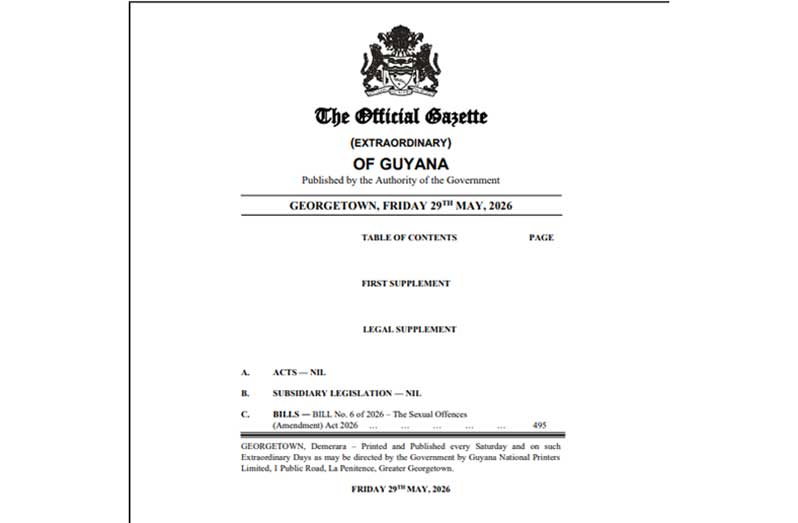
The bill also proposes amendments to Section 19 of the Act to include Toshaos among persons recognised as holding positions of trust, while replacing references to “child-minder” with the term “caregiver”. The Sexual Offences (Amendment) Bill 2026 was published in the Official Gazette on May 29 and is expected to be debated in the National Assembly.
If enacted, the legislation would represent one of the most comprehensive updates to Guyana’s sexual offences framework in recent years, introducing new reporting obligations, enhanced protections for victims and witnesses, and a system for monitoring convicted sex offenders through a national database.