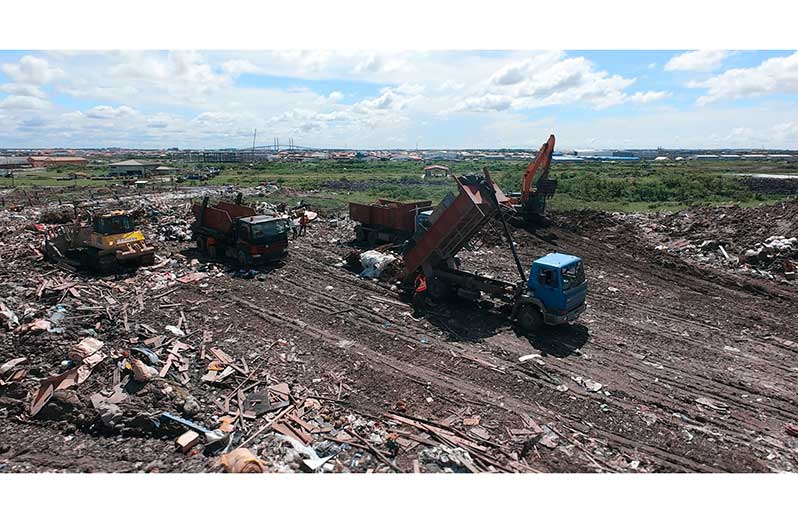
FOR years, residents of the Eccles–Providence area lived with an unwelcome reality: the persistent odour emanating from the nearby Haags Bosch landfill.
For some, it was an occasional nuisance. For others, particularly those living closest to the site, it became a daily disruption that affected the simple comforts of home.
Among them is Eccles resident Ken Sahadeo, whose home sits just a minute’s drive from the landfill. He recalls a time when returning home after work often meant preparing for the smell before even stepping through the door.

the landfill being interviewed
“It wasn’t just a smell,” Sahadeo said. “It was a smell that is actually a taste.”
According to him, the odour would settle heavily across the neighbourhood, lingering in yards and clinging to clothing.
Evenings were often the most difficult, turning what should have been a time to relax into a routine of quickly closing doors and windows to keep the smell outside.
Perhaps the most frustrating aspect was its unpredictability.
Some nights the odour was absent. Other nights, it arrived without warning, carried by changing winds and atmospheric conditions. Residents never knew when they would be forced indoors.
Today, however, many say that reality has changed.
When asked what has improved most since efforts began to address the problem, Sahadeo pointed to something less tangible than engineering solutions or operational upgrades.
“There’s a peace of mind that comes with a simple thing of not smelling the landfill,” he said.
Long-time resident Data Raghubar has noticed the difference as well. Having lived in the area for more than a decade, she remembers occasions when the smell would drift into the community depending on the direction of the breeze.
“When it came our way, you had to go inside,” she recalled.
Now, she says, the situation has improved considerably.
“Everything is okay right now,” Raghubar said. “I’m not getting the smell anymore.”
Their experiences reflect a broader shift being felt across the Eccles–Providence community.
The issue gained heightened attention in September 2025 when Minister of Local Government and Regional Development, Priya Manickchand, acknowledged receiving complaints from residents about foul odours coming from the landfill and committed to addressing the problem.
By December, mitigation works were already underway.
Between September and mid-December, exposed garbage at the landfill was covered, significantly reducing the long-standing odour that had affected nearby communities for years.
At the centre of those efforts is Haags Bosch Site Supervisor Lloyd Stanton, who explained that managing odour has become increasingly important as the landfill continues to handle growing volumes of waste.
The facility serves communities stretching from Timehri to Georgetown, Parika to Vreed-en-Hoop, as well as parts of the East Coast. Over the years, the amount of waste arriving at the site has increased dramatically—from approximately 150 tonnes per day in its earlier years to between 600 and 1,200 tonnes daily.
With those volumes, Stanton said, odour management is a critical operational priority.
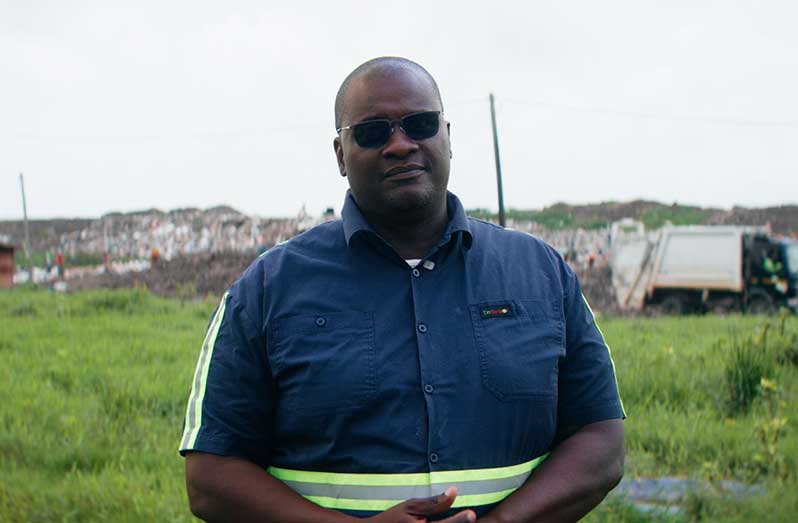
He explained that landfill odours generally originate from two sources: freshly deposited waste and gases produced as older waste decomposes.
The smell from newly delivered garbage typically remains close to the disposal area. Decomposition gases, however, can travel much farther. As organic waste breaks down, it generates heat that causes gases to rise into the atmosphere before being carried by air currents and settling in surrounding communities.
“That’s usually the smell residents farther away experience,” Stanton explained.
To reduce those emissions, landfill operators have been covering exposed waste with clay and other inert materials, creating a barrier that limits the release of odours into the surrounding environment.
Additional measures are also being implemented, including the use of deodorising diffusers, the planting of grass on completed landfill cells, and the installation of additional ventilation pipes designed to cool waste piles and reduce the distance decomposition gases can travel.
Stanton acknowledged the impact the odour had on surrounding communities.
“We are sorry for the inconvenience over the years,” he said.
While noting that occasional odours may still occur, he estimated that the landfill is now about 80 per cent of the way toward resolving the issue and preventing the prolonged episodes residents previously experienced.
For residents such as Sahadeo, however, the success of those interventions is measured less by technical benchmarks and more by daily quality of life.
The changes have made it possible to enjoy outdoor spaces again.
Sahadeo pointed to a community play park in Eccles that now sees regular use by residents. He believes such activity would have been far less likely had the odour remained as strong as it once was.
With fewer complaints about unpleasant smells, families are spending more time outdoors, neighbours are gathering more comfortably, and public spaces are once again serving their intended purpose.
The improvements at Haags Bosch highlight how environmental challenges can affect communities in deeply personal ways. While odour management is often discussed through technical reports, operational plans and environmental assessments, its impact is ultimately felt in everyday moments, opening a window, sitting outside in the evening, or simply returning home after a long day.
For many residents of Eccles and Providence, those moments are becoming normal again.
And for Sahadeo, the greatest sign of progress is remarkably simple: being able to come home without thinking about the landfill at all.