






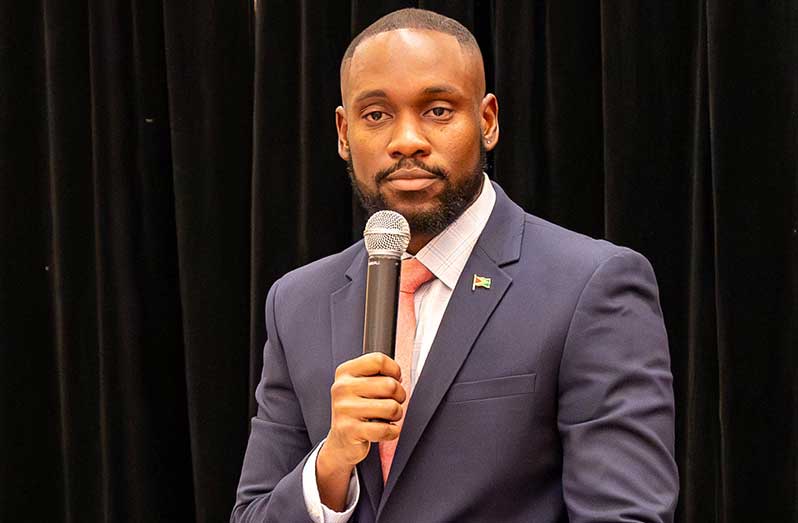
MINISTER of Labour and Manpower Planning, Keoma Griffith, recently said migrant workers pose “no threat” to Guyanese citizens, stressing that foreign labour is needed to help support the country’s rapid economic expansion and growing workforce demands.
Speaking at a stakeholders’ discussion forum titled “Bridging Guyana’s Skills Gap: Diaspora and Migrant Labour” at the Guyana Marriott Hotel Georgetown, Minister Griffith said Guyana’s development requires a balanced approach that protects local workers while strategically incorporating migrant labour and diaspora expertise.
The forum was hosted by the Diaspora Unit of the Ministry of Foreign Affairs and International Cooperation and brought together government officials and stakeholders to examine labour migration, workforce development and skills shortages in Guyana’s emerging economy.
“Migrant workers present no threat to Guyanese,” Griffith said during his feature address, adding that foreign workers “have come to build on what is already here” even as the government continues to prioritise Guyanese citizens.
According to the minister, Guyana has increasingly become a destination for migrant labour, particularly workers from China, India, Cuba, Haiti, Venezuela and neighbouring Caribbean countries, as major development projects continue to expand across multiple sectors.
He emphasised, however, that migration must be managed responsibly through systems that are “safe, orderly, ethical, regulated and grounded in human rights.”
Griffith noted that Guyana is currently experiencing one of the most transformative periods in its history, with unprecedented growth occurring simultaneously across several sectors of the economy. He said this expansion places pressure on labour systems, institutions and policies to adapt to rapidly changing workforce demands.
“As labour mobility intensifies and workforce demands continue to evolve, governments must ensure that economic expansion is matched by strong institutions, effective labour market governance and policies that protect local and migrant workers alike,” the minister stated.
He also linked Guyana’s labour history to the country’s political development, noting that workers’ rights legislation during the colonial era contributed to the suspension of the constitution at the time.
The minister said technological advancement, digitisation, artificial intelligence and climate-related economic shifts are reshaping labour markets globally and require Guyana’s technical and vocational education systems to modernise accordingly.
He added that the country must create opportunities for both Guyanese citizens and migrant workers to contribute meaningfully to national development.
Citing findings from the study Planning for Prosperity: Labour Migration in Guyana’s Emerging Economy, Griffith said Guyana could require approximately 160,000 additional workers in the medium term to fully meet its economic potential.
He also pointed to significant increases in migration flows over recent years, noting that arrivals rose from about 1,510 in 2016 to more than 18,000 in 2018, with further increases projected. At the same time, he said, thousands of skilled Guyanese workers have migrated overseas in search of better opportunities.
Griffith said Budget 2026 outlines plans for a migration policy aimed at recruiting foreign workers to meet labour shortages without compromising the rights and interests of Guyanese workers.
According to the minister, the proposed framework will also strengthen diaspora engagement and improve systems for recognising and mapping the skills of overseas-based Guyanese professionals.
He stressed that labour migration should complement — not undermine — local employment and workforce development.
“Government agencies must coordinate recruitment and training. Employers must commit to ethical practices and workforce integration, and diaspora and international partners must support capacity building and policy development,” Griffith said.
Also attending the forum were Foreign Secretary Robert Persaud and Head of the Diaspora Unit, Ms Rosalinda Rasul.




