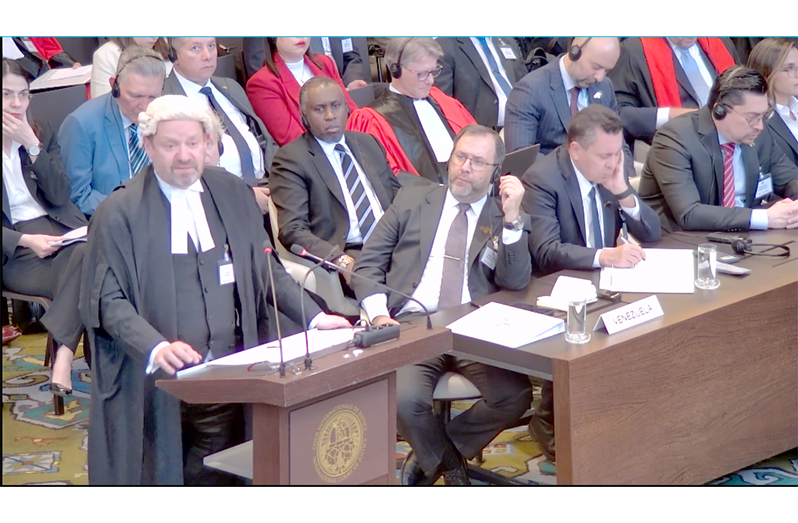
–Guyana tells ICJ; King’s Counsel Sands dismisses Bolivarian Republic’s reliance on Mallet-Prevost Memorandum
–argues Caracas accepted the 1899 Arbitral Award for more than six decades
KING’S Counsel Philippe Sands on Friday delivered a blistering rebuttal before the International Court of Justice (ICJ), accusing Venezuela of weaponising anti-colonial arguments and attempting to reopen a border controversy that had been settled for more than six decades.
Presenting Guyana’s rebuttal in the historic Essequibo border case on Friday, Sands argued that Venezuela’s attack on the 1899 Arbitral Award was rooted not in law, but in political opportunism tied to Guyana’s impending independence in the 1960s.
At the centre of Venezuela’s argument is the so-called Mallet-Prevost Memorandum, a document Venezuela says exposed alleged impropriety in the arbitration process that established the boundary between then British Guiana and Venezuela.
The Mallet-Prevost Memorandum is a document written by Severo Mallet-Prevost, the official secretary to the United States-Venezuelan delegation during the 1899 Paris Arbitral Award proceedings, and published posthumously in 1949.
The memorandum later became central to Venezuela’s complaint before the United Nations (UN) in 1962, which ultimately led to the signing of the 1966 Geneva Agreement between Venezuela and the United Kingdom.
But Sands dismissed the argument in scathing terms.
“The argument is ‘tosh’; it’s a fiction, and it suffers from fatal problems,” he told the court.
He argued that Venezuela’s legal team had falsely portrayed the memorandum as a shocking revelation that suddenly explained why Venezuela repudiated the award in 1962 after accepting it for more than 60 years.
“For these counsel, the Mallet-Prevost Memorandum has a clear purpose,” Sands said, adding: “It offers a rationale, the rationale to explain why Venezuela accepted the award for 63 years, never challenged its validity and then suddenly and abruptly changes its position in 1962.”
According to Sands, however, the facts completely undermine that narrative.
“Venezuela already had all the information it now says was newly available in 1949,” he argued, noting that discussions about compromise and political considerations surrounding the award were publicly reported in newspapers within days of the tribunal’s ruling in October 1899.
Sands cited contemporaneous reporting from both The New York Times and The Times of London, which openly discussed the arbitral compromise and the pressures faced by the arbitrators.
“These two newspaper articles were published within two days of the award,” he stressed, noting: “It was public; it was available. It was plainly known to Venezuela.”
Despite this knowledge, Venezuela not only refrained from objecting to the award, but signed the 1905 Boundary Agreement implementing it and respected the boundary for decades afterward.
“Did this information cause Venezuela to object to the award? It did not,” Sands said, noting: “For the next 57 years, it faithfully gave effect to that treaty and the award it implemented. Not a squeak of opposition.”
He rejected Venezuela’s claims that the arbitration process involved blackmail or extortion by Russian jurist Friedrich Martens, who chaired the tribunal.
Sands argued, “Is there evidence here of extortion or blackmail? No, there is not.
NOT A SHRED OF EVIDENCE
“There is none, not a shred of evidence.”
Instead, Sands described Martens’ efforts to secure consensus among arbitrators as a normal feature of arbitral deliberations.
“The striving for consensus is an act of decency and wisdom,” he said, adding: “That Mr. Martens achieved it is to his credit, not to his detriment.”
Sands argued that Venezuela’s true objective was not legal correction, but rather reopening the territorial question at the moment Guyana’s independence became imminent.
“What are we actually addressing in this courtroom?” he asked the judges, noting: “British Guiana’s desire for independence offered a wonderful opportunity to reopen, for the first time after 63 years, the path to resolve a lingering unhappiness about the substantive outcome of the award and the 1905 treaty.”
According to Sands, the Mallet-Prevost Memorandum was ultimately “instrumentalised” and “weaponised” by Venezuela to justify reopening a controversy that had long been settled.
“The only thing that was new in that document, magical realism, was the claim of an Anglo-Russian deal prompting the outcome,” he said, adding that Venezuela itself no longer appeared to rely on that “outlandish claim”.
Sands also forcefully rejected Venezuela’s attempt to frame the case as part of a broader anti-colonial struggle.
Responding directly to arguments advanced by Venezuelan counsel Professor Makane Moïse Mbenge, Sands said comparisons to the Chagos Islands advisory opinion were entirely misplaced.
“Chagos offers no assistance whatsoever to Venezuela. It is totally different,” he declared.
Sands said that unlike Mauritius in the Chagos matter, Guyana inherited internationally recognised boundaries at independence based on a binding arbitral award and treaty that Venezuela itself had accepted for decades.
Sands reminded the court that Venezuela had voted in favour of United Nations Resolution 1514 of 1960 — the landmark decolonisation resolution affirming territorial integrity — without raising any reservation regarding British Guiana’s boundaries.
“At the moment it voted for Resolution 1514, it still accepted its boundaries as they had existed for more than 60 years,” he said.
According to him, Venezuela only changed its position when Guyana’s independence “suddenly hoved into view.”
In one of the most significant passages of his presentation, Sands warned the ICJ that accepting Venezuela’s arguments would destabilise international borders globally and undermine long-established legal settlements.
He told the judges, “If this court is to accede to Professor Mbenge’s invitation and find invalid the 1899 Arbitral Award and presumably also the 1905 Treaty, you would rekindle the embers of dead empires.
“You would plunge Guyana into a new form of domination and oppression in relations with its much larger neighbour.”
Sands further warned that overturning a century-old arbitral award would create dangerous global consequences.
“You would send a signal to the world that the passage of six decades is no bar to setting aside an Arbitral Award or a Boundary Treaty,” he argued.
“You would rekindle an age of instability and uncertainty.”
The King’s Counsel said such a precedent would threaten borders across Africa, Latin America, and other post-colonial states whose boundaries emerged from colonial-era agreements and settlements.
“That is what Venezuela is asking you to do,” Sands declared, noting: “That is what we feel sure you must resist.”