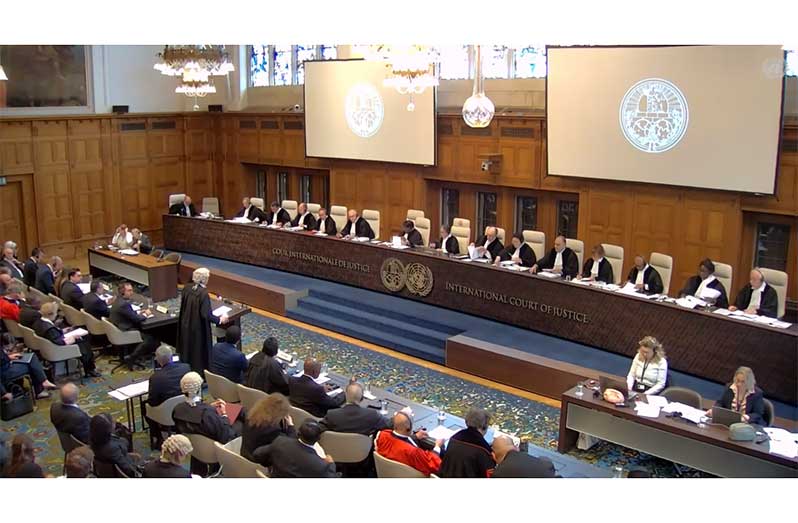
–despite World Court previously ruling it has authority to hear the matter
–case was referred to the ICJ by the UN Secretary-General under the 1966 Geneva Agreement
VENEZUELA, on Wednesday, again used the International Court of Justice (ICJ) stage to once again argue against the court’s authority in the case involving the Essequibo border controversy.
The country’s agent and Permanent Representative of Venezuela to the United Nations (UN), Samuel Moncada Acosta, insisted that the decades-old controversy should not be resolved through a binding judicial ruling.
Addressing judges at the World Court, headquartered at the Peace Palace in The Hague, Netherlands, Acosta repeatedly maintained that the 1966 Geneva Agreement—not the ICJ—should guide efforts to resolve the controversy.
The ICJ has already addressed the issue of jurisdiction on two occasions—first on December 18, 2020, and again on April 6, 2023—each time confirming that the court has the authority to hear and decide the case on its merits.
The court, among other things, held that: “Guyana and Venezuela mutually conferred upon the Secretary-General the authority to choose the means of settlement of the controversy, and on 30th January 2018, the Secretary-General exercised this authority by choosing judicial settlement before the court.”
The ICJ is the principal judicial organ of the United Nations that settles legal disputes between states, with its rulings being binding on the parties involved. Enforcement of its judgments falls under the responsibility of the United Nations Security Council (UNSC).
The Geneva Agreement established a framework for resolving the controversy, including the use of a United Nations Good Offices process if bilateral talks failed. The case was referred to the World Court because the Good Offices process and other diplomatic efforts under the 1966 Geneva Agreement failed to produce a mutually acceptable resolution, prompting then UN Secretary-General António Guterres to choose judicial settlement as the next step.
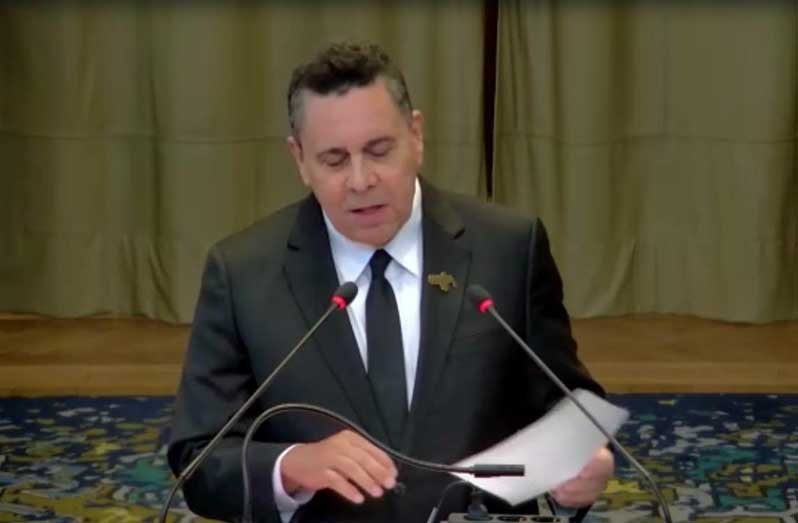
Despite participating in the proceedings, Acosta maintained that Caracas does not recognise the jurisdiction of the ICJ, even as the matter was referred to the court by then UN Secretary-General.
“Venezuela will reiterate that its participation does not imply recognition of the court’s jurisdiction,” Acosta told the judges, describing the appearance as merely an exercise of Venezuela’s “sovereign right to defence.”
The latest submissions come as Venezuela continues to challenge the validity of the 1899 Arbitral Award, the internationally recognised ruling that legally established the boundary between Guyana and Venezuela more than a century ago.
Guyana has consistently argued that the award is valid, final and binding, noting that Venezuela accepted the border for decades before reviving its claim to the Essequibo region.
Throughout his presentation, the Venezuelan agent attempted to cast doubt on Guyana’s sovereignty over the Essequibo, arguing that the territory remains “subject to dispute,” and insisting that the matter can only be resolved through direct negotiations and compromise.
During opening remarks before the court on Monday, Guyana’s Minister of Foreign Affairs and International Cooperation, Hugh Todd, told judges: “At stake is more than 70 per cent of our sovereign territory, which has been recognised to be an integral part of the country [Guyana] for more than 126 years, including the past 60 years since independence.”
During his submissions on Wednesday, Acosta accused Guyana of pursuing what Venezuela views as a “winner-takes-all” strategy by seeking a definitive ruling from the ICJ.
However, on Monday, Guyana’s agent Carl Greenidge told the court that Venezuela has failed to demonstrate any meaningful presence in the Essequibo region. Instead, he said, it relied on abstract and outdated assertions rather than concrete proof.
“In asserting this claim, Venezuela did not point to any military bases or to settlements it had built, officials it had posted, or taxes it had collected. It pointed to the heavens, quite literally,” Greenidge submitted.
The Venezuelan representative also dismissed Guyana’s warnings about threats to its territorial integrity, describing such claims as misleading. He additionally argued that Venezuela has historically supported Guyana through regional cooperation initiatives and maintained that Caracas does not pose a threat to regional peace or stability.
Minister Todd, however, told the court on Monday that Venezuela has repeatedly sought to obstruct the proceedings before the court.
He pointed to Venezuela’s earlier objections to the court’s jurisdiction and the admissibility of the case, both of which were dismissed by the ICJ in 2020 and 2023.
According to Todd, Venezuela later escalated its actions by staging a referendum in 2023 aimed at rejecting the court’s authority and asserting sovereignty over the Essequibo region.
On December 3, 2023, Venezuela held a non-binding referendum, in which officials claimed that Venezuelans supported creating a Venezuelan state in the oil-rich Essequibo region, controlled by Guyana.
Despite provisional measures issued by the court to prevent such steps, he said Venezuela proceeded with actions that directly contravened those orders. These included executive decrees, legislation, and plans to integrate the territory into its administrative framework.
Todd pointed out that these developments have had serious implications for Guyana’s security and development.
The minister pointed to increased military activity near the border, including the construction of bases and deployment of troops, describing the situation as a growing threat.
“This has been a blight on our existence as a sovereign state from the very beginning of our existence. It has been a threat to our peace and security, exacerbated in recent years by the ominous growth of Venezuela’s military activities, including the construction of new bases and airfields, and the deployment of aircraft, heavy weapons, and troops to the border area.”
The minister said the controversy has also hindered economic progress, noting that uncertainty has discouraged foreign investment.
As the case enters its final phase, Todd expressed hope for a definitive resolution grounded in law. Guyana, Minister Todd said, remains steadfast in its commitment to the judicial process and to upholding the rule of international law.