






—Calls for costs instead of dismissals; says litigants must be heard on merits
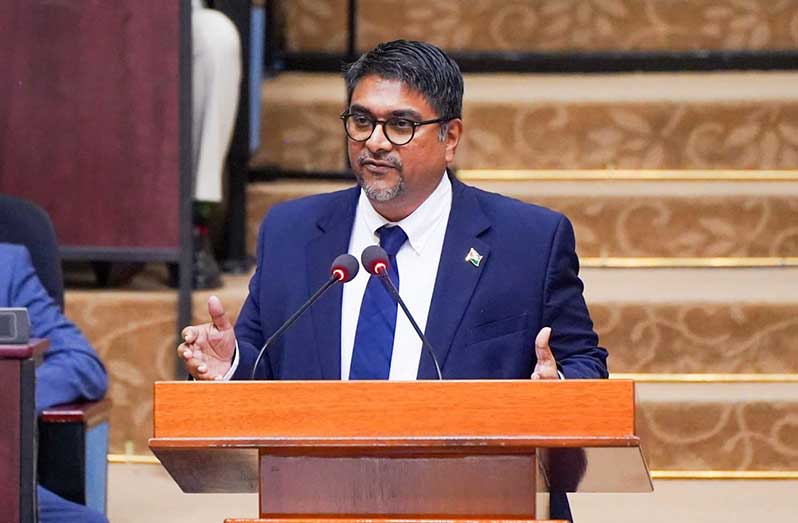
ATTORNEY-AT-LAW and People’s Progressive Party/Civic (PPP/C) Member of Parliament Sanjeev Datadin is calling for a shift in judicial approach, urging courts to impose financial penalties for procedural missteps rather than dismissing cases outright, while insisting that matters must ultimately be decided on their merits.
Datadin, speaking at a recent trialogue on procedural rigidity within the legal system, contended that an overemphasis on strict technical compliance is undermining the pursuit of substantive justice.
He referenced regional case law, including decisions of Guyana’s apex court, the Caribbean Court of Justice (CCJ), noting that these rulings emphasise the need to determine matters on their substantive merits rather than on procedural missteps.
Referencing a case he had argued before the CCJ, Datadin recalled that the court “sent back a case to the Court of Appeal saying a case was to be judged on its merit and not on a technical fault,” reinforcing what he described as a critical principle in modern justice systems.
He expressed concern that judges are increasingly prioritising procedural rules, noting that “far too much weight” is being placed on them instead of examining the substance of disputes.
“I have a very firm view on this. Judges are placing far too much weight on procedural rules rather than merits,” Datadin said.
Using practical courtroom scenarios, he explained that litigants who miss deadlines or fail to comply strictly with procedural requirements should not automatically be denied a hearing. Instead, he suggested that courts should penalise such breaches through costs.
“If you don’t file your defence in time, default judgment is given. But if the man comes to court and he’s late and he says, ‘look, this is my defence,’ you can make an award for costs for the wasting of judicial time, but he should not be shut out,” he stated.
Datadin emphasised that the overarching purpose of civil procedure rules is to ensure fairness and justice, not to create barriers to hearing cases.
“The overriding objective is that the courts must be fair, do justice, and apportion time proportionate to the seriousness of matters,” he explained, adding that strict application of rules often undermines this goal.
He further noted that higher courts, including the Privy Council, have already signalled the importance of balancing procedural compliance with substantive justice.
“The explanation as to why he is late is one part, but for you to do justice, you have to look at the merits of the claim,” Datadin said.
The attorney warned that an overreliance on procedure could have wider societal consequences, suggesting that litigants who feel denied justice may lose faith in the legal system.
“Procedural matters… are going to put people with cutlasses on the road because they will be angry that they haven’t got justice,” he cautioned.
He stressed that the courts serve as a civilised mechanism for dispute resolution, but that function is undermined when individuals are denied the opportunity to be heard.
“Civilised societies settle disputes with a judge, but if the judge is not going to give you a chance to hear your case because you are late, then how do you feel satisfied?” he questioned.
Datadin also raised concerns about the practical realities facing attorneys, noting that tight timelines and heavy caseloads make strict compliance difficult.
“The bulk of judicial time now is wasted by applications for extension of time because the timelines are so short. Lawyers are doing several cases. It’s almost impossible,” he said.
While acknowledging that courts may be concerned about delays, he argued that mechanisms already exist to address repeated non-compliance, such as escalating sanctions and “unless orders,” which can ultimately lead to dismissal if parties continue to default.
“The fact that he is late—punish him with costs… then if you’re repeatedly delinquent, the court makes an ‘unless order,’” he explained.
Ultimately, Datadin maintained that justice must remain visible, accessible, and grounded in fairness rather than technical formality.
“There is a disproportionate weight being placed on procedure rather than substance, so it’s more form than it is substance,” he said, adding that justice should not be confined to “side streets” but must remain “on the highways, clear for everyone to see and understand.”




