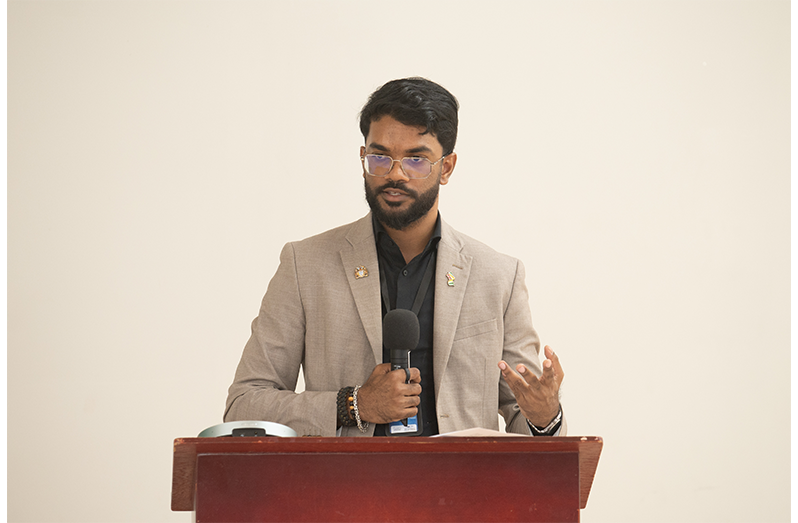
-as NGO launches local chapter to strengthen climate-health awareness across Guyana
GUYANA is moving to strengthen its response to climate-related health threats through the National Plan for Climate Change and Health, which brings together key sectors, targets vulnerable populations and prioritises resilience across the healthcare system.
Head of the Climate and Health Unit at the Ministry of Health, Nayan Persaud, said the initiative focuses on addressing growing risks such as increased disease, damaged infrastructure and food insecurity.
This comes amid the launch of the Guyana Chapter of EarthMedic/EarthNurse (EM/EN). Speaking at the simple launch event on Tuesday, Persaud said the plan aims to advance coordinated action, improve public awareness and build long-term sustainability.
Giving an overview of the National Plan for Climate Change and Health, Persaud was keen to note that both challenges are interconnected.
Highlighting the negative impacts of climate change, Persaud said that increased health risks, emerging diseases and food insecurity are just a few of the numerous impacts of climate change on health.

He added that the Ministry of Health is aware of and has assessed the challenges of climate change on matters of health. This, he said, has led to the development of a structured approach.
“When we look at how diseases spread, how we access community health care, and ultimately how we protect the well-being of persons, we as the health sector need to put certain things in place,” he said.
The plan seeks to take a collaborative approach by bringing together various agencies and stakeholders from around the country. The plan is also inclusive, looking at the overarching structure of how climate change and its health threats can be targeted within the sector and developing a strategic system to tackle those challenges.
Moreover, Persaud said that engagements on implementing the plan are already underway, adding, “With the development of the national adaptation plan, we did a comprehensive stakeholder engagement.” This meeting, he added, allowed for the assessment of the major hurdles. “This would have allowed us to bring together healthcare professionals, environmental experts, policymakers, and civil society to assess vulnerabilities.”
These talks have led to the creation of six “building blocks,” Persaud shared. These discussions have enabled the ministry to highlight several critical areas needed in the comprehensive development of a healthcare system not easily impacted by climate change. Highlighting these areas, Persaud said adding, “These building blocks are health service delivery, health workforce, health information systems, access to essential medicines, health financing, and leadership and governance.” Moreover, through these engagements, the ministry has developed a clear understanding of where integration is most urgent. Speaking on these areas of vulnerability, he further stated, “These assessments allowed us to identify the most at-risk populations, including those in hinterland regions or those in flood-prone regions, and ensure that our intervention is equitable and targeted.”
Moreover, the plan seeks to work through multi-sectoral partnerships as well as international collaborations. As Persaud explained, the ministry has strengthened partnerships across sectors, noting that climate change and health is not just the sector’s priority.
At the international level, the plan has been engaging in a variety of participatory initiatives and knowledge-sharing platforms in an effort to better understand the risks and data surrounding the issue both locally and internationally. “The plan allows us to have this broad perspective of how we can holistically approach climate change and health within the healthcare system,” he said, adding, “These alignments ensure that health remains an essential component of Guyana’s sustainable development plan.”
As the plan moves into its next phase of implementation, Persaud explained that various financing mechanisms will be explored, including local funding. Providing deeper insight into the next steps, he noted that the aim is to move ahead with strong leadership and collaboration toward sustainability.
Speaking on the next stage of finalising and operationalising the plan, he said, “This will involve translating policy into action, developing implementation strategies, mobilising resources, and establishing a monitoring system to track progress and impact.” Moreover, as the ministry remains focused on strengthening health infrastructure to withstand climate shocks, public awareness and engagement also remain vital.
COLLABORATION IS CRITICAL
This is where collaborations with agencies like EarthMedic/EarthNurse (EM/EN) are critical. Also speaking at the launch, Dr James Hospedales, Executive Director of EM/EN, said Guyana is one of the most climate-vulnerable countries in the region by virtue of its low-lying coastline where most of the population resides.
He noted that through partnerships with institutions including the University of the West Indies and the Pan American Health Organisation, EM/EN has supported knowledge-sharing initiatives and regional conferences focused on climate impacts and solutions. Similar collaboration is expected locally as the Guyana chapter takes shape.
Additional perspectives at the launch underscored the breadth of national engagement on climate and health.
Alisha Koulen, who represented Guyana at COP, highlighted the importance of youth involvement in shaping climate responses, noting that young people must be included in decision-making processes as both advocates and innovators.
Dean of the College of Medical Sciences at the University of Guyana, Professor Ragini Kurup, spoke on the importance of integrating while Naomi Parris, a reporter at the Guyana Chronicle and climate activist, emphasised the role of public communication and media in ensuring that information on climate and health reaches communities in a clear and actionable way.
Moreover, retired Chief Medical Officer, Dr Shamdeo Persaud, reflected on the evolving nature of public health in Guyana, noting that climate change adds a new layer of complexity that requires sustained attention, policy alignment and long-term planning.