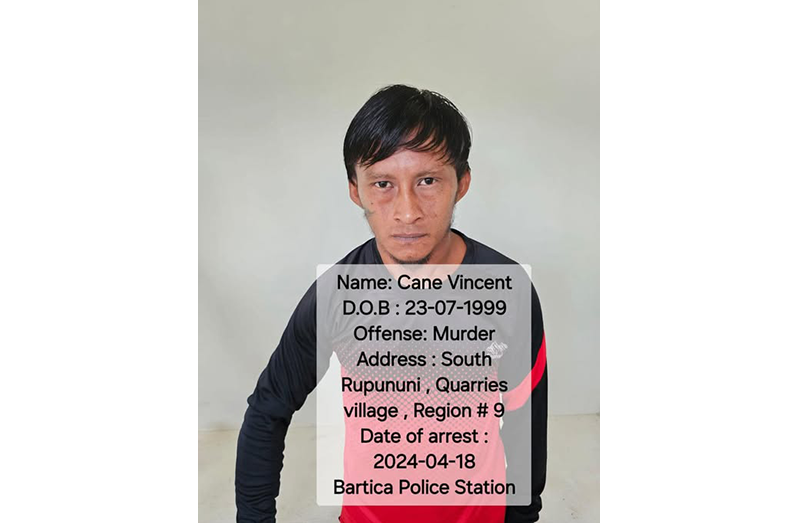
A 31-year-old miner, Cane Vincent of Quarrie, Central Rupununi, has been sentenced to 12 years and eight months in prison for the killing of his co-worker.
The sentence was handed down following a hearing in the High Court at the Essequibo Assizes before Justice Fidela Corbin-Lincoln.
According to the court’s ruling, the convict was given the custodial sentence, with time spent on remand to be deducted by prison authorities.
He is to be enrolled in both a drug-rehabilitation programme and an anger-management programme.
The sentence was handed down after the court considered a number of reports, including a probation report, a pre-sentence (conduct) report, and a psychiatric evaluation.
In arriving at the final sentence, the court applied a structured sentencing approach, starting at 22 years and deducting two years for good character, one year for genuine remorse, and six years and four months for the early plea.
The case stems from a fatal incident involving Vincent and 22-year-old Leonel Manuel Franco Beria, also known as “Frankie” and “Spanish,” with whom he worked on a dredge operation in the interior.
The statement of agreed facts outlined that both men were employed as labourers at the Paiyuki Backdam, Puruni River, alongside other workers. On April 17, 2024, they returned to camp after work, had dinner, and began watching a movie together.
However, in the early hours of April 18, 2024, events took a violent turn.
At approximately 03:30hrs, one of the workers, Benson Peters, was awakened by Beria shouting, “Vincent bore me.” Upon investigating, he discovered the injured man lying on the ground with multiple wounds. The victim repeatedly stated that Vincent had stabbed him.
Workers launched a search for Vincent, who was not present at the camp. After several hours, he was found armed with a knife, restrained, and later handed over to police along with the weapon.
A post-mortem examination conducted by Dr. Nehaul Singh determined that Beria’s cause of death was haemorrhage and shock due to multiple stab wounds, with four stab wounds identified on his back.
During the investigation, Vincent admitted to the act. When cautioned by police, he said, “Officer yes, I stab he cause he does trouble me.”
In a subsequent statement, he provided further details, explaining that he had been drinking and smoking prior to the incident. He claimed that he felt provoked while resting in his hammock and reacted violently.
In his words: “I get vex, and with the passion I get up, I pick up a knife that went next to me, and I go over to he, and I juck he in he back.”
The court also considered a conduct report prepared by Welfare Officer Nedencia Noble, which provided an insight into Vincent’s behaviour during his time in custody.
The report stated that Vincent, who was admitted to the Lusignan Prison on April 24, 2024, had demonstrated good conduct.
“Supervisors who work in the area where Mr Vincent lives have not reported any bad conduct,” the report noted.
It further added, “I, Welfare Officer Ms Noble, have not had any negative experiences with his demeanour.”
Vincent was described as participating in rehabilitation efforts, including a literacy programme offered by the Guyana Prison Service, and expressing a willingness to engage in further development programmes.
The report also highlighted his personal circumstances, noting that he receives emotional support from his sister, and has maintained a consistent presence at the Lusignan facility without any transfers.
On the issue of remorse, the report stated that Vincent “would have [sic] said that he is sorry for the crime that was committed.”
It further detailed that he claimed he was intoxicated at the time and had limited memory of the incident.”
In her conclusion, the Welfare Officer observed that “Vincent appears to be remorseful,” and recommended that he participate in a drug-rehabilitation programme.
The defence, led by attorney-at-law Tonza Sarrabo, urged the court to consider the circumstances surrounding the incident, arguing that it was not premeditated but arose in a volatile environment influenced by alcohol consumption.
In the plea of mitigation, it was submitted that “This was not a premeditated killing. It did not arise out of planning, revenge, or any calculated intent to take a life.”
Instead, the defence contended that Vincent reacted in a moment of impaired judgment, believing he was under threat.
The defence also emphasised Vincent’s conduct since incarceration, noting that “there are no reports of violence, no disciplinary issues, and no evidence of continued aggression.”
She further pointed to his participation in educational programmes, and expressions of remorse as indicators of his potential for rehabilitation.
Importantly, the defence argued that Vincent’s actions were situational rather than reflective of an inherent disposition toward violence.
“Mr Vincent is not a man predisposed to violence; he is a man who made a grave mistake in a moment of impaired judgment,” the court heard.
On the other hand, the state, represented by attorneys Caressa Henry and Aleria Heywood, outlined several aggravating factors.
These included the seriousness of the offence, the use of a weapon, the multiple injuries inflicted, and the fact that Vincent fled the scene without rendering assistance. The state also pointed to the breach of trust between co-workers, noting that the men had shared a meal shortly before the incident.
The prosecution further highlighted the prevalence of violent offences linked to intoxication and urged the court to impose a sentence that would serve as a deterrent.
In its submissions, the state argued that “violence should not be used to settle disputes” and called for “a punishment that would reflect its utter abhorrence to this offence to serve as a deterrence not only to this accused, but also to like-minded persons in society.”
Ultimately, the court balanced both the mitigating and aggravating factors in determining the sentence. The deductions for good character, remorse, and the early plea significantly reduced the starting point of 22 years.