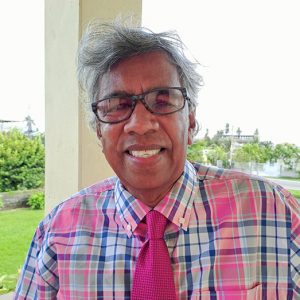
ONE of academia’s longest-serving and prestigious journals is Review of African Political Economy (ROAPE).
Its latest edition (March 27, 2026), has an article devoted to Rupert Roopnaraine on his death and its caption is most fitting – “The Rise and Fall of a Revolutionary Intellectual.”
I have done five parts of the Roopnaraine series, and I have to dismiss as arrogant insipidity the charge of Roopnaraine’s protégé, Wazir Mohamed, that I attacked Roopnaraine after he died. I did just what ROAPE has published –look at the strength and weaknesses, the glorious and inglorious moments in the political life of Roopnaraine.
Here is ROAPE’s opening paragraph: “Do we measure a life by the person’s last deeds – the late disintegration, the compromises, the sell-outs, the repudiations – or by the youthful hope and ebullience, and the militant heyday?” There cannot be a more fitting description of Roopnaraine.
It broke your heart to see what Roopnaraine became the past 20 years. This man was an intellectual genius who would have achieved global status in international academia if only he had remained in academia. Brilliant is simply too ordinary a word to describe his intellectual assets. Why he entered politics is a question we will never know.
Rupert took to his grave, questions that will never be answered. He himself took those questions to his grave because to answer would have destroyed him sooner than later. ROAPE used the perfect words, “the late disintegration.” Roopnaraine’s disintegrated beyond imagination in his last 10 years.
I quote from ROAPE again: He served directly under the PNC’s then-President David A Granger. Granger, it should be noted, had been a senior member of the Guyana Defence Force (GDF) in 1979, working intimately with Burnham and the entire brutal apparatus of the party-state before, during, and after Rodney’s assassination. Granger, Roopnaraine’s new boss, had once been his principal antagonist.”
The two gargantuan questions about Roopnaraine are his relations with Granger during Rodney’s assassination and secondly, his relations with Forbes Burnham. In the book, “Wild Coast: Travels on South America’s Untamed Edge,” Roopnaraine told the author, John Gimlette, of his childhood days with Burnham. I strongly believe that Roopnaraine was indeed recruited by the CIA, as Ravi Dev surmised.
I believe his brilliance was conveyed to the CIA and after observing his genius, the CIA thought he would be perfect for its field operation in Guyana where left-wing politics threatened American Cold War interest in Guyana. The CIA in the 1960s at the height of the Cold War had scouts in the Ivy League universities in the US. Roopnaraine’s infatuation with Anglo-Saxon culture (after all, his field of scholarship was the greatness of Anglo-Saxon literature), would have easily influenced him to work for the CIA.
Of course, it was quite possible that he was first recruited by MI6 when he was at Cambridge University. And when he went over to Cornell University, situated in the heart of New York elitism, MI6 recommended him to the CIA. The question marks on Roopnaraine’s security status from the time he teamed up with Walter Rodney until his zealous camaraderie with David Granger are unlimited.
Bob Marley’s son thinks that the attempt on his father’s life in Jamaica was the work of the CIA. He felt the CIA was involved in the assassination of Walter Rodney in Guyana. Was Roopnaraine involved in Rodney’s murder? I think we should not dismiss that for five reasons: one, is that he had this secret and mysterious relations with Burnham since childhood days.
Secondly, he could not have been close to Granger when you consider Granger’s army status during the confrontation between Burnham and Rodney. Roopnaraine’s 21st-century politics placed him squarely in the company of top army officials who in the 1970s had to know about the plot against Rodney.
Thirdly, his refusal to testify at the Commission of Inquiry would have revealed things about him that could have exposed him. For example, it is alleged that it was Roopnaraine who gave Rodney the transmission device that blew up in Rodney’s face (see Gimlette’s book).
Fourthly, the Americans let Roopnaraine out of Grenada when they refused to let others leave during the invasion in October 1983. In his book, The Sky’s Wild Noise, Roopnaraine wrote that during the invasion, the army gave him a gun to guard the radio station. That was not true. Roopnaraine was not outside on the streets during the invasion. I was there. I know where he was because I was there.
Fifthly, the Rodney Commission cites the name of a high-ranking police officer who was involved in Rodney’s assassination. That man was at Roopnaraine’s funeral. Maybe he was close to Roopnaraine when the plot to murder Rodney was being planned. The Rodney family should now speak up.
DISCLAIMER: The views and opinions expressed in this column are solely those of the author and do not necessarily reflect the official policy or position of the Guyana National Newspapers Limited.