






–amidst global conflict
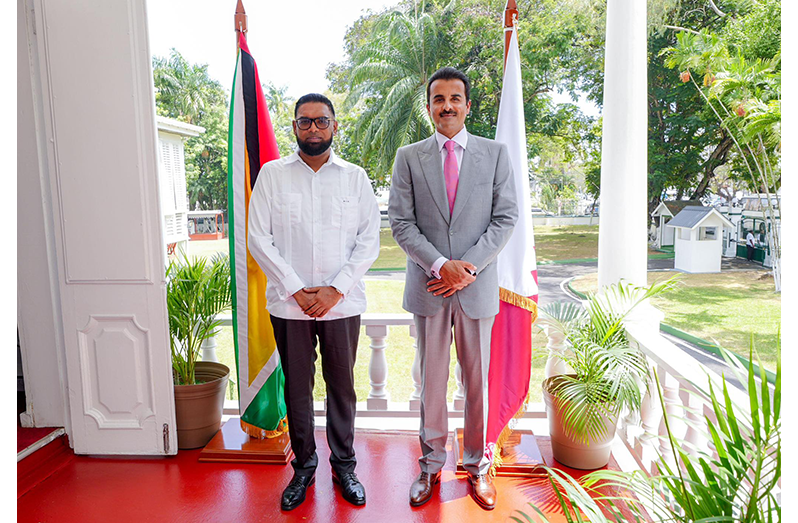
PRESIDENT, Dr Irfaan Ali has positioned Guyana as an important destination for Qatari investment, citing the country’s geographic advantage and market potential during an official telephone conversation with His Highness, Amir Sheikh Tamim bin Hamad Al Thani, on Monday.
“The President also offered Guyana as an important destination from a geographic and market position for Qatar, noting the long-term damage to infrastructure and the impact on their economy caused by the ongoing conflict,” a press statement posted to President Ali’s official Facebook page said.
President Ali conveyed the full solidarity of the people of Guyana to Qatar and strongly condemned all attacks against the Gulf nation and members of the Gulf Cooperation Council.
According to the release, President Ali also noted that the ongoing conflict has caused significant damage to infrastructure and had adversely affected economic activity, while underscoring the importance of forging resilient and forward-looking partnerships.
For his part, His Highness the Amir thanked President Ali and the people of Guyana for their continued support and solidarity with the people of Qatar.
The Amir also expressed Qatar’s keen interest in broadening co-operation with Guyana in several priority areas, including investment, human-capital development, technology, food security and other critical infrastructure.
Recently, President Ali disclosed that Guyana has been promoting itself as a strategic hub for storage and logistics in the Western Hemisphere.
“The war in the Middle East and the closing of the Strait of Hormuz have given us an important piece of history lesson. You have a situation now where marine transportation; global insurance; movement of food; movement of fertiliser; movement of petrochemicals; all of these things can come to an almost instant halt. Right now, most countries are operating from strategic reserves,” Dr Ali said recently.
The situation, he emphasised, has underscored the fragility of global supply chains.
He had further pointed to the possibility of establishing large-scale storage facilities in Guyana with the capacity to hold several months’ worth of critical supplies, including fertiliser, which could serve regional and international markets during periods of disruption.
According to President Ali, Guyana’s geographic location, which offers a direct access to the Atlantic and proximity to major markets such as Brazil, places the country in a unique position to support global supply chains.
He added that the country’s trade arrangements within the Region, coupled with its natural resource base oil, gas and gold could further strengthen its potential as a strategic logistics centre.
“I want to present Guyana as that location, that geographic location that can be a strategic storage location,” he said, adding: “And why Guyana, our geographic location; our access to the Atlantic; our access to large markets in Brazil and the trade arrangement we have within our region. But importantly, our ability also to add our natural assets, which includes gold, that includes crude oil [and] natural gas as part of that portfolio, in building out a strategic geo-positioning for this entire industry.”
Last month, Dr Ali had condemned recent strikes on energy facilities in Qatar, the United Arab Emirates and Saudi Arabia, stressing that the damage would not be quickly reversed.
Much of the pressure, he noted, centres on the Strait of Hormuz, which he described as “an important trading location,” especially for petroleum products and natural gas.
Here is where about 20 to 25 per cent of the world’s total sea-borne oil trade passes through.
Attacks and disruptions in the Gulf have already led to sharp price movements and supply shortfalls.
According to President Ali, 17 per cent of energy capacity had been affected, dismantled and could be considered lost.
He pointed too to a 25 per cent jump in fertiliser prices and rising fuel and freight costs, warning of cascading consequences for food security and global manufacturing.




