By Ambassador Sasenarine Singh, MSc – Finance, ACCA (CA)
THE protracted conflict in West Asia has transcended its geopolitical origins to become a defining force in global commodity markets. With crude oil prices surging past US$110 per barrel in mid-March 2026, the economic reverberations are being felt far beyond the immediate theatre of the conflict. For Guyana, a nation with a burgeoning agricultural sector and a strategic vision to be a leading contributor to the Caribbean’s food security, this untimely external situation presents a “bump in our road”: the significant escalation in the local cost of agricultural inputs.
The foundation of this challenge lies in trade dependencies. According to the UN COMTRADE database, Guyana imported approximately 34,000 metric tonnes of assorted fertilisers in 2025, at a cost of US$51.2 million. Urea constituted the primary component of this import basket. The vulnerability inherent in this reliance is already being tested by volatile international markets.
In response to past challenges, the Government of Guyana has demonstrated a proactive fiscal strategy. As an example, the 2025 National Budget, as presented by the Hon. Minister Dr. Ashni Kumar Singh, allocated $2 billion in fertiliser subsidies to farmers. This intervention was designed to provide farmers with at least one bag of fertiliser per acre, a direct mechanism to mitigate input costs. As the Minister noted, that programme represents a continuum of support for the farmers and is slated to be carried forward into 2026. Such measures underscore a deliberate approach towards insulating the farmers to an extent.
However, the situation in 2026 is proving to be even more problematic than 2025. At the close of 2025, the average cost of urea stood at US$567 per metric tonne. By mid-March 2026, this figure had escalated to approximately US$700 per metric tonne and is set to increase even further, as a result of the global situation.
The instability in the Strait of Hormuz, a critical chokepoint for ammonia and fertiliser feedstocks, has tightened international fertiliser markets. The corridor handles roughly one-third of global seaborne nitrogen‑potassium blends and also supplies 15% of the world’s natural gas. (see table of regional natural gas production).
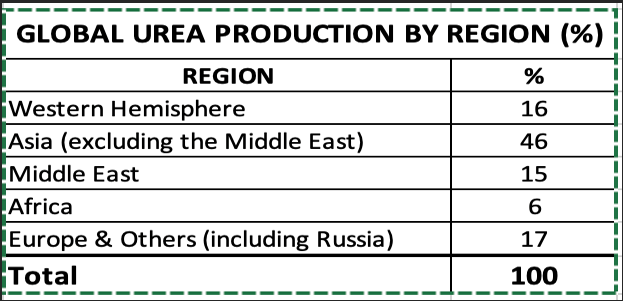
Natural gas is the primary feedstock for nitrogen-based fertilisers, creating a direct link between natural gas and urea prices. On March 8, 2026, Qatar—the world’s largest liquefied natural gas (LNG) producer—declared “force majeure” and halted tanker loadings, a move soon followed by the UAE and Oman.
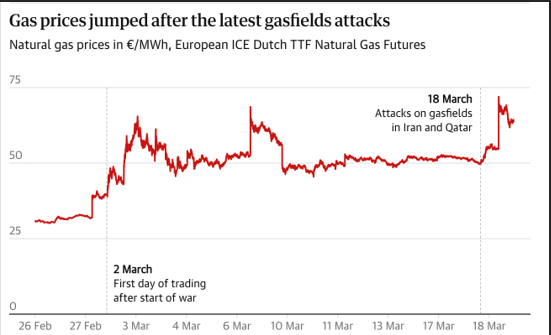
With the Strait of Hormuz effectively blocked, Middle Eastern natural gas supplies have nearly ceased. Countries such as India, which sourced over 20% of its gas from Qatar, now face supply chain challenges, and intensified competition for alternative sources is driving prices upward. The chart below illustrates what has happened in the market since the West Asia conflict started (source Reuters).
In contrast, the Western Hemisphere (particularly the United States, Brazil, Canada, and Trinidad & Tobago), produces substantial natural gas and provide this part of the world with greater supply resilience. Guyana sourced all its fertiliser imports from this region in 2025 and is projected to do so in 2026, insulating it from supply constraints. However, Guyana remains exposed to global pricing pressures, which inevitably translate into higher input costs for local farmers in Guyana.
To address this vulnerability, the Government of Guyana, led by President Irfaan Ali, is advancing a long-term strategy centred on developing a domestic fertiliser production facility at the Wales Industrial Site. With an anticipated capacity of 300,000 metric tonnes, the plant is expected to transform Guyana from a net importer into a net exporter upon completion. Strategically positioned to serve a captive market in northern Brazil (via containerised shipments along the newly paved Lethem Road) the initiative also opens opportunities in other export markets.
To complement its long-term strategy, the government has implemented pragmatic short- to medium-term interventions. These include bulk purchasing agreements for urea to improve pricing predictability, a $2 billion subsidised fertiliser programme that has directly supported all farmers especially the small farmers (those cultivating fewer than 50 acres), and a cash subsidy of $300 per bag of paddy for rice farmers that was paid out in January 2026.
These multi-layered interventions (spanning strategic industrial development to direct fiscal support), reflect a coherent policy framework addressing short-term, medium-term, and long-term objectives. Amid the global disruptions from the West Asian conflict, Guyana is leveraging its resource wealth and strategic geography to ring-fence the non‑oil economy quite commendably. This approach aligns with many successful development models, like that implemented in Singapore, and prioritises a competitive, profitable, and private sector‑driven non‑oil economy as the foundation for long‑term resilience. The oil-economy is just a facilitator for this transition to occur.
History will prove that these measures go beyond defensive posture since they have already proven to have strategically reposition Guyana’s agriculture to serve the Caribbean and northern Brazil, both amid today’s crisis and for the stable future beyond. History will mark this as the moment Guyana turned vulnerability and disadvantages into lasting advantages.