
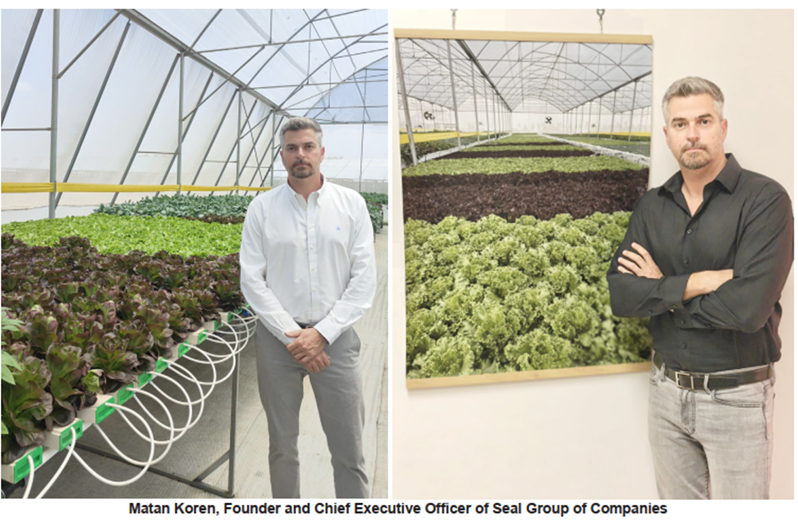
MATAN Koren, Chief Executive Officer of Seal Group of Companies, an investment holding company focused on developing, financing, and constructing large-scale projects in high-growth economies, believes that Guyana is poised to adopt innovation and AI in farming to boost productivity and reduce time loss.
He is notably leading a $15 million+ hydroponics project in Guyana in partnership with KARLICO Inc.
During an exclusive interview with the Pepperpot Magazine recently, Koren said AI in farming, in more practical terms, means using data analytics, machine learning, satellite imagery, IoT sensors and drones to make precise, real-time decisions.
Koren added that instead of relying solely on historical knowledge or manual inspection, farmers now use predictive models to optimise irrigation, detect pests early, manage fertilisers efficiently and forecast yields.
He noted that drones are playing a role in this transformation, as they are among the most visible AI tools in agriculture. Equipped with multispectral and thermal cameras, they collect high-resolution imagery that allows farmers to detect crop stress before it is visible to the human eye, identify pest infestations in early stages, monitor irrigation efficiently and perform precision spraying only where needed.
Koren said that in countries like Brazil and Argentina, drones are widely used in large-scale soybean, corn, and wheat operations. Meanwhile, in Mexico, drone adoption is increasing in avocado, berry and sugarcane production.
He stated that this kind of innovative technology is no longer accessible only to large agricultural corporations, as its accessibility has improved significantly, and in some Latin American countries, both small and medium farmers are increasingly accessing AI tools through cooperatives, government-backed innovation programmes, and subscription-based platforms.
Koren noted that low-cost drone services are also emerging, in which farmers hire certified operators instead of purchasing the equipment themselves, thereby lowering the barrier to entry.
He reported that AI and drone solutions are highly customisable, and that AI systems can be trained according to crop type, soil composition, altitude, and climate conditions.
Koren explained that AI tools are adapted for high-altitude crops and export-oriented fruit production, and banana producers are using drone monitoring to optimise disease detection in humid tropical conditions, while large-scale grain producers rely on predictive analytics for climate risk management.
He stated that customisation ensures the technology aligns with local agronomic realities rather than applying a generic global model.
Koren told Pepperpot Magazine that farmers are seeing measurable impacts, including substantial yield increases of 10 to 25%, water savings of up to 30% through AI-driven irrigation, reductions in agrochemical use of 15 to 35% via precision-spraying drones, and lower crop loss due to early pest and disease detection.
He pointed out that the adoption of drones and AI will not threaten agricultural jobs because, rather than eliminating jobs, the technology is transforming them. Drone pilots, data analysts, agronomic consultants and technology technicians are becoming essential roles.
Koren said the agricultural workforce is shifting from purely manual labour towards higher-skilled, technology-oriented positions.
Delving into the main barriers to wider adoption in Latin America and CARICOM, he emphasised that the main challenges include rural connectivity limitations—though, in many cases, Starlink is offering solutions—financing constraints for small producers, and the need for digital literacy and training.
However, governments and private investors across these regions are increasingly supporting agtech ecosystems and innovation hubs.
Koren added that the future for AI-driven agriculture in the region points towards integrated smart farming ecosystems. Drones, autonomous machinery, soil sensors, predictive weather modelling and AI analytics will operate as a unified system.
He noted that this strengthens Latin America’s role as a global food supplier. For CARICOM nations, it enhances resilience, sustainability and food sovereignty.
In both cases, AI is no longer experimental—it is becoming structural infrastructure for modern agriculture.
“AI and drones contribute to climate resilience due to climate volatility—including droughts, floods, and irregular rainfall—which is one of the region’s biggest agricultural challenges. AI models are being used to forecast soil moisture levels and optimise planting windows. Drone-based imaging identifies early water stress, enabling corrective irrigation before yield losses escalate. By enabling proactive management rather than reactive intervention, AI strengthens climate resilience and reduces catastrophic losses,” he said.
Koren stated that looking ahead, the next phase of AI and drone innovation in farming will be integration and autonomy. Instead of isolated tools, they will see fully synchronised ecosystems where drones scan fields automatically, AI platforms generate prescriptions instantly, autonomous machinery executes precise interventions, and real-time dashboards continuously monitor performance.
He noted that Latin America—particularly Brazil, Argentina and Mexico—is positioned to lead this evolution due to scale, export orientation and growing agtech ecosystems.
Koren said the transformation underway is structural, not incremental. AI and drone technology are refining agricultural productivity, sustainability and competitiveness for the region’s future.