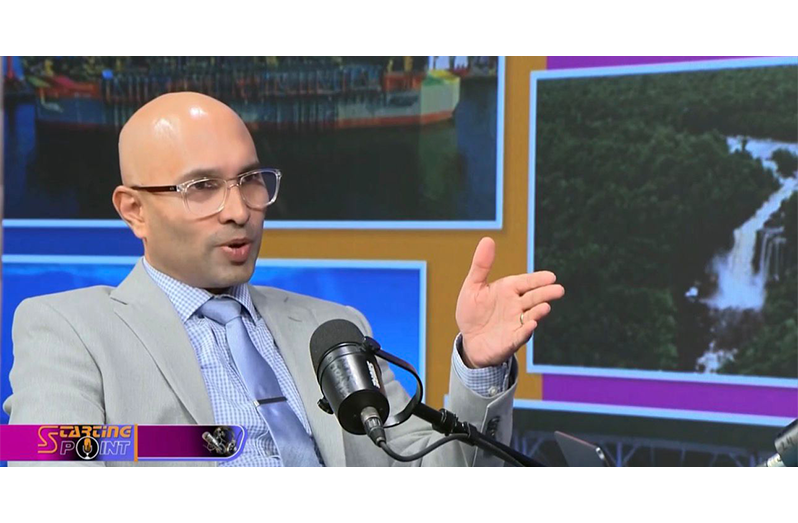
–VEHSI Director urges long-term planning amid rising global instability
EXISTING measures have allowed Guyanese to be shielded from the energy instability in the Middle East, Vreed-en-Hoop Shore Base Inc (VEHSI) Director Nicholas Deygoo-Boyer has stated, but cautioned that external shocks could still be felt.
During a preview of today’s episode of the ‘Starting Point’ Podcast, the discussion is zooming in on how Guyana is deliberately restructuring its economy to weather global shocks.
At the recent Georgetown Chamber of Commerce and Industry’s (GCCI’s) annual general meeting, President, Dr Irfaan Ali insisted that resilience in the face of crises must be designed and not left to chance.
Addressing business leaders in the wake of mounting instability in the Middle East and its spill-over effects on global energy and trade, Dr Ali warned that the world was entering a “frightening” period of disruption driven by attacks on critical infrastructure and chokepoints in international shipping routes.
Deygoo-Boyer deemed President Ali’s remarks as “important,” underscoring Guyana’s current situation of being a large producer of crude, but still remaining heavily reliant on external sources for refined products.
Although alternative solutions, including expanding fuel reserves, have been proposed, he said having a domestic refinery definitely gives long-term stability and not being subject to shocks.
“I think that it might be well worthwhile to re-analyse whether a refinery is feasible or a strategic reserve is feasible,” he said.
Global supply concerns are mounting, with estimates suggesting that disruptions in key transit regions could affect up to 20 per cent of the world’s oil supply.
The implications? An unavoidable rise in inflation, especially for countries that are heavily dependent on imports. But as he pointed out, inflation is, undoubtedly, uncontrollable by the government.
Deygoo-Boyer spoke on the impacts of the external shocks to the business community, stating that shipping companies have already indicated rising costs.
He said, “This is not profiteering. This is passing costs on, so you feel it for them. And nobody’s doing this with a smile on their face. They’re all very gloomy when they’re passing this, these messages on. But it’s the reality, and for a lot of us, it’s a tough thing to deal with, because especially if you have not had a large savings base, that inflation is going to hit you hard.”
He noted that the government has already deployed several measures to cushion the impact, including tax exemptions and adjustments to how import duties are calculated.
One such policy, he said, is: “The government is allowing importers, when they calculate duties, to use a sort of hypothetical shipping cost based on shipping costs many, many years ago, so that when we calculate the duty, it’s effectively giving you a discount on the duty. Without giving you a direct discount. It’s a sort of indirect discount, so that the population doesn’t feel that inflation, which was a measure that was put in [place] during COVID.
For the private sector, it becomes a difficult balancing act, as Deygoo-Boyer pointed out, “It is a concern for businesses. Our issue is that a lot of us are expanding and which means we have taken on debt to fund new projects, so it’s very hard not to pass on the inflation.”