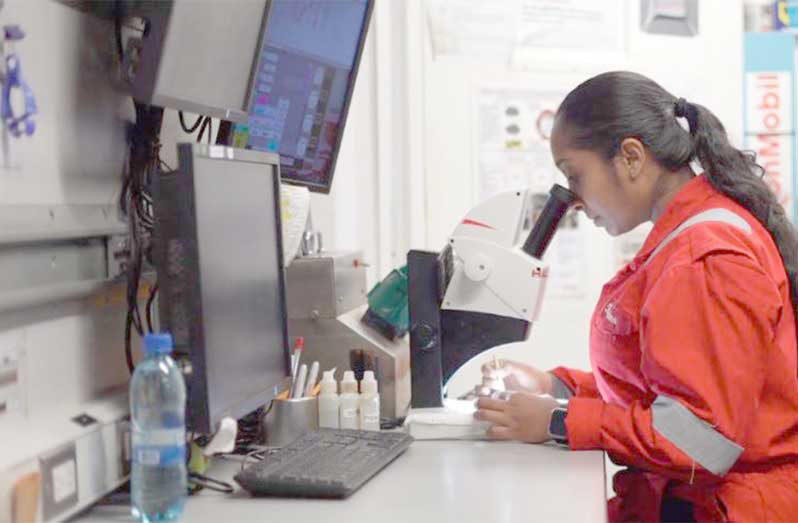
— ExxonMobil Guyana President says Guyanese now make up 70% of oil workforce
EXXONMOBIL Guyana spent approximately $146 billion with local suppliers in 2025, as the company highlighted continued expansion of local participation in the country’s oil and gas sector.
The figure was disclosed by ExxonMobil Guyana President, Alistair Routledge, during a press briefing at the company’s Ogle headquarters on Thursday, when he outlined the company’s latest local-content performance and broader economic impact.
According to Routledge, some 2,000 suppliers were engaged in supporting operations last year, reflecting what he described as a steadily expanding local supply chain.
Cumulatively, since 2015, ExxonMobil estimates that spending with Guyanese businesses reached approximately $753 billion.
“So huge opportunities for local businesses to grow and support further investment… which ultimately… [is] beneficial, not just for our sector, but also for other parts of the economy,” Routledge said.
The figures come as Guyana’s oil and gas industry continues to scale rapidly, with multiple offshore projects in operation and several more under development, creating sustained demand for goods and services across a wide range of sectors.

WORKFORCE LOCALISATION ACCELERATING
Beyond supplier engagement, ExxonMobil also reported continued progress in workforce localisation.
Routledge disclosed that approximately 9,000 persons are currently employed in Guyana’s oil and gas industry, with Guyanese now accounting for about 70 per cent of that workforce, a notable increase from the early years of production.
“Absolutely fundamental that we not only deliver money into the Natural Resource Fund… but… deliver as much benefit to people through jobs and business opportunities as we possibly can,” he said.
He noted that this upward trend reflects sustained investment in training and capacity building by ExxonMobil, its prime contractors, and local companies, enabling Guyanese workers to take on more advanced and higher-paying roles.
“It reflects the level of investment… giving people the opportunity to take more and more senior, more complex roles and to ultimately be better paid,” Routledge explained.
The expansion of local employment is widely seen as a key pillar of Guyana’s Local Content Act, which aims to ensure that citizens and businesses derive tangible benefits from the country’s petroleum resources.
Routledge emphasised that the growth of the local supplier base is not only strengthening the oil and gas sector, but it is also creating spill-over benefits for the wider economy.
With thousands of Guyanese businesses now integrated into the supply chain from logistics and transportation to catering, fabrication and environmental services, the sector is increasingly acting as a catalyst for broader private- sector development.
The cumulative $753 billion spent locally since 2015 represents one of the most significant injections of capital into the domestic economy in recent history, positioning local companies to expand capacity, invest in technology, and compete at higher standards.
LOCAL COMPANY SETTING NEW BENCHMARKS
As part of efforts to recognise local participation, ExxonMobil hosted its second supplier-recognition ceremony on February 5, acknowledging companies that have demonstrated strong performance and commitment in meeting industry standards.
Among those recognised was Environmental Technical Solutions (ETS), a 100 per cent Guyanese-owned company that has expanded significantly through its engagement in the oil and gas sector.
Represented by Director and General Manager Shane Singh, the company has leveraged a five-year contract with ExxonMobil to invest in workforce development, including internship programmes, staff training, and external certification.
Routledge said the company’s growth reflects the level of risk-taking and investment required for local firms to meet the stringent requirements of the oil and gas industry.
“They’re not always recognised for that, and we know how much risk they take, how much effort it takes to meet the standards of the oil and gas industry,” he said.
Notably, ETS has become one of the first companies in Guyana capable of safely handling certain types of low-level, naturally occurring radioactive materials associated with oil production, work that requires specialised procedures and strict safety protocols.
“You need the right procedures… to take that safely to a point where it can be cleaned and the radioactive material disposed of,” Routledge explained.
The company’s workforce is entirely Guyanese, with women comprising 50 per cent of its leadership—an achievement that underscores growing inclusivity within the sector.
While ExxonMobil’s figures point to increasing local integration, Routledge stressed that local content must go beyond revenue flows into the Natural Resource Fund and translate into tangible opportunities for citizens.
According to the company’s 2024 Annual Report, it injected over $170 billion into the economy through Guyanese suppliers that year with over 6,100 Guyanese reported working to support offshore operations.
The sectors benefitting from these opportunities range from Cargo Management Services, Engineering and Machining, and Pipe Welding to Blasting and Coating. Additionally, emergent sectors such as Warehousing, Civil Works and support services, Industrial Cleaning, and Janitorial services are also experiencing growth and investment.