
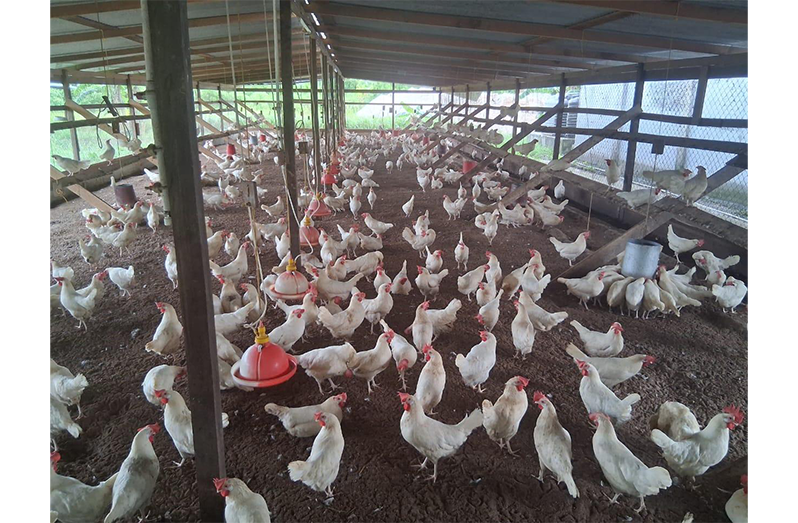
GUYANA’S poultry industry is bouncing back from the disruption of Inclusion Body Hepatitis (IBH), backed by the government’s “people first” agenda to ensure healthier, safer and more affordable protein for all.
Millions of dollars are being invested in modern tunnel-ventilated houses, expanded vaccination programmes and decentralised hatchery services.
With stronger biosecurity and close collaboration between farmers and authorities, the sector is rapidly rebuilding production, improving efficiency and safeguarding the nation’s food security—putting the health and well-being of every Guyanese at the heart of its growth.
Inclusion Body Hepatitis (IBH) is a viral disease that primarily affects young broiler and layer chickens, causing sudden mortality, growth retardation and reduced productivity.
The disease can devastate flocks within days, leading to significant economic losses for poultry producers.
IBH spreads rapidly in poorly managed flocks and is exacerbated by inadequate biosecurity and incomplete vaccination coverage, making coordinated disease prevention essential for the stability of Guyana’s poultry industry.
According to David Fernandes, Director of the Guyana Poultry Producers Association (GPPA) and newly elected President of the Caribbean Poultry Association, the local poultry industry has made notable progress in controlling the disease.

Fernandes explained that while IBH remains a concern, its impact has been significantly reduced through coordinated vaccination programmes and improved biosecurity awareness among farmers.
“While the threat of IBH still exists, the situation today is far more controlled than it was several years ago,” Fernandes said.
“Rigid vaccination programmes, combined with biosecurity training for farmers, have helped improve the health status of flocks across the country.”
A critical component of Guyana’s poultry disease prevention strategy is the legal requirement that all chicks must be vaccinated before they are sold to farmers.
In Guyana, the vaccination of chicks is mandated through the Sale of Chicks Regulations (2008), issued under the authority of the Animals (Movement) and Disease Prevention Act (2003).
These regulations require that hatcheries must vaccinate baby chicks against key poultry diseases such as Inclusion Body Hepatitis, Marek’s Disease and Infectious Bursal Disease before they can be sold, ensuring that disease control measures are in place from the earliest stage of production.
The Guyana Livestock Development Authority (GLDA) serves as the primary regulatory agency responsible for enforcing these requirements, overseeing hatchery compliance, conducting inspections and monitoring vaccination programmes.
While the Animal Health Act 2011 now provides the overarching legal framework for animal-disease prevention and control, the specific obligation to vaccinate chicks before sale remains enforced through these regulations, reflecting Guyana’s commitment to safeguarding poultry health and ensuring safe, affordable protein for the population.
The regulations are enforced by the Guyana Livestock Development Authority (GLDA), which plays a central role in protecting the poultry industry through surveillance, farmer training, hatchery inspection and veterinary diagnostic services.
Fernandes noted that the authority has intensified outreach activities across the country, conducting farm visits and technical training sessions in poultry-producing areas, including Berbice, Essequibo, Region Three and the East Coast of Demerara.
“GLDA has continued to support hatcheries and farmers through regular farm visits and training,” Fernandes explained.
“There were several outreach programmes conducted last year in collaboration with the poultry producers’ association, particularly in outlying farming areas, and similar exercises will take place again this year.”
At the heart of disease prevention is biosecurity, a set of management practices designed to prevent the introduction and spread of disease-causing organisms within and between poultry farms.
These measures include controlling access to poultry houses; disinfecting equipment and footwear; quarantining new birds; controlling rodents and wild birds and maintaining strict sanitation of facilities and equipment.
Effective biosecurity is widely regarded as the first line of defence against viral diseases such as IBH, because it limits opportunities for pathogens to enter farms and infect flocks.
The GLDA has implemented a comprehensive national biosecurity programme to strengthen industry-wide standards.
Biosecurity assessments have been conducted at poultry farms and hatcheries to identify gaps that may contribute to the spread of IBH.
Minimum mandatory biosecurity standards, tailored to farm size and production type, have been introduced, and nationwide on-farm training programmes have helped farmers and workers adopt best practices in sanitation, movement control and equipment hygiene.
Each commercial poultry farm has been encouraged to designate a responsible individual to oversee the implementation and monitoring of the biosecurity programme.
For Stephen Low A Chee, biosecurity and vaccination are essential tools in protecting poultry operations from IBH. Low A Chee is a contracted commercial poultry grower for Bounty Farms Limited, operating a large poultry farm at Badrima along the Soesdyke–Linden Highway, where he rears an estimated 90,000 to 95,000 birds per production cycle.
“Biosecurity plays an integral role in mitigating the risks of IBH on our farm,” Low A Chee said.
“We ensure that access is controlled, sanitation procedures are followed, and the birds are monitored closely throughout the production cycle.”
He emphasised vaccination as a critical layer of protection.
“Each bird is vaccinated at the hatchery before it is sold to farmers.
That early protection gives the birds a stronger start and helps reduce the likelihood of diseases affecting the flock.”
Vaccination has been reinforced through national serotype surveys that identify IBH-associated viruses circulating within Guyana.
Standardised vaccination protocols have been implemented across all hatcheries in line with updated scientific guidance.
A vaccination quality-control system ensures proper handling, administration and record-keeping, giving farmers confidence that chicks arrive with verified protection, which is essential to reducing mortality and improving productivity.
An enhanced national disease-surveillance programme complements these efforts. GLDA officers routinely monitor hatcheries and farms, with heightened inspections in high-risk areas.
Investigations of IBH-related mortality cases include collection of laboratory samples for confirmation.
GLDA’s Veterinary Diagnostic Laboratory has full testing capacity to detect Infectious Bursal Disease (IBD) and related poultry viruses, enabling early identification of outbreaks and guiding targeted interventions.
Farms with unusual mortality patterns are subjected to follow-up assessments, while sero-surveillance data and trend analysis guide timely responses.
In high-density poultry regions or areas with prior IBH outbreaks, farmers receive specialised training in husbandry and management practices to reduce susceptibility to disease.
The human cost of IBH is starkly illustrated by Teffon Telford, a chef-turned-poultry-farmer from Garden of Eden on the East Bank of Demerara.
In 2023, Telford experienced massive losses when IBH spread through his newly expanded flock just two months after acquiring birds.
“Watching them die one after the other broke me,” he recalled.
“I had invested millions of dollars into the farm, and within weeks, everything started collapsing.”
With guidance from GLDA veterinary and extension teams, Telford rebuilt his operation, emphasising record-keeping, feeding protocols and strict biosecurity measures.
“GLDA has always been there to provide advice and technical guidance,” he said.
Another commercial poultry producer who has experienced both the challenges and recovery associated with IBH is Elroy Smith, owner of Prime Farms at Canal No. 2 Polder.
Smith emphasised the importance of biosecurity, vaccination and proper feed storage in protecting flocks.
He recalled the colossal losses during the initial IBH outbreak.
“When the disease first hit, the losses were enormous,” he said.
“But with technical guidance and continuous support from the Region Three GLDA extension team, headed by Dr Ferlin Narine and Livestock Extension Officer Marcus, we rebuilt our production system.”
Today, Smith reports a significant reduction in mortality.
He also credits the Ministry of Agriculture for supporting the national vaccination programme.
Smith sources both feed and vaccinated chicks from Stockfeeds Limited, noting that high-quality inputs combined with robust biosecurity are essential to keeping IBH under control.
The IBH outbreaks between 2020 and 2023 significantly affected national poultry production.
Fernandes explained that during that period Guyana lost a substantial portion of output, even as demand for poultry products continued to rise, especially with the population now exceeding 900,000 persons.
“We lost quite a bit of production during those years,” Fernandes said.
“At the same time, consumption continued to grow, so it will take some time for the industry to recover and close that gap.”
To stabilise supply and prices during recovery, the government allowed limited, carefully monitored imports of poultry products, while local farmers rebuilt their flocks.
Authorities report no new or emerging IBH strains threatening cross-border or regional spread.
Nevertheless, veterinary authorities remain vigilant, maintaining surveillance and supporting rapid response to potential threats.
Looking ahead, modernisation is expected to play a pivotal role in strengthening Guyana’s poultry sector.
Fernandes highlighted the growing use of tunnel-ventilated and climate-controlled poultry houses, which allow farmers to manage temperature, airflow and bird density more effectively.
These facilities improve productivity while reducing disease risks.
He also pointed to the anticipated benefits of the gas-to-energy project, which is expected to lower electricity costs, making modern poultry systems more economically viable.
“The future of poultry production in Guyana lies in climate-controlled and tunnel-ventilated houses,” Fernandes said.
“Once electricity costs decline, these systems will make poultry farms even more efficient and productive.”
Despite the challenges of disease outbreaks in recent years, Guyana’s poultry industry continues to demonstrate resilience and adaptability.
Through mandatory vaccination, strengthened biosecurity practices, and collaboration among farmers, hatcheries, and regulatory authorities, the sector is gradually regaining stability.
As Fernandes emphasised, “If we continue to focus on vaccination, biosecurity and proper farm management, the industry will not only recover, but become stronger and more resilient in the years ahead.”