






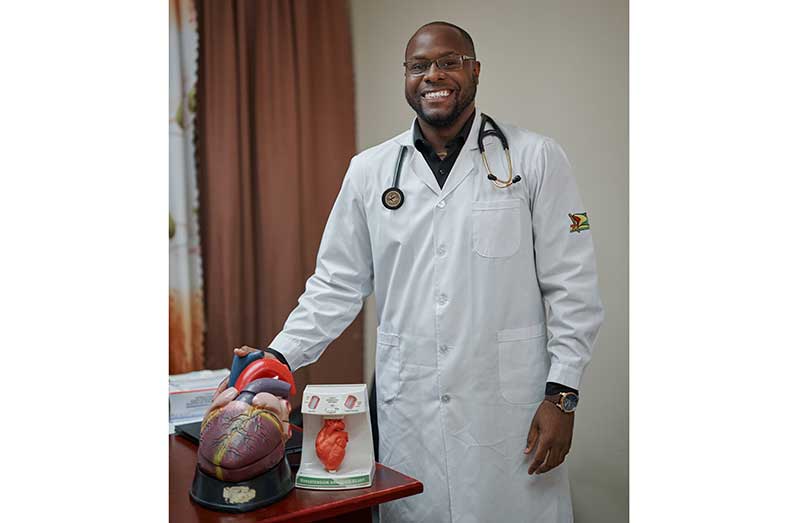
—returning specialist highlights growing cardiovascular burden, sectoral expansion and push toward establishing a dedicated heart surgery unit in Guyana
JUST two months after returning home from specialised training in Cuba, cardiovascular surgeon, Dr. Avlon Jeffrey, has successfully performed multiple heart valve surgeries locally, marking what he describes as a significant step toward Guyana’s transition from mission-based cardiac interventions to a sustainable, locally driven heart surgery programme.
His milestone comes at a time when the country’s cardiovascular caseload has more than doubled in recent years and as the healthcare sector continues to expand with more specialists, training programmes and plans for the eventual establishment of a fully equipped cardiovascular unit.
Speaking to the Guyana Chronicle following the successful procedures, Specialist Cardiovascular Surgeon (Registrar), Dr. Jeffrey, said his return home has been fulfilling, both professionally and personally. Calling it a full-circle moment, he shared, “Personally, the return has been fulfilling for me to come full circle after studying for six years and coming back home to the place that shaped me. It has been grounding and humbling, and reconnecting with my colleagues, family and friends has been a great experience.”
On a professional note, he added that the change in workload and hospital systems has been a major shift for him.
“It has been an adjustment. I am coming from a high-volume centre where we did interventions or surgeries on a daily basis. Coming back home, it is different because we currently operate on a mission-based basis, with visiting teams coming from the U.S. and Canada. So, we get bouts of surgery. It has been challenging, but I am hopeful, because that is why I am back, to change the routine to a norm,” he explained.
While he left Guyana during the early stages of his career, today Dr. Jeffrey is one of Guyana’s newest specialist cardiovascular surgeons. At just 35 years old, his work centres around adult cardiovascular surgery, with a subspecialty focus on minimally invasive right heart catheter placement for haemodialysis patients.
With this area of expertise, Dr. Jeffrey sees his work as part of Guyana’s steps toward creating a specialised heart care facility “Returning now, I am designated a cardiovascular surgeon and currently work with the thoracic team, since Guyana does not yet have a cardiovascular unit or programme,” he added. “My talent is being developed and lent to thoracic surgery at the moment, but the expectation is that we will have cardiovascular surgery in the near future.”
Most recently, Dr. Jeffrey was able to showcase his expertise through a series of heart valve surgeries at the Georgetown Public Hospital. Working along with another team and serving as the first surgeon, Dr. Jeffrey was able to complete a number of successful procedures.
COMING BACK HOME
As he shared, “Since coming home, I was privileged to do multiple heart valve surgeries under the stewardship of Dr. Stevens. I scrubbed in and served as first surgeon on those cases.” Giving insight into what the surgeries required, he added, “The procedure involves fixing a malfunctioning valve. The patient is put to sleep, the chest is opened and the patient is placed on bypass, or the heart-lung machine. The faulty valve is removed and a new valve is implanted. It is technical and we aim to minimise time and achieve the best outcome in every case.”
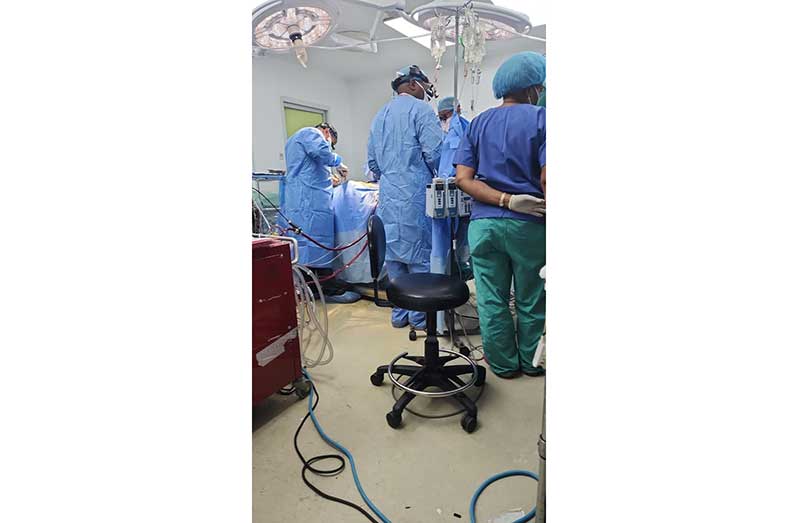
Dr. Jeffrey’s successful work and addition to the sector highlight not only the growth in skilled personnel but also the push towards developing heart care in Guyana. This push comes at an integral time, Dr. Jeffrey explained, as Guyana, like much of the world, continues to grapple with heart-related mortality rates.
“Guyana is among the two countries in South America with very high mortality from cardiovascular disease. We have high mortality, with patients dying under the age of 56 due to heart disease. Compared to the developed world, that is about 30 years earlier,” the doctor said.
As he further explained, while people may not immediately develop heart conditions, underlying or related illnesses are impacting mortality and health rates. “When we talk about morbidity, patients may not die but may develop heart failure, coronary artery disease or stroke.”
A major part of this shift, Dr. Jeffrey explained, deals with lifestyle habits and changes, coupled with misconceptions and underlying illnesses. Common health issues such as coronary artery disease, valvular heart disease and congenital heart disease are among the leading issues patients present with. Underlying health conditions such as hypertension, uncontrolled diabetes, smoking and sedentary lifestyles are risk factors.
Misconceptions, he added, are also a major hurdle, with many people discounting serious health conditions as just stomach pain.
“That is not always the case, especially in diabetic patients who may not feel pain the same way. They could be having a heart attack. Do not ignore symptoms. Address them early,” he said, urging Guyanese to take their health seriously.
Guyana’s healthcare sector has grown alongside the increasing number of cases, with Dr. Jeffrey noting the rise in specialists and training programmes in recent years.
“We have more specialists and more training programmes, which is excellent. The ER and cardiology are primary contact points for heart patients, and we now have specialised programmes in these areas. Patients are better cared for because of the increase in specialists,” he said.
The biggest remaining gap, in his opinion, is a specialised heart care facility. As he added, “We need a cardiovascular unit and everything that goes with it, perfusion services, cardiac anaesthetists, a cardiac ICU and a cardiac intensivist. These areas must accompany heart surgery.”
Guyana is closer than ever to filling that gap, with the idea already being a goal of the Ministry of Health. With current facilities, resources and skilled personnel, Dr. Jeffrey believes this will become a reality in the near future, adding, “I see Guyana in the near future not only serving our population but potentially the greater Caribbean. I see Guyana becoming a hub where heart surgery is possible for the region.”
For Dr. Jeffrey, his recent successful procedures and the work ahead are a win for himself as well as the sector. As he added, “It means everything to me. I am living my dream. It is an honour and a privilege to give back to the country that shaped me. It is a dream come true.”




