






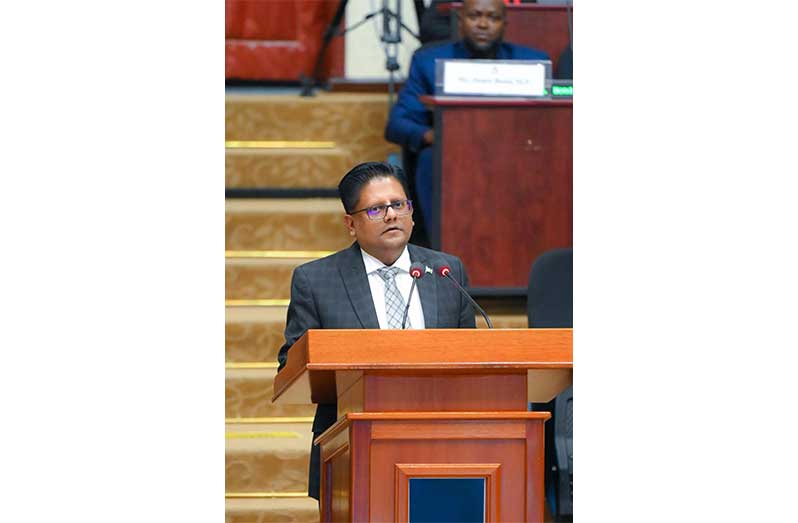
SENIOR Minister within the Office of the President with Responsibility for Finance, Dr Ashni Singh, recently stated that the government has maintained a balanced approach when it comes to ensuring that the nation’s ambitious development agenda is financially sustainable.
The Minister, during a recent interview, highlighted that because of careful budgeting, diverse revenue streams, and disciplined borrowing, the government is building out the country without jeopardising long-term financial stability.
The Minister said: “A lot of people they see roads happening, and they don’t really think about how these things are financed; it’s very important to remember that the national budget is not dramatically different from even a household budget.”
The Minister noted that government revenues come from multiple sources, which include traditional tax collection, climate revenues, and resource-based funds like oil revenues, explaining that revenues cover transfer payments such as old-age pensions, the government wage bill, and the capital investments.
He noted that the government has borrowed very prudently, and “we’ve been able to bring our debt down to the lowest level certainly in recent memory, with one of the lowest debt-to-GDP ratios in the entire Western Hemisphere and the entire world.”
He emphasised a balance has to be struck between recurrent expenditure or consumption and investments.
While noting that the government makes investments so that future generations can benefit, the minister said: “We invest in the things that matter for the next generation- the roads, the bridges that will generate the economic growth, that will create the jobs and that will generate the incomes for the next generation.”
Just recently, Dr Singh contrasted Guyana’s current debt-to-gross-domestic-product (GDP) ratio with those of countries across the hemisphere and beyond, many of which exceed 80 per cent and in some cases surpass 100 per cent.
He had reported that Guyana’s debt-to-GDP ratio stood at 28.6 per cent at the end of 2025, making it the second lowest in the Western Hemisphere.
He further highlighted sharp improvements in the country’s debt-service obligations, noting that in 1993, Guyana had been spending more than its total revenue to service debts.
By comparison, he said, in 2025 the debt service-to-revenue ratio had fallen to 5.53 per cent, meaning that just over five per cent of government revenue was now being used to meet debt payments.
“When countries around the hemisphere and around the world have a debt-to-GDP ratio that exceeds 100 per cent, and in even more cases that exceed 60,70, 80 per cent, Guyana’s debt-to-GDP ratio at the end of 2025 was 28.6 per cent; like I said, the second lowest in the western hemisphere. Mr Speaker, and the same applies to our debt service to revenue ratio,” Dr Singh had said.
He added: “It is this People’s Progressive Party/Civic government and our predecessors that brought Guyana back from bankruptcy.”
The minister explained that this fiscal space has allowed the government to pursue aggressive investments aimed at transforming the country’s long-term economic prospects, while simultaneously expanding and improving social services for citizens.
“…in 2025, the debt-service-to-revenue ratio in Guyana was 5.53 per cent. Coming from a position where we were spending more than 100 per cent of our revenue, we are now spending 5.5 per cent of government revenue to service our debt. And at the same time, sir, we are investing aggressively to transform our country for the long term. And at [the] same time sir, we are improving and expanding social services,” he told the National Assembly.
The ratio of total public and publicly guaranteed (PPG) debt to Gross Domestic Product had fallen from 47.4 per cent at the end of 2020 to 28.6 per cent by the close of 2025.
The total PPG debt stood at US$7.7 billion at the end of 2025, reflecting net inflows from both domestic and external financing sources. Domestic debt accounted for the larger share at 62.3 per cent, or US$4.8 billion, while external debts made up 37.7 per cent, totalling US$2.9 billion.
Further, the total debt-service payments for 2025 amounted to US$264.6 million, of which US$176.6 million was paid to external creditors and US$88 million to domestic creditors.
Notably, 5.5 percent of government revenue went towards debt service in 2025, down from 8.5 percent in 2020.
Dr Singh had made the assurance then that Guyana’s debt position is projected to remain strongly sustainable over the medium term, even as the government presses ahead with its wide-ranging development and economic transformation agenda.




