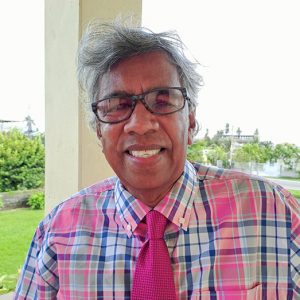
THE story of the anti-colonial struggle is one of class collaboration between the colony’s privileged Mulatto/Creole class (MCC) and the proletariat, peasantry, and the lumpen proletariat. In Guyana and the West Indies, the political parties brought muscle power or strategic numbers in the anti-colonial arena; the MCC, which dreamt of taking over from the White man, brought strategic resources that the political parties could not do without.
In colonial British Guiana, Jagan brought the peasantry while Burnham and Critchlow brought the proletariat into the arena while the MCC, particularly in the form of the League of Coloured People, brought resources. It was a confluence of different class interests. In post-colonial Guyana, an identical situation arose. The historian has not been kind to Rupert Roopnaraine (RR) because they concentrated excessively on Walter Rodney (WR) for a simple reason – he was a global figure of liberation yearnings of the post-colonial masses, and secondly, he personified the struggle against Burnham.
But as I stressed in part one yesterday, there was an inherent class dualism in the WPA’s ramparts in the anti-Burnham struggle for which the historian has been silent so far. Here are my brief analytical notes about the class roles that WR and RR played in weakening the totalitarian fortress of President Forbes Burnham.
I stated yesterday that while WR had galvanised the proletariat, RR had facilitated in priceless strategic ways the assistance of the MCC. Both men held a charismatic sway over two distinct classes in post-colonial Burmhamite Guyana. The proletariat, especially the youths and the lumpen proletariat, saw Rodney as the liberator of the masses.
Although Cheddi Jagan was a virtual god to the rural proletariat and the peasantry, the rural world in Guyana had a profound adoration for Rodney. Unfortunately, RR could not penetrate the rural folks during the 1970s because he appeared too middle class in style, deportment, language, and grounding. In the countryside, WPA’s activism rested with Eusi Kwayana, Josh Ramsammy, and Moses Bhagwan.
I will come to the MCC blood in RR in part 3, which was his biggest, insolvable contradiction, but his unique contribution to Guyanese history lies in the way he harnessed the class to which he belonged and its cultural characteristics in service of the struggle for post-colonial liberation of whom – the masses to which he did not belong.
No one has ever done that in the history of the colonial and post-colonial West Indies. What John Carter did in British Guiana was that he made a demand on Burnham to join Burnham if the MCC would dominate the post-colonial state because eugenics entitled them to that destiny. Burnham agreed, but Burnham had other plans for Carter, the League of Coloured People and the MCC in general.
In British Guiana, the PPP had a Rupert Roopnaraine personality in the form of Miles Fitzpatrick, but his achievements of bringing the MCC to serve the PPP and the interest of the masses did not come within a million miles of achieving the success of Rupert for four reasons. One is Fitzpatrick did not have the charisma of RR who will remain next to Cheddi Jagan, Forbes Burnham, Maurice Bishop and Michael Manley, and Rodney as the six most charismatic political leaders the West Indies produced. Funny, how three are from Guyana!
Secondly, Fitzpatrick was never exposed to the Bohemian, existentialistic campus life that RR had both at Cambridge University and Cornell University in the US. Thirdly, RR was a top leader of the WPA that had penetrating authority inside the WPA. Fitzpatrick had limited contacts inside the PPP, mostly with Janet and Cheddi Jagan. That was the choice of Fitzpatrick. He wanted a limited role for himself in the PPP because, as an MCC personality, he did not want to become submerged in an Indian, rural-supported PPP.
RR on the other hand, had no such qualms. Fourthly, Fitzpatrick was more of a business-oriented person, earning lucrative sums from his prestigious law practice. RR was an inherent academic where the attraction of money was never enticing. When you compare Carter, Fitzpatrick and RR, you see the historical legacy of RR. He did what no other MCC personality has done in the entire Caribbean, may, except, Maurice Bishop.
RR brought the resources of the MCC into the service of the masses led by Cheddi Jagan and Walter Rodney. Did the MCC commit class suicide under RR? I think the jury is still out on that, but for RR he was contributing significantly to the struggle that Cheddi Jagan long started and to which Rodney made significant and strategic contributions. In part 3 I will look at the intrinsic faults of RR that has denied him a seat next to Cheddi Jagan.
DISCLAIMER: The views and opinions expressed in this column are solely those of the author and do not necessarily reflect the official policy or position of the Guyana National Newspapers Limited.