—climate, biodiversity experts praise country’s transparent governance, credible framework
WITH there being more global demand for stronger environmental safeguards, Guyana stands out given its ability to leverage its Low Carbon Development Strategy (LCDS) to build market trust, standardise environmental metrics and unlock new streams of private capital at scale, according to climate and biodiversity experts.
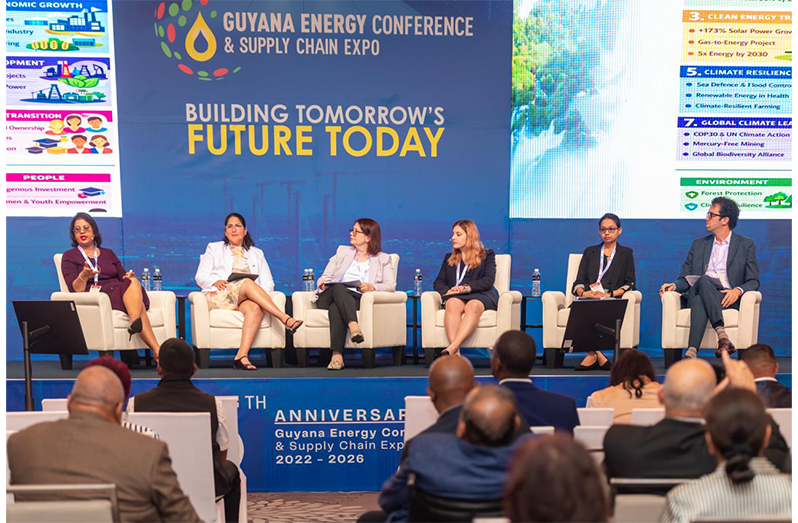
During a panel discussion on day three of the Guyana Energy Conference and Supply Chain Expo, several experts within the climate and biodiversity arena focused on Guyana’s development model and how the country is blending economic growth and environmental stewardship.
Senior Director of Climate And REDD+, Ministry of Natural Resources, Dr Pradeepa Bholanath, explained to the panellists and the wider audience that Guyana’s climate finance architecture has become an attractive investment hub as it aligns economic growth with environmental responsibility.
The LCDS, in this regard, fulfils the “do no harm to nature,” characteristic which investors seek, she said.
Additionally, Bholanath highlighted that President Dr. Irfaan Ali stands out in his leadership as he exemplifies what it means to implement policies that embrace climate security, energy security, and food security.
With the LCDS in place, development is not only reaching the coast but hinterland communities, as Bholanath pointed to the expansion of hydropower and solar power in indigenous communities.
Under the first LCDS, the global climate services provided by Guyana’s standing forests were mobilised to generate revenue for the country, in this instance, under a US$250 million bilateral partnership with the Kingdom of Norway.
On December 1, 2022, the Architecture for REDD+ Transactions announced the issuance of US$33.47 million TREES credit to Guyana for the five-year period from 2016 to 2020. The Architecture for REDD+ Transactions (ART) is a global initiative that seeks to incentivise the reducing of emissions from deforestation and forest degradation (REDD), as well as restore forests and protect intact forests. Subsequently, the government entered into an agreement whereby Hess Corporation purchased approximately a third of Guyana’s credits. The agreement sets out that Hess will buy 2.5 million credits per year for 2016 to 2030 to a total of 37.5 million credits for a minimum payment of US$750 million to be paid to Guyana between 2022 and 2032.
Associate Partner of Mckinsey Social, Healthcare and Public Entities Practice, Dr Stephanie Stefanski explained during the discussion that it is very clear that the primary constraint to successful energy transition is not the ambition, capital or aggregate, but how the opportunity can be captured on a broader scale to foster sustainable, equitable and inclusive economic development.
Recognising Guyana’s push to position itself as a global environmental leader, McKinsey stated that an integrated “lock and step” approach linking the synergies where climate finance can help unlock biodiversity finance and aid in bringing benefits to citizens, is needed.
There is no single instrument that can unlock scale, she said, but in order to build these mechanisms, stability coupled with strong, clear and transparent governance and credible measurement systems are needed.
She said: “Guyana is already taking the first steps today towards one of its kind, national biodiversity information monitoring system that will help unlock and create this transparency around its natural capital, which I believe will be really key to unlocking the climate and biodiversity finance together.”
Country Representative of Inter-American Development Bank (IDB) in Guyana, Lorena Solórzano Salazar added to McKinsey’s comments about building trust in the market.
She noted that markets require blended finance warranties from institutions like hers, the IDB, or warranties from the countries that can enhance and expedite, attracting more investment from the private sectors, concessional capital, or public private partnerships.
Second is harmonised standards to make climate and nature finance more transparent and in this light, she referenced the IDB’s recent launch of a common nature finance taxonomy.
Such frameworks, the IDB country representative said, are critical for emerging markets like Guyana, where blended finance structures are often required to de-risk projects and accelerate investment flows.
She also stated that while REDD+ has played an important role in supporting forest-rich countries, the region must move to now deploy a more sophisticated “toolbox” to further unlock vast natural capital.
“REDD+ has played an important role so far. But we need to scale up, as Pradeepa was mentioning in how we can capitalise, again, the nature capital of this region in a more sophisticated toolbox,” she said.
Also present on the panel were Guyana’s Country Coordinator of the Forest and Climate Leaders Partnership, Preeya Rampersaud and Bioeconomy Investment Expert at Conservation International Humberto de Andrade Soares.
The panellists further explained that beyond REDD+, they proposed new instruments that could further mobilise private capital in Guyana and the wider Caribbean and Latin America region, including debt-for-nature swaps and resilience-linked financing structures.