





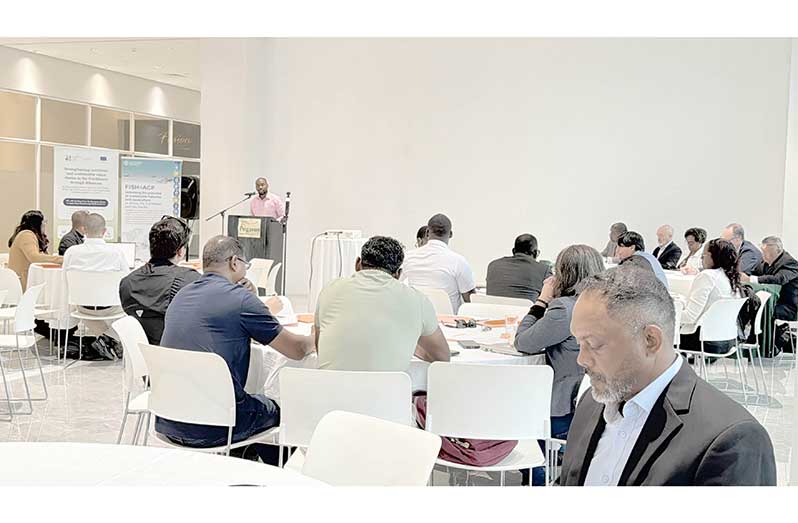
INTERNATIONAL and local partners on Monday hosted a one-day workshop aimed at strengthening Guyana’s fisheries cooperatives, and improving their access to markets and finance as part of wider efforts to support inclusive growth and job creation in the agriculture and fisheries sectors.
The workshop, titled “Strengthening Guyana’s Agribusiness: From Fisheries Cooperatives to Seafood Markets”, was jointly organised by the Food and Agriculture Organisation of the United Nations (FAO), the International Labour Organisation (ILO), and the International Trade Centre (ITC), in collaboration with the Ministry of Agriculture, and the Ministry of Labour. It was held on February 9, 2026.
The forum brought together fisheries cooperatives, seafood and agrifood businesses, financial institutions, business support organisations and policymakers. Organisers said the main objective was to close gaps in Guyana’s seafood value chain by creating direct linkages between fisherfolk, buyers and sources of financing, thereby supporting more stable and profitable business relationships.
Minister of Labour and Manpower Planning, Keoma Griffith, in his keynote address, said the initiative was timely, as Guyana continues to undergo rapid economic transformation. He stressed the importance of ensuring that fisherfolk benefit from national development.
“The forum is timely as it ensures that Guyana’s fisherfolk are fully part of the country’s ongoing development and transformation,” Griffith said. He added that the government supports partnerships between international agencies, cooperatives and the private sector to build more resilient agricultural and fisheries systems capable of driving inclusive economic growth in Guyana and the wider Caribbean.
Chief Fisheries Officer in the Ministry of Agriculture, Denzel Roberts also underscored government support for the development of fish cooperatives. He said the workshop was expected to help create concrete linkages between fisherfolk and financial institutions and expand access to new markets, in keeping with the government’s policy objectives for the sector.
Business stakeholders, including national banks, regional partners and the Georgetown Chamber of Commerce and Industry, also participated in the event. Their involvement shifted discussions beyond policy and concepts towards practical partnerships that could improve access to finance and markets. Organisers noted that, over time, such partnerships could enable cooperatives to invest in better equipment, improve product quality, expand production and generate higher incomes and more secure employment within the fisheries sector.
Several participants welcomed the opportunity for direct engagement. Rory Osborne, a fisherman from Wakenaam, said the workshop provided practical insights into cooperative management and networking. Victor Mangru, a fisher from Region Three, said the event allowed him to connect with business incubators, supermarkets and banks that could support the growth of his operations. A representative from Survival Supermarket also indicated interest in developing relationships with new local seafood suppliers.
Discussions during the workshop focused on strengthening supplier–buyer relationships, improving productivity and quality, and promoting responsible business practices across the fisheries and agrifood sectors. Special attention was given to the needs of cooperatives, small-scale producers and micro, small and medium-sized enterprises (MSMEs), with the aim of ensuring that sector growth benefits a broad cross-section of stakeholders.
Labour standards and decent work were a central theme, with the ILO emphasising the importance of fair labour practices, safer working conditions, skills development and stable employment as market access expands. Officials from the Ministries of Labour and Agriculture also engaged directly with private-sector actors to ensure that emerging business partnerships align with national priorities such as sustainability, inclusive growth and decent employment.
The workshop forms part of the FISH4ACP programme, which seeks to make fisheries and aquaculture value chains more sustainable, inclusive and resilient. FISH4ACP is an initiative of the Organisation of African, Caribbean and Pacific States and is implemented by FAO with funding from the European Union and the German Federal Ministry for Economic Cooperation and Development.
Head of Cooperation for Guyana and Suriname at the EU Delegation, Joan Nadal Sastre said the European Union supports initiatives that create local value, stimulate growth, generate decent jobs and promote social cohesion and sustainable development.
UN partners said they will now focus on translating the outcomes of the workshop into concrete business opportunities, with particular emphasis on sustaining commercial linkages between cooperatives, banks and supermarkets, improving competitiveness and increasing sales volumes. FAO, ITC and ILO, together with national partners, reaffirmed their commitment to continued support for the development of competitive, sustainable and inclusive fisheries and agribusiness value chains that deliver long-term benefits for Guyanese workers, communities and the national economy.





