






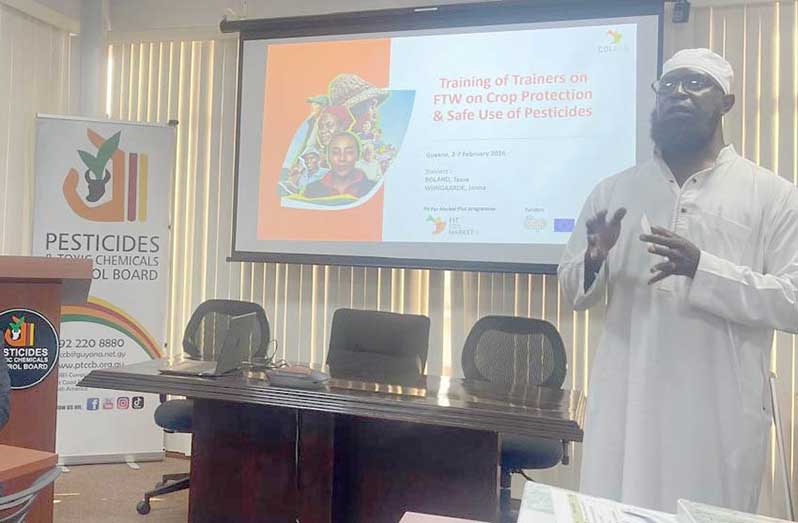
IN a continued effort to strengthen Guyana’s agricultural capacity, COLEAD (the Committee Linking Entrepreneurship-Agriculture-Development), in partnership with the National Agricultural Research and Extension Institute (NAREI), successfully concluded a six-day “Train the Trainers” workshop on February 7.
The intensive programme, held from February 2–7 at NAREI’s headquarters, marked a significant step in modernising agricultural extension services and reinforcing sustainable farming practices nationwide.
Funded primarily by the European Union (EU) and the Organisation of African, Caribbean and Pacific States (OACPS), the initiative demonstrated the EU’s enduring commitment to boosting the resilience and productivity of the agricultural sector across Guyana and the wider Caribbean.
According to a press release from the EU, the programme’s focus on capacity building highlights its broader goal of promoting inclusive growth, improved livelihoods, and long-term food security through technical cooperation.
The workshop aimed to enhance the pedagogical skills of agricultural professionals, equipping them with tools to effectively transfer knowledge to horticultural businesses and local farmers. A core component of the training was the Field Training Workshop (FTW) methodology—an interactive, hands-on learning approach that links technical theory to real-world agricultural practices.
Participants were introduced to best practices in Integrated Crop Protection, emphasising sustainable pest management strategies; Safety and Hygiene, focusing on responsible pesticide use and adherence to traceability standards; and the SIOM Technique (Subject–Interest–Objective–Method), designed to improve the clarity and impact of field training sessions. The workshop also incorporated innovative, active-learning tools—such as puzzles, flipcharts, and group exercises—to foster engagement among adult learners.
The session brought together extension officers, regional training coordinators, and supervisors from a diverse cross-section of local institutions, including the Guyana Rice Development Board (GRDB), the Guyana School of Agriculture (GSA), the University of Guyana (UG), and the National Plant Protection Organization (NPPO). This collaborative setting created a platform for knowledge sharing and cross-institutional coordination across Guyana’s agricultural landscape.
As a private-sector, non-profit organisation, COLEAD remains dedicated to initiatives that strengthen the agricultural sector’s contribution to global sustainability. With support from the European Union and OACPS, COLEAD continues to help Caribbean nations develop robust horticultural value chains and align with evolving international food safety standards.
NAREI, Guyana’s leading agency for agricultural research and extension, plays a central role in advancing agricultural diversification and innovation. Its collaboration with COLEAD and international partners marks another milestone in Guyana’s evolving journey toward sustainable agri-development.




