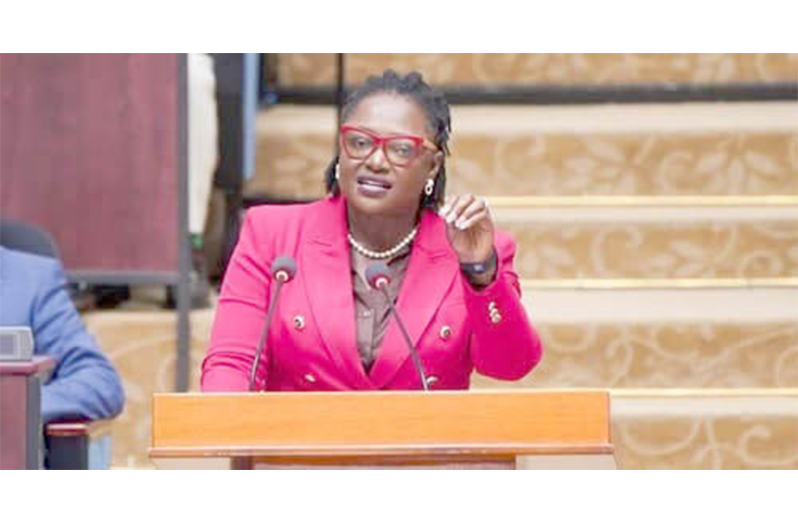
–McAllister tells National Assembly, highlights significant gains made in improving systematic, technical processes
GUYANA’S maritime sector has undergone a profound transformation since 2020, emerging as a cornerstone of national development and regional leadership.
During her contribution to the 2026 Budget Debate on Thursday, Parliamentary Secretary within the Ministry of Public Utilities Thandi McAllister detailed a series of achievements designed to modernise the sector, enhance safety and efficiency, and align the country with international standards.
She highlighted that Guyana has recorded a 67 per cent increase in vessel traffic and port calls between 2020 and 2025, a development the government views as a clear indicator of its “aggressive positioning” of the maritime sector.
This growth is being treated not merely as a by-product of economic expansion, but as a deliberate outcome of policy choices centred on infrastructure, regulation and institutional strengthening.
“This increase is recognised as an indicator of the value and impact of this government’s aggressive positioning of the maritime sector as a cornerstone of national development. This bold and ambitious undertaking instructs the development of a comprehensive and robust regulatory, legal and institutional framework,” McAllister said.
MODERN LEGAL AND REGULATORY FRAMEWORK
A central plank of the government’s maritime agenda is the development of a comprehensive and robust regulatory, legal, and institutional framework.
She highlighted ongoing work on a Modern Port Authority Act, being crafted jointly by the Maritime Administration Department’s legal division and the Ministry of Legal Affairs. The new legislation, she explained, is intended to reflect global standards of operation, oversight and regulation, translate complex international maritime conventions into clear and consistent national law and provide a blueprint to guide Guyana’s maritime sector “for decades to come”.
Lashing back at opposition members of parliament who had attempted to discredit the gains in the maritime sector, McAllister contrasted the plans for the new legislation with a 2017 draft Port Authority bill, which she described as “woefully inadequate” and not truly tailored to Guyana’s maritime realities.
She stressed that the current approach is not a mere exercise in “cut and paste”, but a systematic, technically grounded process.
“We’ve sustained technical capacity… strengthening our current institutions and establishing new ones, such as a modern Port Authority that will bring the sector into the right alignment with established gold global standards and best practices, embracing innovation and increased efficiency for safe, secure and sustainable shipping,” she said.
HISTORIC GAPS AND AUDIT FAILURES
McAllister drew a sharp distinction between the current administration’s approach and that of the previous A Partnership for National Unity (APNU) government, particularly in relation to international obligations.
She recalled that during an International Maritime Organisation (IMO) mandatory audit in 2018, Guyana recorded 19 findings against it, including, lack of technical and legal personnel for effective implementation of maritime conventions, failure to make use of external support options, maritime affairs not being prioritised at the national strategic planning level, reliance on an archaic management system and inadequate policies for information retention and absence of effective mechanisms to ensure navigation safety messages were readily available as is required by the IMO and other international bodies.
Since 2020, the government has rolled out a series of practical upgrades to strengthen Guyana’s maritime infrastructure and improve safety across its waterways. More than 30 navigation markers and key aids have been installed along the Demerara River to enhance navigational reliability, while three new pilot boats have been acquired, significantly improving speed, efficiency and safety compared with the ageing second-hand vessels previously in use.
She pointed to plans to further expand the fleet with a modern hydrographic survey vessel and a specialised craft dedicated to maintaining navigational buoys and beacons, supporting safer shipping and more accurate hydrographic data for ports and rivers.
The country has now received both regional and international recognition for its advancements within the maritime space, she noted.
“The Caribbean and the IMO have recognised Guyana as a critical maritime state. And this year we will hold, for the first time, two major regional maritime conferences, the third, first meeting of the Caribbean port state control conference, and the fifth regional meeting of the heads and directors of maritime agencies,” McAllister said.