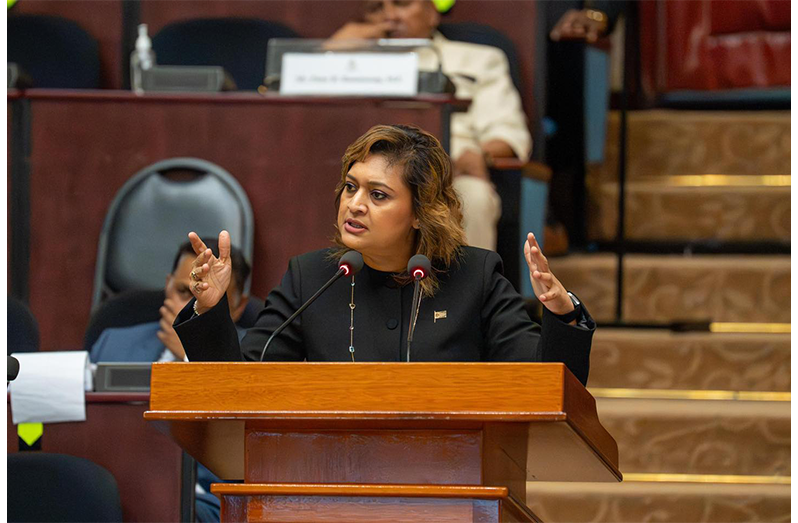
WHILE brushing aside the pessimism emanating from the parliamentary opposition, Minister of Local Government and Regional Development Priya Manickchand stated that billions will be directed towards Neighbourhood Democratic Councils (NDCs), solid waste management and the construction and rehabilitation of markets.
Minister Manickchand during the fourth day of the 2026 Budget Debate delivered a blistering defence of the People’s Progressive Party/Civic (PPP/C) and its record in office.
The minister did not mince her words as she called out the opposition for gutting key social support programmes, mismanagement, and hypocrisy, rejecting their negative claims on Guyana’s development.
She told the House that the government, especially her ministry has been listening and engaging citizens, declaring that wholesome, clean, and safer communities are being actively pursued.
Minister Manickchand pointed to the strides that have been made within her subject ministry and how the injections of investments by central government have decentralised power and strengthened local governance across Guyana.
Key initiatives, which will positively aid in transforming communities include the allocation of $30 million for each of the 70 NDCs, the $50 million allocation to municipalities and the construction of eight new NDC buildings, and the rehabilitation of five others.
To further boost the capabilities, Minister Manickchand said that every NDC and municipality will receive at least one garbage compactor.
In spite of the heckling by the opposition bench, the minister made it clear: “I never fail baby.”
The minister detailed plans to overhaul the country’s waste management system with the construction of eight modern landfill sites in region two, three, four, five, six, seven, nine and ten.
Recycling and waste education targeting schools and communities will also be pursued, she noted.
The minister said the way solid waste management is handled will change, noting “It’s not a one moment fix.”
In addition, according to her, $4.9 billion has been earmarked for the rehabilitation, rebuilding, or construction of some 34 markets/vending areas nationwide.
On employment, the minister announced that $11.7 billion will be spent this year on the National Pathway Workers Programme.
In 2025 alone, more than 13,883 women were employed under the programme and 3,882 men.
‘WITHOUT DIRECTION’
After highlighting the attempts by the opposition to downplay Guyana’s development, Minister Manickchand said the We Invest in Nationhood (WIN) party was devoid of an ideology and questioned the motives of the party, pointing out that the “disaffected” opposition bench is being led by someone who is U.S-indicted and dodging accountability.
“This [opposition] is a collection of persons who are disaffected, without direction, without leadership, owned by a person who is soon going to be departing your shores,” she told the House.
Questioning the sincerity of the “newfound interest in democracy” by the presenter who came before her, WIN Member of Parliamentarian (MP), Duarte Hetsberger, Minister Manickchand reminded the House of the 2020 General and Regional Elections, which saw attempts by the then government to destroy the very fabric of democracy he speaks of.
‘YOU ATE THE CHILDREN’S MONEY’
Minister Manickchand then blasted the A Partnership for National Unity (APNU) for removing pro-poor initiatives, including the $10,000 ‘Because We Care’ cash grant when they entered office, “You [APNU] said you couldn’t afford it at the time, it was costing this country, $1.6 billion to give each child $10,000 you took that away, snatched it from the hands of parents who needed it. But you know what increased? Dietary in the budget; went up by $1.6 billion. You eat out the people money. You eat out the children money and you coming here now to tell us about love for children.”
The minister further highlighted the duplicity within that section of the parliamentary opposition, in which at one time APNU called for the ‘Because We Care’ grant to be rubbished and another time they demand an increase.
She warned parents “If the PNC ever got their hands on power again, they are taking away your ‘Because We Care’ cash grant. They’re taking it away, and they’re going to replace it with dilapidated busses, no breakfast, no books or anything else that they fail to give.”
The minister further rubbished the untruths from the opposition regarding the education sector in Region Ten, pointing to the four new secondary schools being built, including one costing $2.6 billion, and disclosed to the House that the region already has 120 per cent trained teachers.
Turning to the opposition’s claims of neglect in Region Nine, the minister said that close to $10 billion was spent on healthcare in the region between 2020 and 2024, highlighting the construction and upgrading of multiple health facilities and the increase in patient treatment.
“The Region Nine health story is a success story. Our people used to have to go to Brazil for service. People from Brazil are now coming over to us for service,” the minister said, asking the opposition: “That is a story we should all be cheering on. Where is your national pride?”
Minister Manickchand faced the parliamentary opposition head on and reminded the House that with or without oil, the PPP/C has governed in the best interest of all Guyanese.
She pointed to initiatives by the PPP/C that were implemented long before the discovery of oil, including old-age pension and the uniform voucher for children.
Minister Manickchand went on to say: “The People’s Progressive Party has consistently shown, has consistently shown, in or out of government, with or without oil, that it is the only party that will look after children, that will look after women, that will look after our Amerindian brothers and sisters, that will look after our farmers, that will look after our businessmen, that will look after our service people, that will look out for teachers, that will build schools, and roads and hospitals. It is the People’s Progressive Party/Civic that has consistently shown that kind of pro-poor, pro-development approach to governance in the country.”