Educators reveal the weeks of planning, creativity, and passion that bring children’s Mash to life
With Region Three, Essequibo Islands–West Demerara, hosting its Mashramani 2026 celebrations, Pepperpot Magazine sat down with just two of the many educators across the region working with their students to bring culture and creativity to life. Shaundell Fresco, Head Teacher at Vergenoegen Nursery School and Assistant Coordinator, says that staging the children’s Mashramani competition is no small undertaking, with planning, training, and creating done weeks in advance to ensure each school’s performers shine. In the nursery segment, 36 of the 51 schools are participating in one or more segments or categories of the competition, while the primary level has 97 entries and the secondary level has 59 entries. Also adding to the glow of the region’s Mashramani competition is Seon Wallis, a teacher at Greenwich Park Primary School, who walked us through this year’s design and highlighted the work that goes into making costumes for what could be one of the most competitive stages.

Head Teacher at Vergenoegen Nursery School, Shaundell Fresco, is an integral part of this year’s regional competition, working alongside the committee to plan and address any issues that may arise. The aim, Fresco shared, is to ensure that everything runs smoothly, working with fellow teachers and students to make the competition as seamless as possible. “It has begun with a lot of planning from the nursery throughout the secondary sectors. We begin with assembling our programme together—what categories of the programme we’d like to have showcased. We have also considered having the team for the road march competition; we usually have a regional team,” she added. “It begins with a lot of training, a lot of pulling together of persons who are professional in different areas like music, drama, and dance. We have professionals who come together and conduct training programmes. We also have meetings with all of those categories of persons.”
The entry and scrutiny process for the competition is harder than most would think. As Fresco explained, schools across the region are contacted and given categories for the competitions, and then present their entries to the committee. After entries are submitted, Fresco and her team must determine whether each entry is eligible for the category for which it has applied; this includes reviewing themes, which she noted can be particularly challenging. “This year, we have had a lot of scrutiny because we have looked at entries that really spoke against religion and politics, because we do not want that to be a part of our competition,” she added. “We have had meetings upon meetings and training sessions with our teachers, head teachers, and all stakeholders in order to have this competition today and make it a success.”
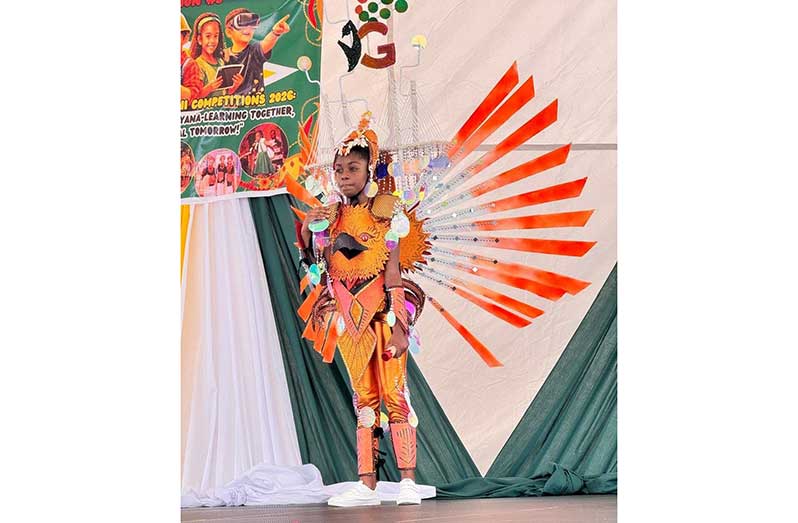
Seon Wallis is a teacher with a creative touch at Greenwich Park Primary, where he has worked for the past few years. This year marks only his second time participating in the Mashramani competition, but Wallis was undeterred, sharing that his costume—worn and modelled by one of his pupils—draws inspiration from Guyana’s development to convey the theme Gateway to Region Three. “This year we chose to enter the costume competition category in the 8 to 10 age group at this year’s Mashramani Regional Competition in Region Three. My costume is depicting the gateway to Region Three, which features the newly constructed Bharrat Jagdeo Demerara River Bridge,” he explained. “When you reach the west side, there’s a roundabout there. That is where the bodice of our costume, the body part, is depicting that monument associated with our Indigenous people. My costume portrays the growth and development of our country while also paying homage to our culture.”
Sharing insight into the creative process, Wallis explained that he partnered with well-known Guyanese designer Randy Madray to help create the unique piece. The goal this year, he said, was to improve upon last year, when he placed second in his category. “Randy and I shared a little insight this year because we wanted to better last year’s costume. Costume-making is not easy work, and I must thank him greatly because the time and effort—it’s not easy to produce such a wonderful costume for this year’s competition.” He also noted that the costume is largely made using local materials. “Most of the materials used include binding wires, glitter foam, and regular items that you can mostly pick up in stores here in Guyana to produce something so spectacular, bringing out our culture, our history, and the tremendous development our country has experienced over the past five years.”

One striking aspect of the event is the level of competitiveness among children and teachers alike. This, however, is for good reason, says Wallis, as each year becomes more competitive, with schools bringing new levels of creativity. “I competed last year. After entering last year’s competition with our creativity and vision, as the years go by, it’s the real truth of growth. At these costume competitions, it’s either you go topical or you go fantasy. Fantasy pays homage to our culture, for example, the Old Higue stories or the Bacco.” Explaining his decision to go topical, he added, “Topical-wise, it’s the development in our country and what is most relevant today. We have major development: the new bridge, the roundabouts in Region Three that allow easy traffic flow, the Heroes Highway, and so forth.”
The next step after the regional competitions will be the national competitions, which will be held in the coming weeks. The event is about more than costumes; every level features a variety of dance and music categories. This diversity is what teams look forward to. As Fresco explained, Vergenoegen Nursery School is often among those vying for top spots and bringing home trophies. “Overall, as the years have gone by, we’ve done excellently. We have always brought back trophies. Even for road march, we bring back lots of trophies.” Speaking about this year’s competition, she added, “This year is going to be no different. We will take more than the amount we have taken in years past.”
Beyond the competition, detailed costumes, and vibrant dances, children’s Mash in Guyana offers much more. As Fresco shared, it is one of the most anticipated events on the school calendar, bringing balance to a year primarily focused on academics. “This is so important because the wider spectrum of society believes in education and in giving children a strong academic foundation. But for education to be realised in the lives of our children, there must be balance,” she said, adding that events like these give children opportunities to explore their creative talents. “Some children may not excel in English or maths, but they may be very good at dancing, dramatic poetry, or music. We are giving every child an opportunity to be themselves and to excel in a way that is most comfortable for them.” Whether through planning, designing, choreography, or music, children’s Mash involves much more than meets the eye, with significant effort invested in placing young stars on stage. Both educators agreed, however, that it is essential—not just for teachers or the event, but for the moments of happiness and laughter it creates for children.