LINDENERS and the wider Region Ten (Upper Demerara-Berbice) are set to benefit from improved power reliability and cleaner energy following the announcement of the plans to install a 15- megawatts (MW) solar photovoltaic (PV) system.
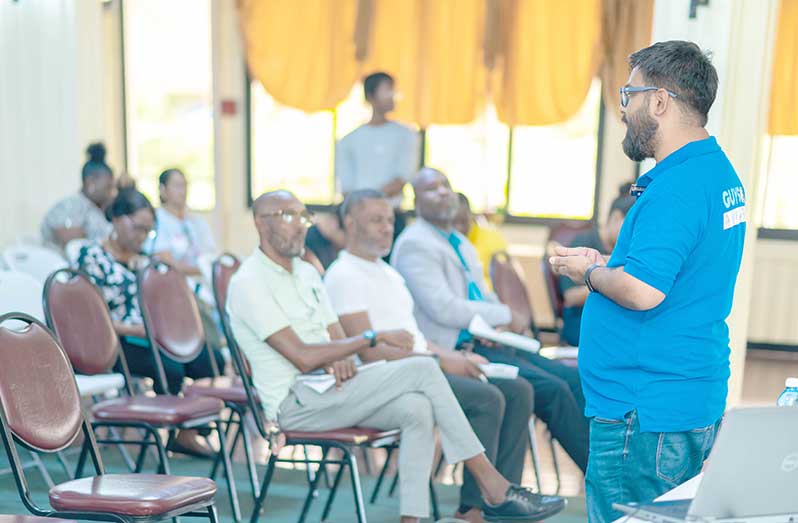
Guyana Utility-Scale Solar Programme (GUYSOL) on Tuesday held a community meeting at the Watooka Lodge to engage residents, local leaders and community representatives on the plans for the upcoming implementation of solar farms at Retrieve, Block 37, and Dakoura.
GUYSOL Programme Director, Amir Dillawar during the engagement emphasised the importance of the direct engagement and affirmed that the implementation of the solar farms aims to expand renewable energy capacity and enhance power reliability.
Moreover, the People’s Progressive Party/Civic (PPP/C)’s government aggressive national drive to strengthen power reliability, and expand renewable energy infrastructure will result in other benefits.
According to Dillawar, the power generated from the solar farms will be significantly cheaper, helping to reduce government electricity subsidy and in the long run, “free up” revenue for other development priorities within the region.
“Every unit of energy that we produce from the solar farm, I can guarantee you, is cheaper than a unit of energy you buy from BOSAI, dollars and cents wise…The objective is to reduce the volume or the quantity of the subsidy,” he told a resident who was curious as to the cost-effective nature of the project.
Construction is scheduled to commence in the first quarter of 2026 and expected to conclude in the first quarter of 2027.
The solar farms within the region will be built through a joint venture between SUMEC Complete Equipment and Engineering Company Limited and XJ Group Corporation.
The project is being funded under the Norwegian Agency for Development Cooperation.
This US$83 million is part of the US $220.8 million earned by Guyana through its forest climate services through its partnership with Norway during the previous PPP/C’s term in office.
The objective of the programme is to diversify Guyana’s economy and facilitate a smooth transition to cleaner, cheaper, renewable energy sources.
Earlier this week, Prime Minister, Brigadier (Ret’d) Mark Phillips had stated that almost 50 MW of power will come from solar farms and mini hydropower grids alone by the end of this year.
More than half of this power is coming from the GUYSOL programme.
Recent commissions highlight the pace of progress and the government’s commitment to strengthen power generation nationwide.
Just last week, the US$8.14 million, 3MWp Charity Solar Farm was commissioned and is set to benefit over 3,000 residents of Region Two (Pomeroon-Supenaam).
Last November, a US$10.4M solar farm was commissioned at Onderneeming, Region Two. This together with the one at Charity is expected to offset more than 9,300 tonnes of carbon dioxide emissions annually. Investments in remote-controlled substations and real-time monitoring systems are also expected to improve grid reliability and responsiveness. The two facilities contribute 8MWp of solar capacity and 12MWh of battery storage to the regional grid.
Under the GUYSOL programme, Berbice has also benefitted from the addition of 10MWp of solar capacity through the commissioning of solar farms at Hampshire, Prospect, and Trafalgar, strengthening energy security in Regions Five and Six.
INCLUSIVE DEVELOPMENT
The major renewable energy project expands beyond power generation as Dillawar told residents that the programme is also focused on inclusive human resource development, as he pointed to several training programmes for women and young professionals, including persons with disabilities.
Currently, applications are opened for the second women in solar training programme in Linden and this will see them being trained to install solar PV and PV.
Dillawar said that the training is part of the broader effort to address the underrepresentation of women in technical fields and not to exclude anyone.
He did make it clear that opportunities for men are still available and the programmes targeting vulnerable groups are only part of a wider employment picture.
He said contractors have been encouraged to hire locally, “As they go into full construction phase, we expect that they will allow a number of opportunities for local people with skills, who wish to work, to become employed…There is an avenue for the young men who are trained and skilled to get employment for the construction duration and possibly even after.”