
-charts pathway for significant systemic reforms, better service delivery
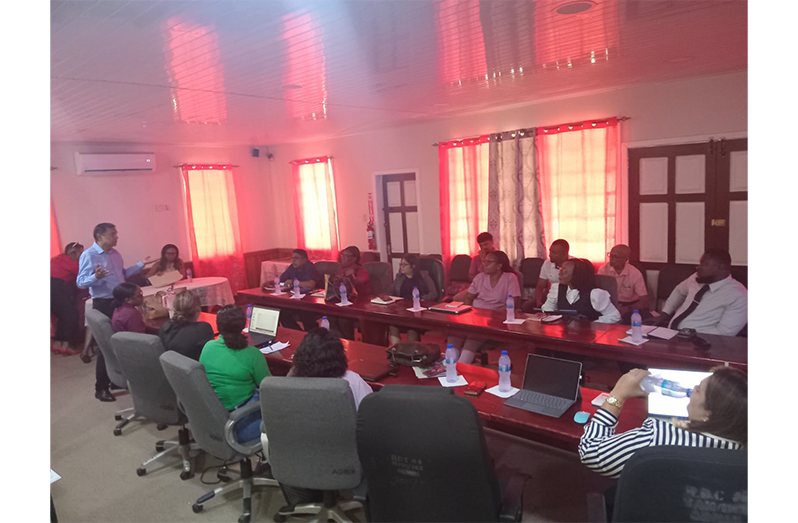
WITH a focus on systemic improvement and service excellence, Region Five on Saturday convened its Regional Leadership Review Meeting for 2025 in the Regional Democratic Council (RDC) boardroom.
The meeting brought together the heads of the various departments and members of the regional health management team to review the region’s health sector performance for 2025, assess operational challenges and identify priority actions to strengthen service delivery.
“All the departments would have [sic] presented their work that was done during 2025 and compare it with previous years, and they would have [sic] also put forward their preliminary proposal for 2026. They also listed their challenges, some of which they managed to overcome with the intervention of the ministry and the RDC and some of which will be dealt with in this year’s budget,” Director General, Ministry of Health, Dr Vishwa Mahadeo said.
During the meeting, Adviser to the President on Health, Dr Mahendra Carpen, encouraged health officers to acknowledge their successes while striving for continued improvement.
“One of the things that we would like you to do is identify succession plans. Identify young people in your communities, schools, churches, and hospital settings, junior doctors, nurses, pharmacists, those with the potential to go further. Let us invest in them so that we are not constantly faced with the same challenges of staff shortages or undertrained personnel,” he said.
Regional Executive Officer Mr Sadiek Ishmael, during the engagement underscored the critical role of health professionals in improving population well-being, saying, “Health is the wealth of any country, and whatever we do at our hospitals and health centres will directly impact the well-being of our people. Your work as health professionals across the region plays a pivotal role in strengthening the health sector and improving the quality of life for our citizens.”
A team from the Ministry of Health, led by Director General, Dr Vishwa Mahadeo, was present to guide discussions and interact with the regional leadership team on strategies to improve systems, efficiency, and patient outcomes.
“Region Five had a significantly better year than previous years. The new hospital at Bath has contributed significantly to the better performance and this of course is going to continue to improve. We are now providing services like specialist services, but also different types of surgeries and diagnostics,” Dr Mahadeo stated.
He was accompanied by Chief Medex, Carleen Howard-Mohabir; Chief Inspector, Vector Control, David Williams; and Latoya Warde from the ministry’s Biomedical Engineering Department.
The Director General further noted that departmental plans for 2026 will be presented and discussed at the level of the ministry.
“We would have [sic] heard that Region Five is now doing CT and have done a number of such scans in 2025. The statistics speak for themselves on the improvements that we would have [sic] made…we have set ourselves specific targets and goals that falls [sic] within the national plan and also within the plan of the Government of Guyana and we will be working towards those,” Dr Mahadeo added.
The construction of new hospitals, upgrades to health infrastructure and the expansion of services form part of President, Dr Irfaan Ali’s vision to ensure that every citizen has access to world-class healthcare throughout Guyana.
The review showed that Region Five health facilities saw 153,579 patients in 2025, up from 98,991 in 2021. Hospital admissions totalled 3,014, with 361 surgeries and 160 deliveries, underscoring ongoing efforts to expand critical care and maternal health services.
Bath Regional Hospital recorded 23,002 patients from July 2025 to date, with 804 hospital admissions, 196 surgeries, and 71 deliveries. The hospital also provided 402 CT scans, 2,029 ultrasounds, 37,783 blood tests, and dental services to 1,561 patients.
Key priorities for system improvement include completing the Stimulation Centre, expanding health centres, upgrading hospital electrical systems, and rehabilitating the Fort Wellington Hospital. The Bath Regional Hospital will also see the introduction of dialysis, cardiology, endoscopy, and colonoscopy services, strengthening critical- care capacity.
To enhance patient care, the region will implement Electronic Medical Records (EMRs) linked to the national network, roll out Quality Assurance and Quality Control systems and improve patient–doctor engagement, diagnostics, follow-ups, and waiting times. Supply-chain management will also be strengthened through the digitisation of inventory systems and training of specialised staff to ensure 100 percent availability of vital and essential medicines.
Human resource development remains a priority, with emphasis on succession planning, recruitment, and training, including ongoing professional nursing and patient care assistant programmes aimed at building a sustainable health workforce within the region.
The review meeting formed part of ongoing efforts to assess performance, recognise achievements, and implement targeted improvements aimed at delivering accessible, efficient, and high-quality health services to the residents of Region Five.