







-says solar farms, renewable energy projects to provide just under 50 megawatts of renewable energy
SOME 37,000 household solar systems have been distributed to hinterland and other off-grid communities, providing reliable electricity to thousands of families and marking a major expansion of Guyana’s renewable energy drive, Prime Minister, Brigadier (Ret’d) Mark Phillips has said.
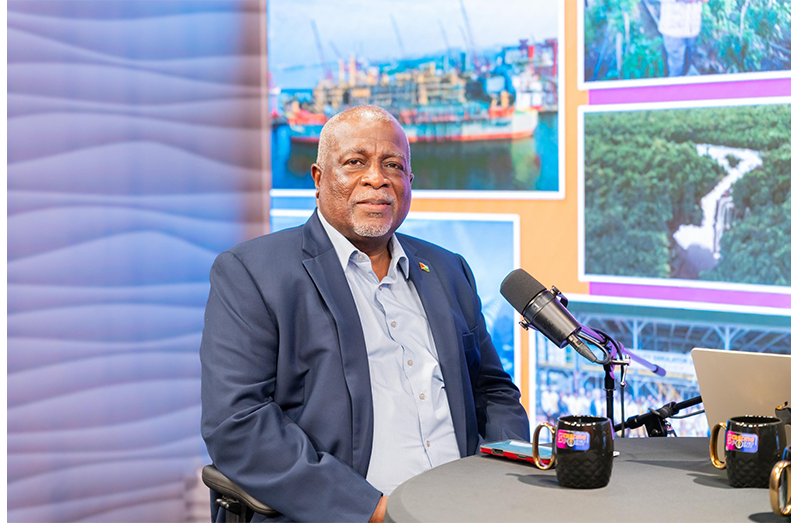
Speaking on the ‘Starting Point’ podcast which aired on Sunday, the Prime Minister explained that the household systems form part of a wider programme of renewable energy investments, which are expected to bring just under 50 megawatts of renewable energy on stream by the end of 2026.
The projects span the period 2020 to 2026 and include a mix of utility-scale solar farms and solar systems that have been installed at the household level.
“Well, based on the projects, just under 50 megawatts of renewable energy will be Online, definitely by the end of 2026 …from 2020 to 2026, and I say 2026 because we have a major project in Linden, 50 megawatts that started, but hasn’t reached the point of commissioning yet,” the Prime Minister said, adding: “And also, we had the community solar project where we went into the large and medium-sized Amerindian villages, and we started to install solar farms and mini grids to power the important buildings, you know, like the village office, the police station, the health centre or hospital, the school. And the intention is to continue that project as we satisfy all the Amerindian villages.”
He emphasised that the current household solar systems represent an improvement on those distributed under the 2009 Low-Carbon Development Strategy. Each system includes a 160-watt solar panel, a battery for energy storage, a fan, two charging ports and two LED lights, making it more inclusive and practical for daily use.
“We’ve also invested in household solar system, and to date, we have distributed 37,000-household solar systems, one to each household, mainly in the hinterland, riverine, in off-grid areas,” he said.
According to the Prime Minister, the systems have had a transformative impact on hinterland communities, allowing residents to extend productive hours into the evening.
“That has transformed people lives. It means that more hours can now be used for productive activities…the children can study more hours in the night for the exams. People can connect to the internet through powering of their devices. People who have small businesses, people who do a lot of sewing or agro processing on the cottage level, they can now do additional work.”
PM Phillips also pointed to the link between renewable energy investments and improved connectivity, noting that some 253 Amerindian communities are now connected to the internet through the solar initiatives and the work of the National Data Management Authority.
He added that the government is constructing ICT hubs in 200 communities, with 114 already completed and several more nearing completion, alongside the installation of Starlink devices to expand internet access in hinterland areas.
“Some 253 Amerindian communities are now connected to the Internet through that project and through the work of the NDMA,” he said, adding: “We are building ICT hubs in 200 communities. We finished just about 114, and now we have another 60 to complete, but then, in addition to that, we’ve connected 253 Amerindian communities using what we call the Starlink device. We’ve installed Starlink devices in every one of those Amerindian communities, and they’re now connected to the Internet.”



