






–Minister Singh says, points to deliberate policies geared at improving lives of all Guyanese
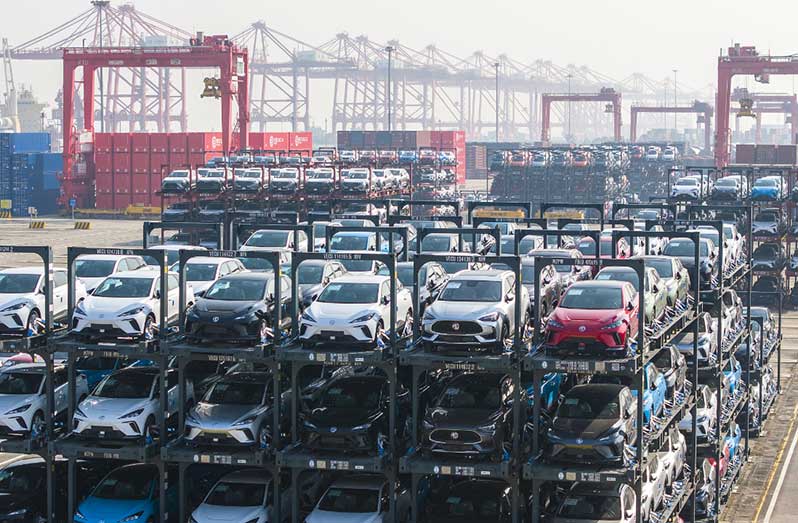
FOR the first time, thousands of Guyanese have finally been able to own their own car, with entire registration series being completed in just three months.
This has emphasised how the government’s policies are reshaping the lives of all, Senior Minister in the Office of the President with Responsibility for Finance, Dr. Ashni Singh, said during a recent interview.
He highlighted how the speed of new registrations reflects how accessible vehicle ownership has become.
The People’s Progressive Party/Civic (PPP/C) government has issued a series of policies that target improving financing options, reducing value-added tax along with infrastructural investments.
Earlier this month, the new car registration series PAN commenced, just three months since the last car series started.
Minister Singh has observed this growth and said: “For the 1000s of people who now own a motor car, for the first time, motor car registrations are being recorded at the fastest rate ever. Now we’re completing an entire 9,999 series in just about three or four months, reflecting the fact that motor car ownership is more accessible now than any other thing… that’s an improvement in quality of life.”
Earlier this month, President Dr Irfaan Ali unveiled a sweeping five-year agenda for what he describes as “the most ambitious phase” of Guyana’s economic and social transformation, anchored in diversification, digitisation, and broad-based prosperity.
Dr Ali said his re-elected administration would “build on the historic achievements” of the past five years, with a sharpened focus on ensuring that growth is widely shared.
Notably, Dr Ali revealed a wide-ranging package of tax incentives aimed at deepening economic diversification, encouraging private investment, and easing the financial burden on households, small businesses, and vulnerable groups.
Central to this is the creation of special development zones which will be detailed in the 2026 national budget.
These zones will operate under a tax-free incentive regime, targeting sectors that generate export earnings, or replace imports, with a particular emphasis on agricultural technology, agro processing, and non-oil economic activity.
In a bid to support both businesses and families that rely on ‘pick up’ vehicles, the government, he said, will introduce a flat tax on double cab pick-ups, regardless of age.
Vehicles up to 2,000cc will attract a tax of $2 million, while those between 2,000cc and 2,500cc will face a $3 million tax.
Officials say this will make it easier to renew or upgrade transport capacity, especially for enterprises operating in agriculture, construction, and services.
With a clear intention of rewarding work, and encouraging formal employment, the administration has pledged to continue raising the income tax threshold over the next five years, with the goal of approaching levels seen in more developed economies.
At the same time, it will abolish net property tax on individuals; this is a move framed as an incentive for citizens to build savings and assets.
“These plans represent a blueprint for transformation that can be tangible in your daily life, in the work you do, the wages to earn… with your trust and partnership will turn this moment into a movement, a momentum that carries growth in our homes,” the President said.




