






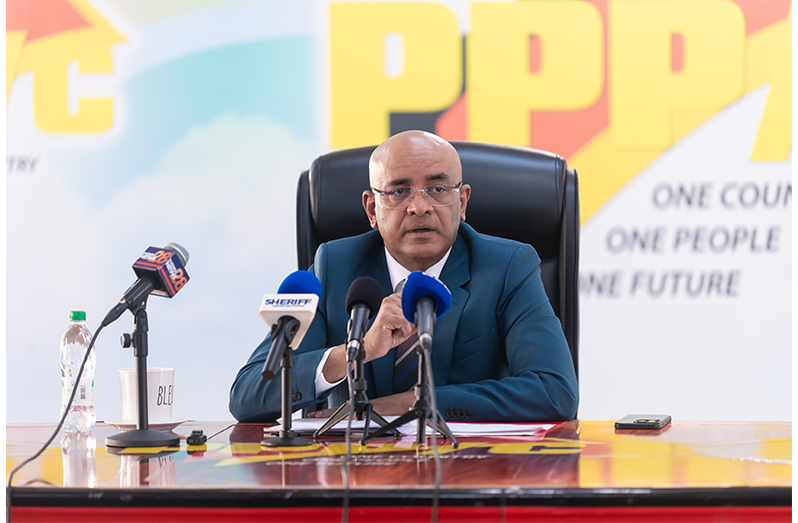
–VP Jagdeo says; touts establishment of economic zones, other initiatives to foster growth
–gov’t to roll out special instruments to help ordinary Guyanese build wealth
OVER the next five years, the government aims to accelerate job creation and investments beyond Region Four (Demerara- Mahaica), People’s Progressive Party (PPP) General Secretary and Guyana’s Vice-President Dr Bharrat Jagdeo said, noting that targeted incentives will be introduced to encourage businesses to establish operations in outlying regions.
During a press conference last Thursday, he said while there has been significant progress made under the PPP/C administration in terms of providing jobs and driving inclusive growth, the government will push even further to correct long-standing regional disparities in development.
Dr Jagdeo made these comments in light of President Dr Irfaan Ali’s sweeping five-year agenda, which he revealed last Wednesday, and described as “the most ambitious phase” of Guyana’s economic and social transformation, anchored in diversification, digitisation, and broad-based prosperity.
“The President made it clear, consistent with what we do now, to even out development. So, we recognise that to get jobs and high-paying jobs in the Amerindian communities, in the hinterland and riverine areas, in places like Region Ten or Six or the other regions, outlying regions, Essequibo Coast mainly, we have to drive more businesses to go there,” the VP said.
While the services, and oil and gas sectors have led to an economic boom in Region Four, creating an increase in the establishment of hotels and the provision of a range of services, as it relates to outlying regions, the Vice-President said: “It’s not reaching these areas as quickly as we wish.”
To address this imbalance, President Ali has touted a wide-ranging package of tax incentives aimed at deepening economic diversification, encouraging private investment, and easing the financial burden on households, small businesses, and vulnerable groups.
Central to this is the creation of special development zones which will be detailed in the 2026 national budget.
These zones will operate under a tax-free incentive regime, targeting sectors that generate export earnings, or replace imports, with a particular emphasis on agricultural technology, agro processing, and non-oil economic activity.
Dr Jagdeo explained that these measures form part of the government’s broader strategy to diversify the economy, reduce regional imbalances and ensure all Guyanese- regardless of where they reside- benefit from national, inclusive development.
He further noted that the nation can expect to hear the details of the incentives and the eligible sectors in the 2026 National Budget, which is expected to be presented in January.
“We will build out a rural credit programme at scale, through the Guyana Development Bank. We will create value chain and market access,” President Ali said.
In fact, the soon-to-be-established Guyana Development Bank, capitalised with US$200 million, will provide zero interest, zero collateral, micro credit to small and medium-sized enterprises, women-owned businesses, young entrepreneurs, and persons living with disabilities, alongside structured mentorship and training.
SMEs will be able to access up to $3 million without collateral at zero interest, with a further $7 million available through co-financing with commercial banks at preferential rates. Agent-banking networks, digital banking, and mobile wallets will be rolled out to reach remote communities, supported by legal and regulatory reforms, and a modernised Bank of Guyana.
In addition to this, a series of investments is expected to open new agricultural acreage, while a revamped taxation framework will eliminate duties on agricultural, veterinary and agro-processing inputs within existing trade rules.
Further, additional incentives will support agro-processing ventures, agri-value chain development, large cold-storage facilities and a graduated corporate tax system based on turnover. This structure is designed to bring small and medium-sized agribusinesses into formal compliance, enabling them to improve standards and meet regional and international market requirements.
Measures to encourage land conversion and value-added production are also planned.
INDUSTRIAL & TOURISM INCENTIVES
The President had disclosed that industrial expansion will be anchored by new manufacturing hubs benefitting from enhanced incentive regimes. At Wales, where the country’s flagship gas-to-energy project is taking shape, a significant programme is already under design, featuring a fertiliser plant, a gas bottling and logistics facility, two power plants, a data centre, the potential development of a glass factory and a small industrial estate.
“For the two investments of the bottling plant and the fertiliser plant, where the expression of interest is already out, we want those to be owned by Guyanese here and in the diaspora and our regional partners, and we will have guaranteed returns on these investments that no other can match,” he said.
Meanwhile, the country’s tourism industry is earmarked for rapid growth, supported by improvements in transport infrastructure, increased airlift capacity along with special incentive zones dedicated to tourism development will be introduced across several locations.
EXPAND INVESTMENT OPPORTUNITIES
Other instruments will also be established to expand investment opportunities for Guyanese, Dr Jagdeo said, pointing out that soon the government will introduce a government bond aimed at expanding financial inclusion and giving ordinary Guyanese a chance to attain higher and more lucrative returns on their savings.
The bond, which will be exclusively available to Guyanese is expected to have a low entry point, which could start at $50,000, with an upper limit of around $1 million, making it accessible to low-to-middle income earners and public servants and others who traditionally have limited investment options.
He said: “So, if you have a bank account now, say $500,000, you are probably getting 1-2 per cent interest at the bank. You will get a guaranteed 5 per cent interest.”
To ensure flexibility, the Vice-President said the government is also planning to develop a bond market, which would make the bond a more liquid instrument, similar to fixed deposits, while still offering high returns.
The bond initiative is part of a wider financial inclusion strategy and the Vice-President underscored that the government wants to promote a shift in mindset, from relying solely on wages and cash grants to actively managing savings, investing and building assets.
He said: “Too often, people just park their savings in the banking system and they don’t look at the return on the savings and we want to give small people especially a higher return on their savings. That’s one. Two, there would be other opportunities for people who have more money so they can invest in bigger instruments, Guyanese. It’s only for Guyanese.”
ALL GUYANESE ARE INCLUDED
Dr Jagdeo had also firmly stated that the government is working assiduously to ensure that every Guyanese feels included in the development agenda, acquiring opportunities for growth and development and seeing their concerns being reflected.
The government continues to work on ensuring every citizen is heard. Just last week, President Ali led a two-day Cabinet outreach in Region Three, taking government services directly to the people.
The President, ministers, Members of Parliament, Advisers and technical officers engaged residents in dozens of locations including Leonora, Uitvlugt, Farm, Patentia and Stewartville. They provided platforms for residents to raise concerns, share their views and learn about government programmes and services.
Moreover, the Vice-President explained that governance is serious business and he rejected the notion of “dumbing down” government communication to buzzwords or a few talking points but instead, he made it clear that the philosophy of governance needs to be balanced, anticipating future challenges and avoiding short-term gains which could lead to long-term decline.




