.jpg)



Eagerly embraces Government’s traceability system to boost consumer confidence
IN the quiet stretches of Guyana’s countryside, a new rhythm is taking hold — one that hums with the industrious buzz of bees. Apiculture, once a modest pursuit, is now flourishing across rural communities, offering farmers not only a source of income but also a sustainable livelihood that complements traditional agriculture.
This rise in beekeeping is part of the Government’s broader vision to create resilient, diversified economies across the nation, ensuring that families in villages from Berbice to Essequibo can thrive in harmony with the land. Importantly, the expansion of apiculture aligns with Guyana’s Low Carbon Development Strategy (LCDS), which emphasises sustainable practices that protect biodiversity, reduce emissions, and create green economic opportunities.

Among the many stories of transformation is that of Treavon Prass, a young farmer from Number 51 Village, Corentyne, Berbice. Five years ago, Prass had little interest in bees. Today, he manages 15 hives of Africanised bees and has harvested an impressive 20 gallons of pure honey so far this season. His journey reflects the broader story of apiculture’s rise in Guyana—a blend of tradition, innovation, and community empowerment.
Beekeeping in Guyana is shaped by the cyclical pattern of two main honey flow seasons, traditionally spanning March to May and October to December, when flowering plants produce abundant nectar. However, these periods are highly dependent on rainfall patterns. When the rainy season ends early, as in July or August, trees respond with earlier or extended blossoming periods, sometimes prolonging honey production into January or February. This weather-driven variability influences honey flows across both inland and coastal regions.

The previous year, an unusually prolonged dry season significantly disrupted production in Sandvoort, East Canjie, and Berbice. Saltwater intrusion into freshwater zones stressed mangrove ecosystems, causing many trees to fail under elevated salinity levels. As a result, honey yields declined markedly until rainfall returned, restoring brackish conditions conducive to mangrove flowering and the recovery of honey production.
Prass explains that location is critical, noting that his ancestral lands along the sea dam provide the ideal environment for his bees to thrive.
“Beekeeping is addictive when you know what you are doing,” he reflects. “It’s not about money alone, but the love of caring for the bees. They give back to you through their honey production.”
He also prides himself on supplying his customers with natural, pure honey. In the absence of a formal traceability system, he has relied on a traditional test to reassure buyers: pouring honey into water. If the honey sinks without spreading, that is an indication of purity. This simple demonstration has built trust with local customers, but Prass welcomes the new National Traceability System, recognising that it will increase market confidence by ensuring that food safety standards are adhered to at every level of the production chain, from the farm to the consumer.
The National Traceability System is a digital platform that registers and monitors all apiculturists and beekeepers in Guyana. It centralises data on honey production, movement, and distribution, ensuring that all honey products are traceable from hive to market. A key feature is the use of QR codes, which allow consumers to instantly scan and verify the honey’s origin and certification. For farmers, this builds credibility and opens access to premium markets, while for consumers, it guarantees transparency and authenticity.
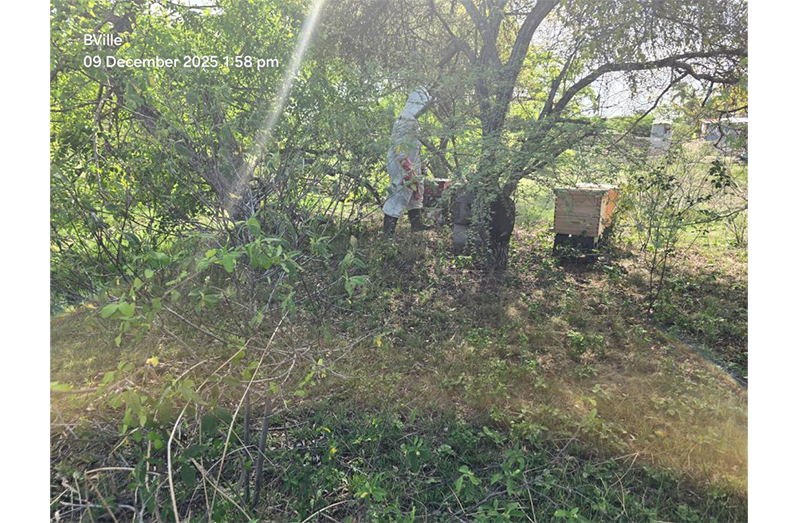
With technical guidance and support, including start-up boxes from the Guyana Livestock Development Authority (GLDA), Prass welcomes the initiative to further strengthen his apiary by adhering to food safety protocols, including monitoring through the traceability system piloted by the Guyana Food Safety Authority (GFSA) and GLDA. While he acknowledges that his production system is still evolving, he is desirous of more support from both agencies to help him expand and refine his operations. He is particularly grateful for assistance with the design and printing of his labels, which he now understands must be aligned with international standards if his honey is to compete in broader markets.
Prass’s journey is also a family affair. His wife, Nadira Lildgar, has become equally versed in beekeeping, assisting with hive care and honey harvesting. Their partnership underscores the communal nature of apiculture, where families work together to sustain livelihoods and strengthen rural economies.
As Guyana advances its agenda of sustainable development, apiculture offers a model of how traditional practices can evolve with modern technology. Farmers like Treavon Prass exemplify this transformation — rooted in ancestral land, guided by government support, and propelled by innovation. With each honey flow season, they are not only harvesting sweetness but also cultivating resilience, trust, and opportunity for rural communities across the nation. In doing so, they are contributing to Guyana’s Low Carbon Development Strategy, proving that livelihoods built on sustainability can be both prosperous and environmentally protective.