







By Zhou Jin
(China Daily) WHEN Joseph Njane, a railway training officer from Kenya, boarded for the first time a high-speed train from Beijing to Wuhan and then Guangzhou, he was captivated by the speed, safety and technological sophistication of the country’s railway network.
The three-week training session in 2019, provided by Beijing Jiaotong University, allowed Njane, who works for Afristar, the company that operates the Mombasa-Nairobi Standard Gauge Railway, to learn about China’s scientific approach to railway planning and construction, control and monitoring systems.
“Seeing China’s railway network firsthand was really eye-opening,” he said, adding that the field trip ignited his desire to bring the advanced technology back to help modernise Kenya’s railway systems.
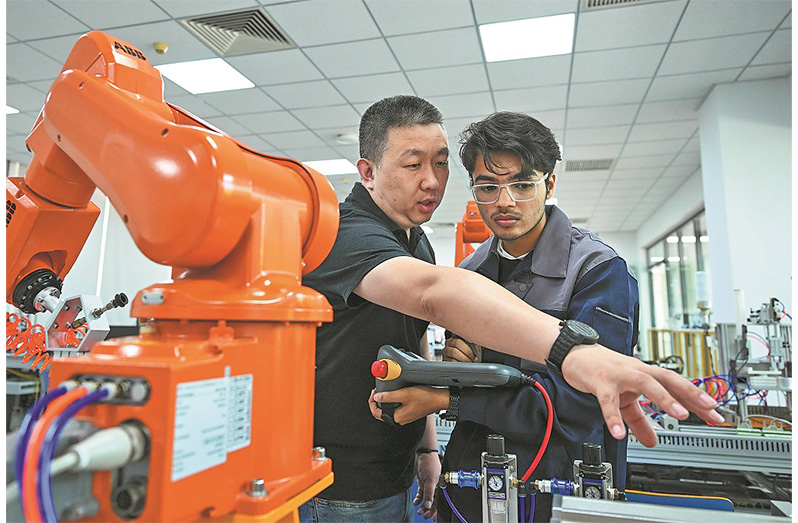
“The knowledge that I acquired, the scientific methods and models, can be used for our railways in Africa to improve the capacity and utilisation of our lines.”
Three years later, Njane participated in an online course also provided by the Beijing Jiaotong University, which he said enhanced his understanding of railway systems, from the structure of the railroad to dispatching technologies.
The most valuable takeaway of the training was China’s emphasis on integrating technology with education, he said.
“The two training courses enabled and inspired me to come up with something that can be used in Kenya to train our staff and ensure their access to railway knowledge.”
When he returned to Kenya, Njane established an online system where he uploaded the training materials from his visits to China and online training.
Now, any employee can log in and access those training materials within minutes, even though they did not get a chance to study in China, Njane said. “This accelerates technology transfer from Chinese experts to Kenyan workers.”
The type of training that Njane received, as part of China’s international human resources development co-operation, is seen as an important aspect of the country’s foreign aid.
Over the past 70 years, China has carried out nearly 15,000 training programmes for over 180 countries and organisations through various forms such as short- and medium-term training programmes in China, overseas expert consultations and youth volunteer services.
These programmes have covered 17 fields and trained more than 500,000 professionals in total, according to Li Ming, a spokesman for the China International Development Cooperation Agency.
China’s foreign aid training programmes focus on cultivating and enhancing the recipient countries’ self-development capabilities, playing a vital role in international economic and technological exchanges and co-operation, he said.
Li shared examples such as a Rwandan trainee who founded a Juncao production company upon returning home, after learning about Juncao (mushroom and grass) technology in China, thereby helping to lift over 50,000 local farmers out of poverty.
An Iraqi trainee brought back China’s “checkerboard” sand control method to combat desertification in Iraq, Li said, adding that another trainee from Afghanistan used emergency response training to prevent an explosion in Kabul.
The agency plans to launch over 2,000 training programmes for more than 50,000 participants in 2025, he said, adding that China will continue to design development co-operation projects and provide 100,000 training and study opportunities to Global South countries over the next five years.
TWO-WAY EXCHANGE
Jing Guoqing, a professor at the highway and railway engineering department of Beijing Jiaotong University, said that sharing China’s railway development philosophy and experience allows participants to share insights into their countries’ railway challenges and expectations.
“Teaching is a two-way process,” Jing said. During the training, the trainees share their experiences, concerns, questions and aspirations, and such feedback is valuable for Chinese companies operating overseas, helping them to navigate cultural differences and improve their projects, he said.
“Foreign aid training plays a crucial role in bridging Chinese enterprises and international stakeholders, ensuring smoother co-operation,” Jing said.
Such training helps to enhance local engineers and officials’ understanding of China’s technical expertise and project management approaches, he said, adding that as the locals become more familiar with Chinese standards, they trust Chinese companies more and feel more confident in adopting those standards.
“In this way, it will help China to promote its technology and standards overseas,” he added.
Jing said that China should focus more on vocational training such as railway technology, new energy vehicle-related skills and photovoltaic installation, areas that will efficiently boost local development while fostering long-term partnerships with developing countries.
KNOWLEDGE TRANSFER
Liu Xian, a research associate at the Institute of International Development Cooperation at the Chinese Academy of International Trade and Economic Cooperation of the Ministry of Commerce, said that the fundamental mission of human resource development cooperation is to “teach people how to fish” rather than mechanically export China’s model.
“It is about unreservedly sharing China’s experience and technology, enabling partners to grasp not only the ‘how’ but also the ‘why’ of the country’s development practices through interaction,” Liu said.
Stephen Ndegwa, executive director of South-South Dialogues, a Nairobi-based development communication think tank, said that by providing actionable knowledge, recipient nations will be able to adapt Chinese methods to their unique contexts, focusing on long-term planning and development models.
Ndegwa said that the impact of China’s training programmes is evident in their ability to strengthen development capacity and promote modernisation in recipient nations.
Through skill development, policy learning and South-South co-operation, these programmes equip participants with the tools needed to enhance local industries, improve productivity and develop homegrown policies inspired by China’s success, Ndegwa said.
He noted that lessons from China’s experience, such as prioritising public investment in critical sectors, offer valuable insights for African countries seeking to balance tradition with innovation while pursuing their development goals.
As the Global South pursues its modernisation journey, co-operation with China is expected to focus on inclusive growth, technology-driven development, and resilient infrastructure, he added.
Ndegwa stressed that China’s approach to foreign aid training is practical and results-oriented.
The training programmes emphasise respect for sovereignty and noninterference in domestic affairs, offering flexible knowledge that countries can adapt to their own governance structures, he said.
Participants often highlight the focus on tangible outcomes, such as improved infrastructure and poverty reduction, he added.
According to a survey regarding China’s foreign aid training by the Institute of International Development Cooperation at the Chinese Academy of International Trade and Economic Cooperation, which was conducted among over 1,400 participants from 32 countries and regions, 75.89 percent of participants believed the training significantly improved their professional knowledge or skills.
The survey found that 75.23 percent of participants feel that the training greatly enhanced their career competitiveness, while 75.38 percent find the experiences gained in China highly applicable in their home countries.
World Youth Peace Initiative
This year marks the 80th anniversary of the victory in the World Anti-Fascist War and the founding of the United Nations.
Eighty years ago, in face of the dark and evil forces of fascism, people from different countries, nations, social systems, and ideologies united together and, through tremendous sacrifice, secured the triumph of justice and peace, marking the beginning of a new chapter in rebuilding post-war world order and the pursuit of lasting peace for humanity.
Over the past 80 years, under the themes of peace and development and propelled by waves of scientific and technological innovation, human civilization has enjoyed unprecedented prosperity, the world has become more interconnected than ever before, and humanity has increasingly become a community with a shared future that shares weal and woe.
Today, 80 years on, transformations of the world unseen in a century are unfolding at a faster pace. Changes of the world, of our times, and of the historical trajectory are taking place in ways like never before. Once again, humanity has come to a crossroads of unity or division, dialogue or confrontation, win-win cooperation or zero-sum games.
As representatives of the youth from around the world, we deeply cherish peace and understand the responsibilities borne by our generation. Only by treasuring peace and upholding unity can humanity embrace a brighter future. To this end, we solemnly issue this World Youth Peace Initiative, calling on young people across the globe to unite in safeguarding peace, promoting development, and shaping our shared future.
We call on youth to defend world peace. History must not be distorted; justice must be upheld and peace be safeguarded. Young people of all nations should draw wisdom from history and take concrete actions to defend peace, oppose all forms of war and violence, and reject unilateralism, hegemonism, and protectionism. Together, we should defend the hard-won outcomes of the victory in World War II, safeguard the international system with the United Nations at its core and the international order based on international law, and put true multilateralism into practice, to contribute youthful strength to the cause of global peace.
We call on youth to pioneer mutual learning among civilizations. To safeguard world peace, we should first construct defenses of peace in our minds. Young people of all nations should uphold the principles of equality, mutual learning, dialogue and inclusiveness among civilizations, and let cultural exchanges transcend estrangement, mutual learning transcend clashes, and coexistence transcend feelings of superiority, to contribute youthful wisdom to fostering harmony among civilizations and deepening friendship among peoples.
We call on youth to advocate win-win cooperation. Development is the cornerstone of peace. Young people of all nations should adhere to the philosophy of win-win cooperation and common development. By making full use of multilateral and regional mechanisms and platforms, we should deepen and expand youth cooperation, actively participate in the implementation of the United Nations 2030 Agenda for Sustainable Development and the outcomes of the Summit of the Future, to inject fresh momentum into bridging global development divides and promoting inclusive, equitable global growth.
We call on youth to tackle climate change. Climate change poses a threat to our shared home on Earth. Young people of all nations should act on the spirit of “promoting global solidarity” and actively engage in global climate actions, to demonstrate commitment of the youth in delivering innovative solutions to the climate crisis, improving global ecological governance, and addressing international challenges hand in hand.
We call on youth to promote “technologies for social good.” While technological advances bring opportunities for peace, they also pose new challenges. Young people of all nations should stand at the forefront of emerging fields such as artificial intelligence, shoulder responsibilities, and work for the goal that technological advances benefit the entire humanity, and that digital development remain inclusive, to contribute youthful solutions to improving global tech governance and building an inclusive, fair, and sustainable global future.
Eighty years ago, our predecessors illuminated darkness with unity. Eighty years later, it is up to us—the youth—to define the future through action. Let us take the 80th anniversary of the victory in the World Anti-Fascist War and the founding of the United Nations as a new starting point, unite for peace and work hand in hand for the shared future of mankind!




