






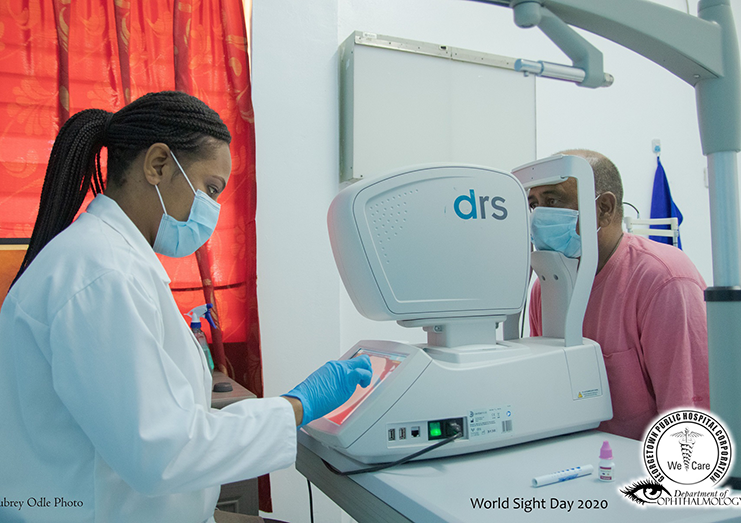
-local optometrists urge patients to have regular eye exams
By Naomi Parris
THE number of persons in Guyana who suffer from Diabetic Eye Disease (DED) is a cause for concern and it points to how little people may know of the effects diabetes can have to the eyesight.

Retinopathy Screening Centre of the Georgetown Public
Hospital Corporation (GPHC)
According to Dr. Fionna Todd, an optometrist attached to the Guyana Diabetic Retinopathy Screening Centre at the Georgetown Public Hospital Corporation (GPHC), there are many diabetic patients who are unaware of the long term effects the disease can have to the eyes.
The Pan American Health Organization (PAHO) disclosed that Guyana has an estimated number of 18,630 Guyanese who suffer DED, with nearly 5,000 of them at risk of losing their eyesight completely.
The leading cause of this is a condition called Diabetic Retinopathy (DR), which if not treated early, can lead to permanent blindness.
However, Dr. Todd noted that those numbers can be reduced if diabetic patients conduct regular eye screening exams.
In explaining how the eye screening examination is done, she said, “We start by taking a measurement of the patients visual acuity then we would put in some dilating eye drops so that we can get to see a clear view of the retina, which is the inner most layer, which would be screened to see if there is any diabetic related damage to the eye.”
She explained that after this step, the dilation process will begin and when the eyes are fully dilated, the optometrist will take various images from several angles of the retina to have a holistic view.
Dr. Todd added that patients who show no sign of the condition are advised to return to the clinic within a year to have the test redone.
Meanwhile, for the patients who have the condition, depending on the stage of the illness, they will be referred to an ophthalmologist, who will conduct a further evaluation.
“If the patient is found to have severe [Diabetic Retinopathy] or worse, then we would refer them immediately to another ophthalmologist so that they can be further evaluated and monitored at the eye clinic.”
She added, “According to how bad the condition is, that is how the follow up time will be, for various stages we will know when [the patient] can come back and check it.”
DETECTION KEY TO EARLY PREVENTION
Dr. Lani Lord, another optometrist, who is also attached to the Guyana Diabetic Retinopathy Screening Centre at the GPHC, highlighted the importance of diabetic patients having the test conducted regularly.
“For the persons who would have had diabetes for a while, either controlling or not controlling, it is important for them to be screened as well because diabetes causes bleeding in the eye which can eventually turn into blindness if they’re not checked or screened,” she explained adding that, “unless the patient is screened, we cannot know what is going on and most of them by the time it starts to affect their eyes, it’s already at a stage where treatment is meant to intervene or treatment is needed.”
Dr. Lord stressed that even if a person was recently diagnosed or have been diagnosed for a while, it is critical for him/her to have yearly eye screening to detect any diabetic eye diseases.
“It is always important for a diabetic patient to get their eye tested; whether they are newly diagnosed or diagnosed years ago it is very important.”
WATCH YOUR DIET
In Guyana’s food culture, starch is a major part of a Guyanese meal. However, what many diabetic patients are unaware of, is that starchy foods play a major role in spiking one’s blood sugar level.
Dr. Malissa Elias, the optometrist who is attached to the Enmore, Diabetic Eye Centre, explained that many diabetic persons believe that their blood sugar level is only measured by the amount of sugar they make take in but that is not the case since they are many other foods, such has starchy foods and fruits, that can add to a person’s blood sugar level rising.
For example she said, “I find that most persons are not aware that they need to be careful with their intake of fruits as well, because fruit has fructose which is converted to sugar actually.”




