






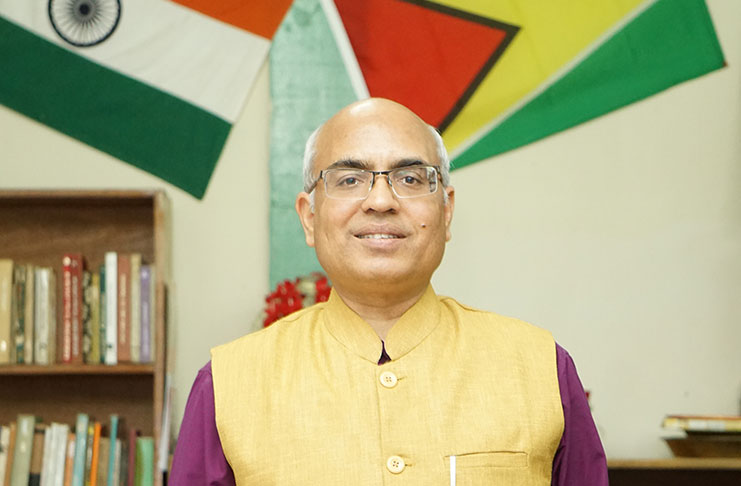
— visiting ICCR director-general ahead of Arrival Monument commissioning today
By Tajeram Mohabir
COUNCIL for Cultural Relations (ICCR) Director-General, Akhilesh Mishra, who is here for the grand opening of the Indian Arrival Monument in Berbice today, has praised Guyana for preserving its diverse cultures.
Contending that India has a lot to learn from Guyana as much as it can share, Mishra noted that his country is looking to deepen intellectual dialogue between the two nations to generate new ideas for cooperation and development.
Guyana and India established diplomatic relations in 1966 and ever since, the two nations have shared cordial and fruitful relations. However, India’s connection with Guyana dates back to May 5, 1838 with the arrival of the first batch of indentured Indian servants here to work on the sugar plantations.

Between 1838, and 1917, when the Indentureship System ended, some 240,000 Indians drawn from the states of Uttar Pradesh, Bihar and Madras (now Tamil Nadu), came to these shores
The monument at T junction, Palmyra Village, Corentyne, Region Six, built through funding from the Government of India, honours their arrival to Guyana.
It features a mounted bronze memorial that consists of artistic sculpted metal, depicting the lives of Indians in their daily routines.
Each of the figures carry something of importance – their jahaji bhandal (ship bundle) loaded with food, spices, herbs, clothing, jewellery, their gods, religious texts, drum, karaahi (cooking pan), taawa (flat circular metal for cooking roti), grass knives (scythe), cutlass and rice plants.
The figures are presented in a straightforward realism with the human factor ever present. Guyanese sculptors, Philbert Gajadhar and Winslow Craig, designed the statues, which were then sent to India where a world-renowned artist was employed to cast the figures.
SPECIAL IN INDIA’S HEART
Speaking with the Guyana Chronicle at the Swami Vivekanand Cultural Centre (SVCC), Bel Air, Georgetown, Mishra, who is on his first visit here, describes the commission today as historic.
He said Guyana is dear to the ICCR, the cultural relations arm of India.
He supported his point by pointing out that the SVCC, formerly the Indian Culture Centre, was the first of its kind to be established outside of India.
The centre focusses on strengthening cultural relations and mutual understanding between India and Guyana and their peoples. The centre runs regular classes in yoga and dance (kathak). Cultural events on festivals, mythology and works of eminent scholars and authors are also hosted at the centre.
Mishra, who noted the warmth and hospitality of the Guyanese people, said Guyana and India, in some respects, share a common history, both being former colonies of Great Britain, and culturally, there is much they can learn from each other.
The resilience of the Guyanese people, be it Indian, African, Chinese, Amerindian or Portuguese, and their efforts to preserve their culture here, the ICCR director said, is quite remarkable by any standard.
Strikingly, he pointed out, more than 180 years since the arrival of Indians in Guyana, the descendants of the immigrants have kept their culture intact.
REMARKABLE ACHIEVEMENT
This, he said, is a remarkable achievement when compared to other nations where Indians were taken during the Indentureship period.
Here, he said, there are valuable lessons his country can learn from Guyana as much as it can share in the areas of cultural preservation, literature and other art forms.
“I am inspired at the way Guyana has revived and preserved her culture. The devotion of the students to learn kathak (dance) and yoga at the swami Vivekananda Cultural Centre is touching and remarkable. As a parent, I want to learn from Guyana how it has managed to preserve its culture. Guyana is an inspiration!” he told the Guyana Chronicle.
During his visit, which ends on May 6, the ICCR director said he looks forward to meeting other ethnic cultural groups to lean more from them on how the arts and culture between the two nations can be deepened in contemporary society.
The ICCR issues 4,000 scholarships annually to students in the diaspora to pursue studies at the Bachelor’s, Master and PhD levels in a wide variety of areas.
At any one time, some 7,500 students from countries around the world are studying in India on ICCR scholarships. The organisation also hosts cultural seminars, conferences and festivals in India and abroad, as well as facilitate cultural exchanges between India and nations around the world. This has seen many cultural delegations from around the world visiting India to share their culture and experiences. India has also sent out many cultural delegations to different parts of the world to share its culture and experiences to build a unified world, where all exists in peace and harmony.




