






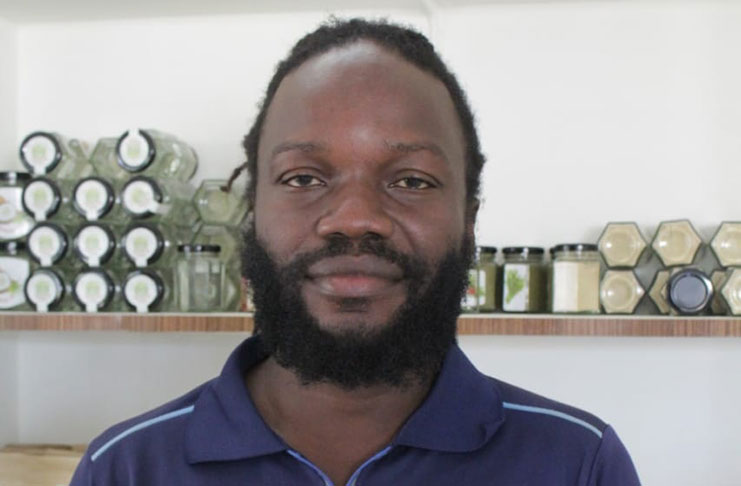
FOR years, the Jacobs family has been involved in agriculture. But now the family has decided to take their farming to another level: agro-processing that involves making unique products out of the common local produce while maintaining international standards.
You could say that the Jacobs’ farming transformation is being heralded by a son of the soil, Mark Jacobs. He’s 45 years old and is from Stanleytown, on the West Bank of Demerara (WBD)- right where the farm is located.
“My family has always been involved in agriculture… we grew up on a farm,” Mark shared. “I love agriculture. I love what I’m doing.”
The man studied aviation and financial analysis in the years gone, but in 2012 he returned to Guyana- back to his roots. What he’s doing, is working as a full-time farmer with family and employees every day on their farm to produce things like ginger, turmeric, cassava, celery, parsley, pepper, fruits, cassava, dasheen, and other ground provisions- all of which he listed without skipping a beat.

But more importantly, what he has done is introduce a greater focus on processing and packaging.
“If you’re a farmer it doesn’t make sense to sell fresh produce… there’s the farmer, the middle man, and the people who sell in the market. So for me, it never made much sense to just plant and sell, so the next step was to process,” he explained.
On the farm, there’s no regimented schedule. Mark shared that the farmers try to get there for 06:30 hrs.
“Most of the time is spent either filling in new plants or clearing… we try to plant couple hundred trees every month – either coconut, citrus fruits or other fruits and vegetables, or if we’re harvesting or planting turmeric or ginger. Something is always going on,” he said.
At Jacobs’ farm, he explained that natural controls are used. There is a focus on growing natural produce because it just makes better products. And with good products, he said, the family was confident that the products would be sold easily and so he said, “The first thing was to actually start making these products.”
Some of the products are sold locally- in restaurants and shops- while some are sold in regional and international markets.
In terms of agriculture here in Guyana, finances might be the biggest challenge, according to Jacobs.
“You find that farmers won’t be able to access funds to grow their businesses… I think many agro and agro-processors in Guyana operate in survival mode,” he said, and added: “Another problem, in the local industry, is the lack of standards also.”
Cognisant of these is what enables the business to enjoy its successes, according to Mark.
“We always maintain a high standard so that it is easier to export our products outside of Guyana. Our package must meet the basic international standard so that it can go to those markets,” he said.
In fact, the family does their own packaging at two locations: In Kuru Kuru and in Republic Park. And what’s great is that there is focus on using less plastic, as part of environmentally friendly efforts.
FUTURE PLANS
The family isn’t anywhere close to being finished. The aim, as related by Mark, is to keep growing the business.
In so doing, the family is making a larger place for processing in Georgetown. The place is expected to be completed before the end of March, and it will be both a packaging plant and a showroom for the Jacobs’ products.
Jacobs also shared that in growing the business, it is their hope to employ many more persons in the field- particularly folks from Stanleytown and in Kuru Kuru, where the business has a deep connection with the people.
In the future also, he related, there are plans in place to construct a facility to process cassava into flour, cassareep, cassava bread, and starch.
“I think where we’re heading is where the industry needs to go,” he said.

Lending credence to this, was Minister of Finance Winston Jordon who recently checked out the work of the Jacobs’. Mark indicated that the government has connected with the business to engage in certain projects that could boost the field.
He also indicated that the business is focusing on data collection too, and said: “Everything we do, we produce, we want to take account of it.”
This move aligns with the international focus being placed on traceability, where agro-businesses need to account for each ingredient used in production, provides insight into the supply chain and ensures compliance and safety.
Aside from expanding and development, Mark also shared that the family business is looking to train about 300 young people a year- and engage in school tours.
All in all, he affirmed that the Jacobs’ farm business is only going to get bigger and better in Guyana.



