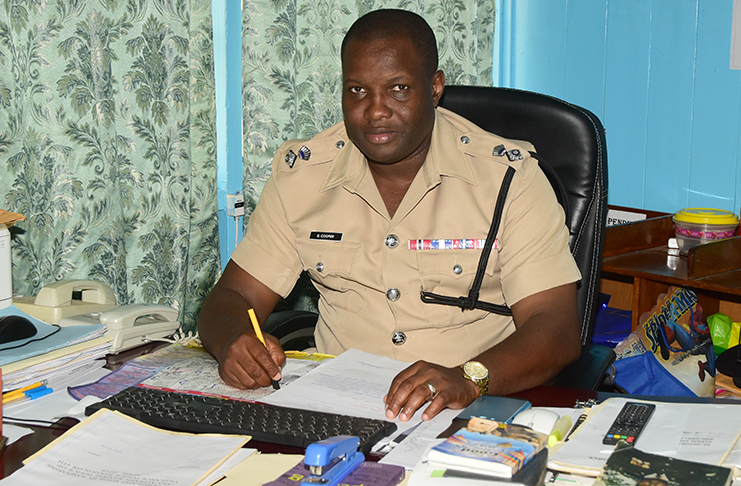
– Commander Cooper tells students
“Crime and deviant behaviours don’t pay,” ‘D’ Division Commander, Senior Superintendent Edmond Cooper said in a charge to Uitvlugt Secondary school students on Tuesday.
The commander offered the advice after ranks made presentations in the areas of Drug Abuse Resistance Education, sexual offences, traffic and road safety, among other areas at the West Coast Demerara school.
He said young people can keep on the safe side of the law by educating themselves which will also enable them to lead healthy and productive lives.
According to Commander Cooper, many youths commit minor offences infrequently which do not come to the attention of the police and noted that their actions are due to several reasons.

These, he said, includes being born into a family that values anti-social behaviour or lacks effective parenting skills, peer group influence, neighbourhood and community factors, and low socio-economic status.
He noted that it is not just the external environment that negatively affects some children and pointed to their transition from primary to secondary school as an example.
“It involves the movement from one teacher to multiple teachers, a few subjects taught in one classroom by one teacher to multiple subjects taught by a number of teachers in different classrooms, differing teaching styles, greater and more complex academic demands, and greater demands for self-monitoring and self-reliance, with the need to move around several classrooms,” he said.
This transition period, he said, is especially risky for girls, who are more likely than boys to experience pubertal maturity at the same time as they experience the transition from primary to secondary school.
“Because they assemble together, large numbers of at-risk youth, schools can become breeding grounds for the development of criminal offending, especially where there is little adult supervision. Both inside and outside the classroom, students develop social hierarchies and groups that have a significant influence on their performance and play a large role in shaping both their appropriate and inappropriate behaviours,” Commander Cooper underscored.
He said early intervention plays an important role in keeping minors from embarking on deviant behaviour or even a life of crime.
The Guyana Police Force, he said for its part, plays an important role in educating students and improving communications between law enforcement and youths.
“It keeps officers safer and helps officers develop relationships with youths that can yield helpful information. Good communication means that interactions don’t escalate into complicated situations and result in unnecessary arrests.”
The senior superintendent also said a single conversation cannot address every issue affecting youths, noting that the process requires multiple conversations before the youth and the police could find common ground.
Deputy Commander, Superintendent Dion Moore, who also spoke to the students, said the division will continue its outreach to schools in the new year.