
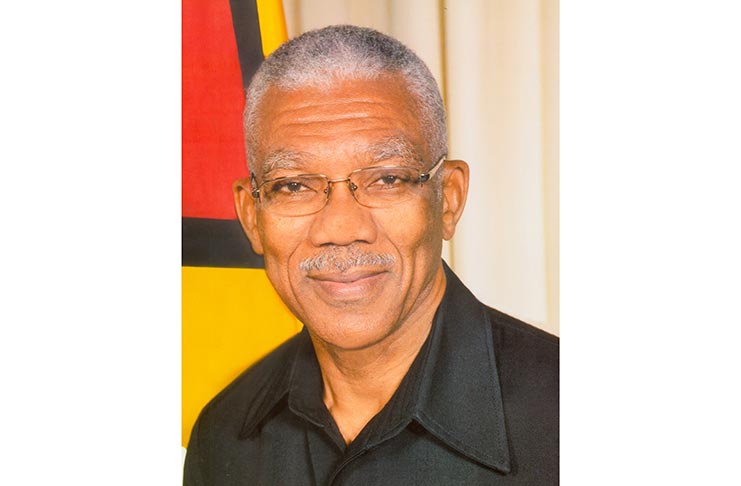
-President Granger
PRESIDENT David Granger said Guyanese should be pleased with the decision of the Caribbean Court of Justice (CCJ) to uphold the constitutional amendment on term limits for executive presidents in Guyana.
“The constitution is clear, and I think that the CCJ has spoken what the majority of the Guyanese people feel is embedded in the constitution, that is, no president would be eligible for election more than twice, and I think the Guyanese population should be happy with that ruling,” President Granger told the Guyana Chronicle.
At the time he was attending the CARICOM Heads of Government Conference in Jamaica on Thursday. Last month, the CCJ, by a 6-1 majority overturned the High Court and Court of Appeal ruling in the presidential term limit case here and declared that Section 2 of the Constitution (Amendment) (No 4) Act of 2000 was a constitutional amendment to Article 90 of the Constitution of Guyana.
The then CCJ President Sir Dennis Bryon and Justices Adrian Saunders, Jacob Wit, David Hayton, Maureen Rajnauth-Lee and Denys Barrow all ruled that the two-term presidential limit here is constitutional and does not infringe on the rights of any citizen to so choose a president of his or her choice. Justice Winston Anderson, however, was the dissenting voice.
“With all things considered, we are satisfied that the case is not made out to disturb the will of the people expressed through the Act, considering as we do that it did not dilute democracy in, nor undermine the sovereignty of the people of Guyana,” the CCJ held.
In handing down the decision, Sir Dennis Byron said that Cedric Richardson was misguided in law, when he took the decision to challenge the amendments made to Article 90 of the Constitution that were enacted in 2000 following a bipartisan Constitutional Reform Process.
Article 1 states that “Guyana is an indivisible, secular, democratic, sovereign state in the course of transition from capitalism to socialism and shall be known as the Co-operative Republic of Guyana” and Article 9, states that “Sovereignty belongs to the people, who exercise it through their representatives and the democratic organs established by or under this constitution.
The then CCJ President in making the ruling stated clearly that the amendments were never unconstitutional, while noting that Guyana remains a democratic sovereign state.
It therefore means with the ruling in effect, former President Bharrat Jagdeo cannot run for a third term in office.
It was just before the 2015 General and Regional Elections, when, Richardson, a resident of Georgetown, challenged the amendments made to Article 90 of the constitution and many had drawn the conclusion that the constitutional challenge filed by Richardson was engineered by Jagdeo.
Former Chief Justice (ag) Ian Chang had in July 2015 ruled in favour of Richardson, which in effect prompted the Attorney General Basil Williams and former Speaker of the National Assembly Raphael Trotman, the named parties, to appeal against the ruling. Justice Chang had said Article No.17 of 2001 is without legal effect, because it does not comply with other articles of the constitution dealing with repugnancy, democratic society and sovereignty belonging to the people which require a referendum for any alteration.
Chang had reasoned that Articles 1 and 9 underpin the republican commitment to the fundamental concept of popular sovereignty or imperium populi, thereby safeguarding against elective despotism by the elected representatives of the people.
The Court of Appeal by a two-one majority in February, 2017, upheld Chang’s ruling that the presidential term limit is unconstitutional and void. Now retired Chancellor of the Judiciary (ag) Carl Singh, and Justice BS Roy upheld the High Court ruling handed down by former Chief Justice (ag) Ian Chang, while then Chief Justice (ag) now Chancellor (ag) Yonette Cummings-Edwards had disagreed.