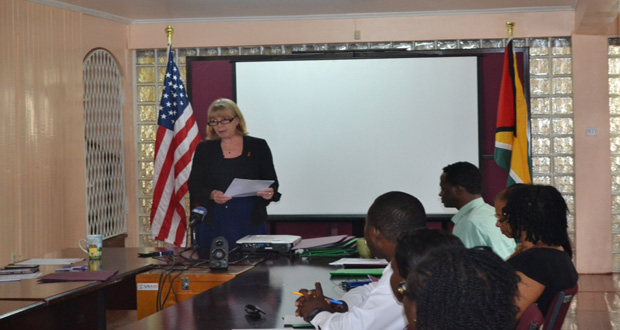
ADOLESCENT children in Guyana are requesting more information on sexuality but the United Nations Children Fund (UNICEF) office here is concerned that the age of consent, being 16-years-old, is a factor that hinders the testing of sexually active adolescents for HIV/AIDS.This was revealed by UNICEF Resident Representative Marianne Flach yesterday when she addressed stakeholders at a Children Rights workshop organised by the Society Against Sexual Orientation Discrimination (SASOD) and the Advancing Partners and Communities (APC) NGO, a project funded by USAID and other international partners.
The forum was held at APC’s offices in Bel Air Park in the city.
Flach said that research undertaken among teenagers in Guyana revealed that adolescents are asking for more information on sexuality.
To this end, she said the organisation is confident that comprehensive sex education programmes will be offered in schools either as part of the HIV curriculum or to fulfill this need.
In addition, of much concern to UNICEF is the age of consent here, which is 16 years, and in the scenario Flach said it requires authorisation of the parent for persons at and below the age group who are sexually active to undergo an HIV test. She said that it was generally reported as a prohibited service by parents.
Importantly, she said, global statistics indicate that 25 children, up to age 14 years, still acquire HIV each hour.
She said that for children living with HIV, the stigma and discrimination exist despite many global efforts to reduce the burden for those affected by the disease, and she noted that they are the ones who are disproportionately affected.
VULNERABILITY
The UNICEF representative said that children can be made vulnerable due to the loss of one or both parents or a caregiver who passed away as a result of contracting HIV/AIDS.
She noted that they can also bear the burden of infection themselves, through mother-to-child transmission and they often live a lifetime battling a disease which they are too young and ill-equipped to address.
“They may turn into confused and angry adolescents and this is why sensitive, child-friendly services that protect, treat and respond to children affected by HIV /AIDS are so critical,” Flach informed.
For adolescents, a comprehensive health and family life education and access to youth-friendly services can greatly reduce the spread of HIV among that population.
Flach said global statistics indicate that only 26 per cent of girls and 33 per cent of boys have a full understanding of how HIV is transmitted and can be treated. In addition, an alarming figure of girls in the 15-19 age group make up the majority of teen HIV infections worldwide.
Over the years, UNICEF has been providing support to a number of NGOs in addressing HIV/AIDS. One such organisation in Region Six has implemented a programme which teaches life and livelihood skills to adolescents who are living with HIV.
“These young people have been educated on secondary prevention, side effects, disclosure, family and peer support,” Flach said.
In addition, UNICEF has supported the National AIDS Programme Secretariat (NAPS) in hosting a camp for children living with HIV as well as those who are orphans and made vulnerable by the disease.
“We will continue to broker this area to ensure that all children affected by HIV in Guyana are protected and supported,” Flach told those gathered.
On the global front, UNICEF continues to engage partners to forge HIV prevention and treatment available as much as possible, including in remote areas and for children in marginalised populations. However, Flach said that more needs to be done to support women, children and adolescents to get tested and continually use treatment for the disease.
It was noted too that although instances of stigma and discrimination have been decreasing, a greater effort is needed to completely eliminate the trend. This is against the backdrop of figures of a recent survey which indicates that only 23 per cent of both women and children ages 15 to 49 express “expectant attitudes” towards persons living with HIV.
At the moment, the Caribbean is gearing towards being the first region worldwide to eliminate mother-to-child transmission of HIV. Flach said it is a promising development, which Cuba has already achieved and other countries such as Jamaica are moving closely behind.
SEXUAL VIOLENCE AND HIV TRANSMISSION
Flach also reminded participants of the link between sexual violence and transmission of HIV. This, she said, is especially notable given the “almost daily reported cases of domestic violence and violence committed against women and children”. She said if one is silent about violence, he/she may also be silent about HIV.
Earlier, Folami Harris, the Chief of Party for APC, noted that there is a limited number of persons “on the frontlines” addressing children issues. She said teachers are not always in a position to assist vulnerable children and caregivers and NGO staff also cannot give full assistance. She said it is a reality which needs to be changed.
“We have a heavy responsibility as the protectors of children, we protect children, we protect ourselves,” Harris posited.
SASOD’s Managing Director Joel Simpson said the collaboration with APC to host the workshop was considered to focus on the rights and issues affecting orphans and other vulnerable children in Guyana.
The workshop was held on the heels of World Human Rights Day, which was celebrated on Thursday, December 10. This year’s activities were held under the theme “Our Rights. Our Freedoms. Always”.