





— destiny as Caribbean bread basket soon to be realised
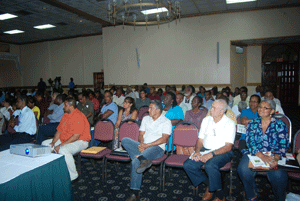
THE Ministry of Agriculture launched its ‘Assembly of Hydroponic Vegetable Producers’ at the Pegasus Hotel yesterday, and its aim is to reduce risks to farmers in event of severe flooding.  A collaborative effort between the government of Guyana, the Pan American Health Organisation (PAHO), the United Nations Children’s Fund (UNICEF), Food and Agriculture Organisation of the United Nations (FAO), and the Inter-American Institute for Cooperation on Agriculture (IICA), hydroponics is currently being practised in Regions 2, 3, 4, 5, 6 and 10.
Delivering the feature address, Agriculture Minister Dr. Leslie Ramsammy noted that the ‘Assembly of Hydroponic Vegetable Producers’ represents an important part of the life of the country, and is an emerging trajectory of the country’s development.
Ramsammy boasted that Guyana has reached a stage where its destiny as “the bread basket of the Caribbean” can soon be realized, as its pursuit of new technology and ways of doing things will make this a reality.
“(The) Guyanese family has adapted to new technology in an opportunistic and positive way, and this assembly is testimony to the fact that we are into new technology,” Dr. Ramsammy asserted.
The Agriculture Minister posited that farmers should not focus on a livelihood of subsistence farming only, being content at merely providing food for the family, but should also provide for the country, and by extension for export purposes. He reminded that “agriculture is more than just putting food on the table.”
“I want to encourage you to pursue loftier goals, goals of generating wealth through agriculture, and not stick to the day-to-day subsistence production,” Ramsammy added.
Regarding the importation of food, Dr Ramsammy encouraged Guyanese to diversify the options offered to the Guyanese people, adding that there is opportunity to reduce the food import bill, as some things that are bought can be substituted with locally grown products.
He made reference to the fact that, in Region One, potatoes, ginger and other spices are grown. He added that farmers can find ways to make such production feasible, hence reducing the level of food imported.
Speaking on the issue of climate, Ramsammy aired his belief that Guyana has to grow food in a temperature-smart way,  so it will not be affected by the changing climate.
Turning his attention to exportation of food, Dr. Ramsammy said he believes that Guyana has reasons to sing its own praise, since it has come a far way in this regard. Over the last year, Guyana has exported some 11,000 tonnes of cash crops to the Caribbean and North America.
While Guyana has made tremendous progress in this regard, Dr Ramsammy believes the country can do better, and adopting new technologies and being open to new techniques stands as testimony.
Meanwhile, Country Representative of the Inter-American Development Bank (IDB), Ms. Sophie Makonnen, told the gathering that the project is aimed at ensuring farmers have better production. She said the project aims to protect farmers from the effects of floods.
She boasted that the project is deemed one of the most successful, having surpassed its target. The project also promotes private sector growth.
Acting Representative of the Inter-American Institute for Cooperation on Agriculture (IICA), Dr. Maxine Parris-Aaron gave a background to hydroponic vegetable cultivation in Guyana. She emphasised the importance of hydroponics in Guyana, and recalled that it was introduced as a flood mitigation measure.
In reaffirming support for the project, she noted that the FAO has provided training for some 38 secondary school students.
She happily reported that the new technology has been adopted by the Ministry of Education in Guyana, and has been introduced to secondary schools as an integral component of the environmental and agricultural science programmes. It has also formed part of the School Based Assessment (SBA) for Caribbean Secondary Examination Council (CSEC).
“Food security, disaster mitigation and agricultural diversification form a link to hydroponics which facilitates access to fresh food all year round,” she declared.
IICA has trained in excess of 380 secondary school students, 38 teachers, and 300 individuals in hydroponics.
Dr. Parris Aaron reaffirmed IICA’s commitment to ensuring sustainable development of the project, and other venture of a similar nature in Guyana. She disclosed that IICA will be partnering with the FAO to provide support for hydroponic technology in two of Guyana’s hinterland areas.
First Lady Deolatchmie Ramotar was also present at the event. She recently launched a ‘Garden for the children of Guyana’ initiative on the lawns of State House. The initiative is aimed at fostering healthy eating habits among young people, and allows inner-city youths to acquire the gardening experience of their rural counterparts.





