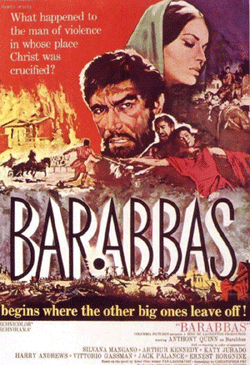
IF WE stick to pursuing the theme of Mangano’s creatively subconscious attraction to inhabiting and exhibiting qualities of body and soul in her screen roles, we can skip a notable film like the tough pro-feminist all-girl ‘FIVE BRANDED WOMEN’, directed by the always touching and humane American, Martin Ritt, and focus on the significantly unique yet somewhat ignored ‘BARABBAS’ of 1961, also produced by De Laurentiis.  We should also permit ‘Barabbas’ to give us a little more time with the other half of this dynamic professional/conjugal pair, Mangano’s producer/husband, Dino de Laurentiis.
The professional success of De Laurentiis is obviously not solely related to the transfer to film production of profits from the spaghetti factory his father founded, but to his own early teenage interest in all aspects of filmmaking, when, at 17, he studied for two years at Rome’s ‘Experimental Film Centre’ among a number of other rising stars in Italy’s post-war film boom.
His dedication to producing, along with his great colleague film producer, Carlo Ponti, built the huge ‘Dinnocitta’ studio which helped make Italy one of the best film producing countries throughout the 1960s, until too many maverick entrepreneurs bought into the industry; traded shares skyrocketed while quality fell; and the entire Italian film industry went bust. To this day it has not got back on its feet to a similar extent.
De Laurentiis moved to the US, where he set up another studio away from Hollywood (Marcello Mastroianni didn’t jump at an offer to work for it), but before that, went bankrupt through sheer fatigue and age; his films had not only made a bundle for both the studio and the diverse artists it employed, but showed exemplary taste and risk in bringing to the screen outstanding contemporary films like Roger Vadim’s ‘BARBARELLA’ (1968); Michael Mann’s ‘MANHUNTER’ (1986); and Curtis Hanson’s ‘THE BEDROOM WINDOW’ (1987), among others.
‘Barabbas’
‘BARABBAS’(1961) directed by the American, Richard Fleisher, a flexible all-round director who proved his skill at handling indoor space and surprising outdoor action in such film classics as ‘THE NARROW MARGIN’ (1952); ‘BANDIDO’ (1956); and ‘THE VIKINGS’ (1958), is a film so subtly nuanced it can appear sketchy and naïve, when, in fact, it slowly and powerfully builds its mystical theme of life’s dual nature via a rich variety of characters.
Compared to other big-budget epics like ‘BEN-HUR’ of 1959, and ‘EL CID’ of 1961, in the same period, ‘Barabbas’ was overshadowed by the ‘star promotion’ of these two Box-Office hits, and in comparison was considered a flop. Yet, even in its superb and wide cast line-up, Anthony Quinn, Silvana Mangano, Kathy Jurado, Arthur Kennedy, Victorio Gassman, Jack Palance, Ernest Borgnine, among others, ‘Barabbas’ outshines ‘Ben-Hur’ and ‘El Cid’ and shows us how De Laurentiis distributed work to these famous effective actors whose roles in the film channeled meaning and values away from one ‘superstar’ or ‘superhero’ towards unforgettable collective characterizations.
From the film’s first scene, the duality yet contrasting values pertaining to the theme of body and soul is established when Barabbas, a thief, killer and crude lecher, played brilliantly by Anthony Quinn, is set free by the choice of the masses, while Christ, a stoic ‘loser’ who sees something more fulfilling than the material ‘success’ of mundane vanities, is condemned to death via crucifixion by both the local social leaders of the Roman colony, and the resident Roman powers-that-be.
Barabbas is the material world’s ‘body’, driven to satisfy its corporeal pleasures in ultimate futility, while Christ is the world’s ‘soul’, humbly participating in the pleasures of mortality, not as a yardstick to ‘success’, but representing an imaginary or invisible pleasure beyond earthly temporality that is the ‘soul’ of life’s mortal forms.
Barabbas’s freedom will remain indebted to Christ’s condemnation in a dual logic, as the film, like all great art, builds into a strong and gripping paradigm of how opposites either find ‘higher’ resolution, or remain in stagnant duality.
Mangano’s quiet mastery
Silvana Mangano’s performance in ‘Barabbas’ as the poor converted follower of Christ, living among derisive wanton women and wine-drunk criminal men in colonised Jerusalem occurs only in the film’s first half-hour. But it is a deeply humble and spirited performance, deliberately down-played by the camera, which emphasises her bare feet, her shabby clothes, pale shrouded features, quiet speech, etc.
She was once Barabbas’s favourite girl among the loose, dancing women of a tavern/brothel, but he returns to find her changed, refusing his sexual advances, not outright, but dependent on his conversion as well to the teachings of the same man whose condemnation provided his freedom.
The film’s dualities spin like the planets themselves, and when we see Mangano’s pale figure resisting Barabbas in bed, it is filled with her mastery of corporeal significance, where sexuality and the body’s pleasure is not denied, but lifted into a higher ecstatic plane, where the ‘soul’ is a pleasure present, but without proof.