






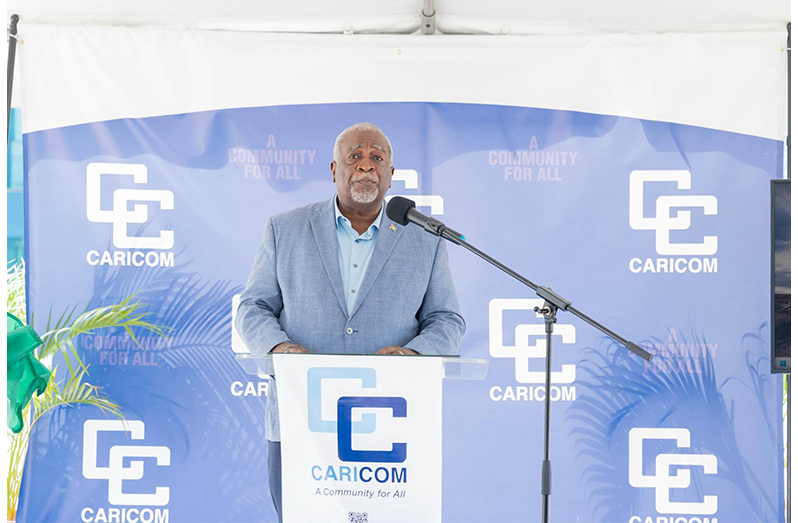
— PM Phillips says energy investments must improve livelihoods, drive economic growth and strengthen climate resilience
GUYANA is targeting 100 megawatts (MW) of installed solar photovoltaic capacity by 2031 as the government accelerates its renewable energy programme and expands electricity access across hinterland, riverine and remote communities.
Prime Minister Brigadier (Ret’d) Mark Phillips, performing the functions of President, announced the target during his feature address on Friday at the opening of the CARICOM Energy Fair 2026 at the Arthur Chung Conference Centre, Liliendaal.
The Prime Minister emphasised that while expanding generation capacity remains a national priority, the success of energy investments must ultimately be measured by their impact on citizens’ lives.
“Our success will ultimately be measured not only by the energy we produce, but by the extent to which our investments improve livelihoods, drive economic growth and build a more sustainable and resilient future for generations to come,” he said.
Between 2020 and 2026, Guyana added 13 utility-scale solar farms, 57 solar mini-grids, three hydropower plants and 239 rooftop solar photovoltaic systems.
Additionally, 37,730 solar home energy systems were distributed, with these initiatives collectively contributing to the country’s total installed renewable energy capacity of 45 MW.
PM Phillips said the government will continue deploying solar mini-grids and rooftop systems to serve public and community buildings, alongside upgrades to existing infrastructure.
Renewable energy is also being integrated into eight water treatment plants and the Cheddi Jagan International Airport (CJIA).
Under the Low–Carbon Development Strategy (LCDS) 2030, the government’s wider objective is to deliver more than 500 MW of new installed generation capacity through a diversified energy mix comprising natural gas, hydropower, solar, wind and other technologies.
BUILDING LOCAL TECHNICAL CAPACITY
The Prime Minister underscored the importance of developing the technical expertise required to support Guyana’s evolving energy landscape.
He called for stronger technical training to equip Guyanese with the skills needed to operate, maintain, and manage modern energy systems.
Phillips noted that the CARICOM Energy Fair provides an opportunity for citizens, particularly young people, to interact with industry professionals and gain practical knowledge of renewable energy and energy-efficient technologies.
“I encourage everyone, particularly our young people, to take full advantage of the exhibitions and demonstrations. Ask questions, explore the technologies on display and consider how the knowledge gained can be applied in your homes, schools, workplaces and communities,” he said.
OVER 250 PUBLIC BUILDINGS TARGETED
Beyond expanding electricity generation, the Prime Minister stressed that improving energy efficiency remains equally important to achieving national energy objectives.
Through the Caribbean Efficient and Green Energy Buildings Programme, Guyana is advancing energy audits, renewable energy integration, battery storage and energy management measures targeting more than 250 public buildings.
Phillips also encouraged households, schools and businesses to adopt responsible energy consumption practices, including switching off unused equipment, properly maintaining appliances and investing in energy-efficient models.
Such measures, he noted, could reduce electricity demand and lower energy costs.
Turning his attention to the wider Caribbean, the Prime Minister highlighted persistent challenges facing the region, including high energy costs, dependence on imported fuels and the vulnerability of critical infrastructure to climate-related hazards.
He called for climate resilience to be incorporated into the planning and design of energy infrastructure to ensure essential services can continue operating during disruptions.
Phillips also emphasised the importance of regional cooperation in accelerating the Caribbean’s energy transition.
“Regional cooperation provides opportunities to exchange technical expertise, mobilise investment, strengthen institutional capacity, share best practices and accelerate the deployment of appropriate energy technologies. By working together, CARICOM Member States can strengthen energy security, advance sustainable development and build greater resilience across the region,” he said.
The Prime Minister commended the Guyana Energy Agency (GEA), the CARICOM Secretariat, exhibitors and participating organisations for their contributions to CARICOM Energy Month before officially declaring the 2026 Energy Fair open.
Among those in attendance were CARICOM Deputy Secretary-General Dr. Armstrong Alexis; Chief Executive Officer of the Guyana Energy Agency Dr. Mahender Sharma; and Programme Manager for Energy at the CARICOM Secretariat Sandra Britton.
Executive Director of the Caribbean Centre for Renewable Energy and Energy Efficiency Dr. Mohammad Rafik Nagdee, participated virtually.




