






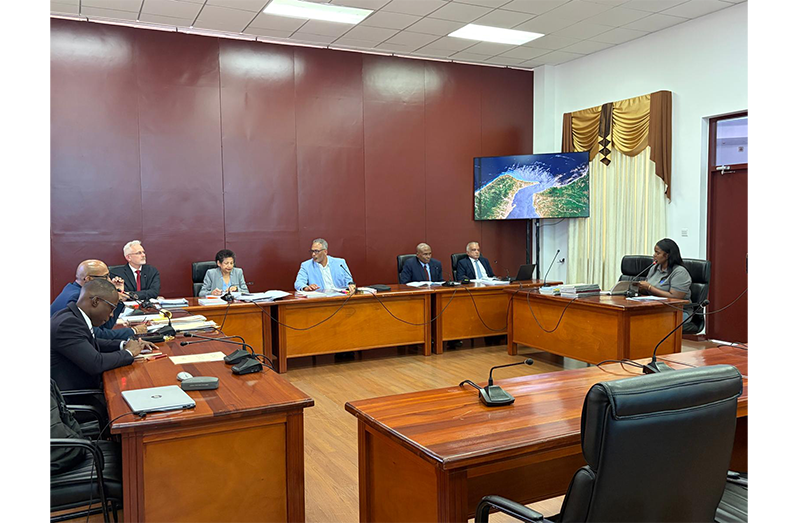
A TRANSPORT and Harbours Department (T&HD) checker described to the Presidential Commission of Inquiry into the sinking of the MV Barima a handwritten, layered system for documenting cargo before it is loaded.
She has appeared three times so far and will return next week to present even more records at the commission’s request.
Kessa Case, a Clerk III at the Kingston Wharf, is soft-spoken and answered questions that were asked of her by commissioners.
She said the process starts when cargo arrives at the bond in the days before departure. The checker examines the cargo, enters it in a ledger and issues the customer a slip. The customer takes it to the cashier, pays and returns with a receipt. The checker records the receipt number, and only then is the cargo allowed to be loaded.
Case said different cargo types are documented in separate slip books. These cover general goods, bags and gas, and perishables. She said each type arrives on a designated day before sailing, and the superintendent publicises those days.
Case explained that while the slips are printed and numbered, and because checkers share each book, the numbers do not always run in sequence.
Commissioners examined the books, which showed that several entries carried a slip number but no corresponding receipt number. Case said customers do not always return, and that she then checks the manifest to see whether payment was made. For one customer, she assumed payment would be made at Port Kaituma. Under questioning, she accepted she did not know how the process “over there” worked. She said cargo can sometimes be loaded before payment is made.
There are exceptions to the general procedure. Regular customers moving goods from Georgetown to Barima-Waini, Region One, may not be at the wharf in person. For them, a “to pay” list is prepared to show the auditor that payment will be made “on the other side”. That means at the destination, before the cargo leaves the bond there.
Case said the list is a collective, handwritten sheet given to the cashier, and that it then goes to head office.
She produced earlier lists, some marking items as paid or not paid. No such list was prepared for July 18. Case said the day was extremely busy and the hours went by, and then the tragedy followed. She could not recall another day when the list was skipped.
Case acknowledged removing a carbon-copy page that sat immediately before her first July 14 entry. She said she had no specific reason and that carbon copies are usually discarded.
She explained that numbering restarts at one with each new shipment. Upon inspection, the page after the removed one is numbered one with no sign of alteration. Case also said her Thursday statement that she worked on July 13 was a mistake, and that she began on the 14th.
On her third appearance, late on Friday, Case returned with further records, including slip books and past “to pay” lists. She agreed to supply the checkers’ WhatsApp communications. She was asked to return next week when the inquiry resumes.
Lolita Amsterdam, a charwoman with 17 years at T&HD, nine of them at the Kingston wharf, said she boarded the vessel on the morning of July 18 to buy food. Testifying at the CoI on Friday, she said she saw bags of potatoes and onions on the passenger deck, and that she reported it to her supervisor. Commissioners commended her for what they called helpful testimony.
Labourer Wilfred Hunte said he boarded at about 1 p.m. and saw gas cylinders standing in a passage near the canteen. He said he saw nothing abnormal. A commissioner said he had brought information the commission had not heard in some time.
Labourer Shondell Richmond, who lost two friends on the Barima, said he helped pack potato sacks onto pallets and took ice and water to the workers loading the hatch.
Forklift operator Tromain Duncan said he moved pallets from the bond to the wharf. He did not check, weigh or record the cargo. He suggested a shorter distance between the bond and the wharf, because rain can damage goods in transit.
The commission said its terms of reference require it to recommend a more robust and auditable system.
The inquiry continues on Monday.




