






AT the inaugural Global Biodiversity Alliance summit in July 2025, President, Dr Mohamed Irfaan Ali, announced that Guyana was aiming to become the first country in the world to develop a national ‘border-to-border’ biodiversity monitoring initiative (NBMI).
According to a press release from Iwokrama, the aim of the NBMI is to collect data using a standardised approach that will allow for local and national decision making, fulfilling international reporting requirements and providing the information required for various biodiversity finance schemes.
Spearheaded by the Environmental Protection Agency (EPA), a consortium of organisations including the Yale Centre for Biodiversity and Global Change (Map of Life), Landscape Alliance (CIFOR-ICRAF), the Field Museum and Iwokrama International Centre for Rain Forest Conservation and Development have partnered to establish the initial data-collection framework for the Iwokrama Forest which has been selected as the pilot site for the NBMI.
The framework will combine various biodiversity monitoring tools including camera trapping, passive acoustic monitoring, environmental DNA and satellite observation to develop the most cost-effective and scientifically robust approach for collecting data.
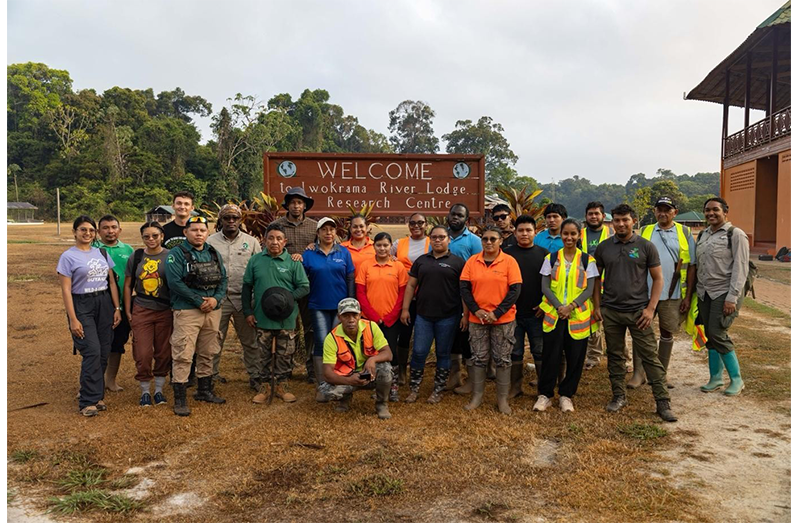
To kick off the first round of data collection, a training session was held on 9th and 10th November at Iwokrama and included staff of Iwokrama’s Monitoring Unit, along with representatives from Landscape Alliance, the EPA, the Guyana Wildlife Conservation and Management Commission, the Protected Areas Commission, the University of Guyana and Frankfurt Zoological Society.
The sessions equipped participants with the skills to deploy camera traps and passive acoustic monitoring devices as well as how to navigate using a GPS.
Leading the design of the data-collection framework is Neal Millar, Biodiversity Coordinator for Landscape Alliance.
Millar highlighted the importance of the NBMI, stating, “Guyana’s biodiversity represents an important natural asset, both nationally and globally. Realising its value and ensuring its long-term protection requires a strong foundation of reliable information”.
The NBMI is working towards establishing a coordinated, science-based approach to understanding and monitoring the country’s ecosystems and species over time.
This data will feed into the National Biodiversity Information System (NBIS) which will be housed at the EPA.
By generating credible evidence on the status of biodiversity and how it is changing, the initiative will help inform conservation priorities, strengthen national decision making and create opportunities to better recognise biodiversity within Guyana’s sustainable development and emerging nature-finance framework.
The year 2030 has been identified as the target for implementation of the NBMI. Over the coming years, additional sites will be identified across Guyana where the standardised data-collection protocol will be adjusted and implemented until the full border-to-border systems is established.
Dr Raquel Thomas, Director for Resource Management and Training at Iwokrama, joined the teams during the training, and highlighted, “Iwokrama is the pilot site for the Government of Guyana’s biodiversity monitoring system, which is being established with the EPA as the lead along with partners. Iwokrama Forest works well as a pilot site, because it is a Protected Area of a million acres of intact tropical rainforest that has the majority of forest types found in Guyana. Additionally, through a long-term, established Monitoring Programme, Iwokrama boasts a consistent dataset of close to 20 years.”
Kemraj Parsram, Director of the EPA, shared that “The combination of the NBMI and NBIS will enable continuous monitoring of Guyana’s biodiversity by integrating existing and new data. It will support tracking and reporting on progress towards global commitments, inform biodiversity-financing decisions, and help identify opportunities to build on existing MRV approaches to support biodiversity credits. He also welcomed the continued partnership and collaboration on the initiative, highlighting its potential to benefit Guyana and, ultimately, the global community”
The NBMI and NBIS will be a fully owned Guyanese system where all data collection, analysis and implementation will be conducted by Guyanese institutions.
Over the next eight months, the rangers from Iwokrama with some partner assistance, will continue to collect data which will then be analysed to determine the biodiversity that is located within Iwokrama.




