






–intended to improve payment flexibility and safeguard project timelines
THE government has tabled four amendments to financing agreements supporting the US$-backed Gas-to-Energy Project and the new arrivals terminal at the Cheddi Jagan International Airport (CJIA), aimed at streamlining disbursements and ensuring the timely execution of both major infrastructure developments.
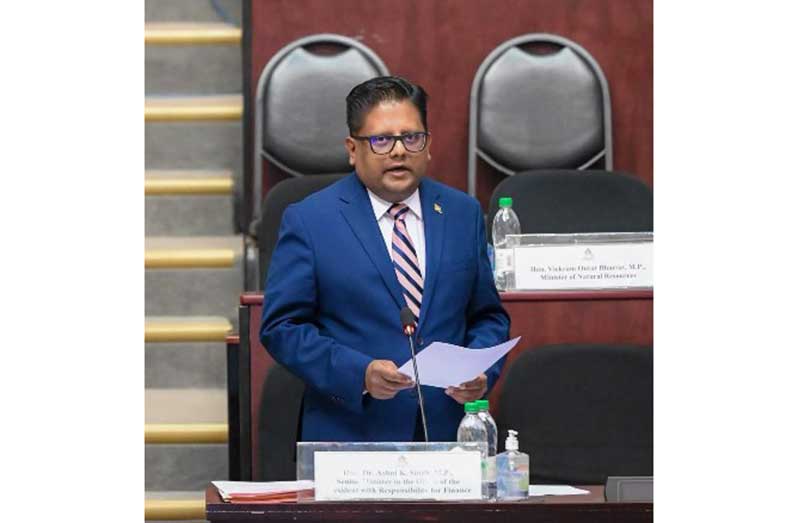
Senior Minister in the Office of the President with Responsibility for Finance, Dr Ashni Singh, tabled the amendments in the National Assembly on Wednesday, November 18, 2026, as part of the government’s commitment to transparency and accountability in the management of public finances.
Two of the amendments relate to the credit agreement with the Export-Import Bank of the United States (US EXIM), which finances the Gas-to-Energy Project, while the other two concern the financing facility provided by Banco Santander, S.A. for the construction of the new CJIA arrivals terminal.
According to the Ministry of Finance, the amendments were negotiated to provide greater operational flexibility, align financing arrangements with the government’s payment procedures and protect the implementation timelines of the projects.
For the Gas-to-Energy Project, the amendments simplify the process through which the government submits reimbursement requests and extend the facility’s final disbursement deadline.
The adjustments are intended to ensure that financing remains available throughout the construction and commissioning phases, while preserving the originally secured financing terms.
The project, which is expected to significantly expand electricity generation capacity and reduce the cost of power, is a central component of the government’s efforts to strengthen national energy security and support economic development.
Meanwhile, the two amendments to the CJIA financing arrangement concern a €61.43 million facility provided by Banco Santander, S.A., backed by UK Export Finance. The agreement was signed on June 12, 2026.
The changes streamline payment requests and associated fee schedules to bring them in line with established government payment procedures. They also extend the deadline for satisfying the conditions required for the first drawdown.
The ministry said the adjustments would make the disbursement process more predictable, facilitate the first release of funds and support the timely delivery of the new arrivals terminal.
The tabling of the amendments comes against the backdrop of Guyana’s significant improvement in public debt management over the past three decades, with the country’s debt indicators showing a substantial reduction in the burden relative to the size of the economy and government revenues.
Public and Publicly Guaranteed (PPG) debt, which stood at more than 600 per cent of gross domestic product (GDP) in 1991, declined to 28.9 per cent by the end of 2025. Over the same period, debt-service obligations fell from approximately 90 per cent of government revenues to 5.5 per cent, creating greater fiscal space for investments in infrastructure, healthcare, education and other national priorities.
Guyana’s debt sustainability has also been recognised by the International Monetary Fund (IMF).
In its Staff Concluding Statement following the 2026 Article IV Consultation, issued on July 31, the IMF said the government’s “prudent borrowing strategy continues to support debt sustainability” and maintained its assessment that the country faced a low risk of debt distress.
The IMF Executive Board, in concluding the consultation on October 8, further noted that Guyana maintained one of the lowest debt-to-GDP ratios in the Western Hemisphere, with prudent macroeconomic policies continuing to underpin strong economic growth.
The government has maintained that its borrowing strategy is geared towards financing priority development projects while preserving fiscal sustainability and ensuring that the country’s expanding economy can support its long-term financial obligations.