






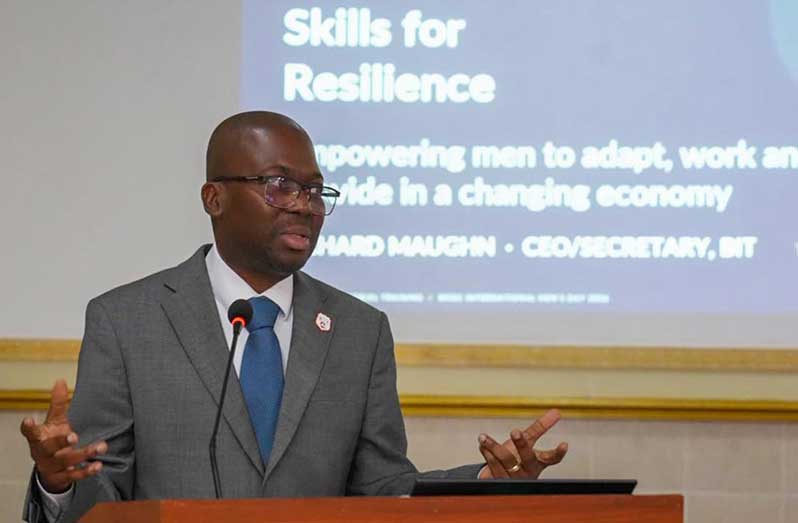
MEN must be prepared to acquire new skills, adapt to changing economic conditions and redefine what it means to be providers as Guyana’s economy continues to expand, Chief Executive Officer of the Board of Industrial Training (BIT), Richard Maughn, has said.
Maughn made the call on Tuesday during the Women and Gender Equality Commission’s (WGEC) International Men’s Day Forum 2026, held at Regency Suites, Georgetown, under the theme, “The Future is Everyone’s.”
Addressing participants, he highlighted the importance of technical and vocational education and training in helping men respond to changing workplace demands, improve their employment prospects and contribute to national development.
He noted that developments in construction, infrastructure, energy, transportation, manufacturing, hospitality and digital services are creating new opportunities, but are also requiring workers to keep pace with emerging technologies, operating standards and professional expectations.
Against this backdrop, Maughn emphasised the importance of resilience and the willingness to pivot when existing skills or employment opportunities no longer meet changing demands.
He explained that resilience involves responding constructively to setbacks, while pivoting requires individuals to develop new competencies, apply existing skills differently or move into other areas of work.
He cautioned, however, that resilience should not be interpreted as expecting men to endure difficulties in silence, noting that seeking guidance, support and alternative opportunities is also part of overcoming challenges.
Maughn also challenged traditional perceptions of men as solely responsible for providing financially for their families, arguing that the role of a provider extends beyond earning a salary.
While acknowledging the importance of income in maintaining household stability, he said being a responsible provider also involves caring for family members, supporting their wellbeing, honouring commitments and contributing positively to communities.
He further stressed that men’s advancement should not be viewed as competing with women’s progress, pointing to the forum’s theme as a reminder that both genders have shared responsibilities in building stronger families, workplaces and communities.
Turning to BIT’s role, Maughn outlined the institution’s longstanding mandate to develop occupational competencies and prepare Guyanese for employment through structured apprenticeships and community-based vocational training.
Established in 1910 under the Industrial Training Act, Chapter 39:04, BIT is responsible for regulating aspects of apprenticeship, registering suitable Masters, overseeing training, conducting assessments and certifying occupational competency.
He disclosed that between 2020 and 2026, the institution supported the capacity development of more than 19,000 persons through its training initiatives.
He clarified that the figure represents the total number of persons reached through BIT’s capacity-development efforts, and should not be interpreted as the number of certified graduates or as a figure relating exclusively to men.
The beneficiaries include young people seeking their first employment opportunities, adults attempting to re-enter the workforce, persons with disabilities and experienced workers seeking to strengthen their existing competencies.
Maughn identified three principal approaches through which BIT delivers its programmes: the National Training Programme for Youth Empowerment (NTPYE), the National Training Programme for Empowerment (NTPE) and the National Apprenticeship Scheme.
The programmes cater to different stages of the working population, providing opportunities for young people to acquire occupational skills, adults to develop new competencies and apprentices to gain practical experience under the guidance of competent Masters.
He explained that training opportunities cover a range of occupational areas, including carpentry, electrical installation, plumbing, welding, motor vehicle maintenance, heavy-duty equipment operation, refrigeration and air-conditioning.
Other areas include information technology, computer maintenance, food preparation, hospitality, agro-processing and furniture making.
These skills, he noted, can provide pathways into formal employment, entrepreneurship and self-employment, particularly as demand increases across several sectors of the economy.
However, Maughn cautioned that the courses listed form part of BIT’s wider training portfolio and that availability varies according to approved projects, regional needs, resources and scheduled intakes.
He said the institution follows a bottom-up, demand-driven approach to identifying training needs, with technical officers engaging communities, prospective trainees, employers and other stakeholders before developing programmes.
Training projects are subsequently designed around identified needs, with attention given to course content, instructors, equipment, materials and workplace safety. Participants are monitored and assessed, with certificates awarded upon successful completion of programme requirements.
The BIT chief executive also encouraged men interested in pursuing vocational training to contact the institution to determine which programmes are available in their respective regions and the requirements for enrolment.
He noted that the Government’s vocational training courses are free to trainees, while some programmes may also provide materials, equipment or stipends, depending on their arrangements.
Maughn stressed that participation in training does not automatically guarantee employment, but provides an avenue for individuals to develop recognised competencies and improve their prospects of securing work or generating income.
The International Men’s Day forum also featured discussions on employment opportunities through the Guyana Online Academy of Learning (GOAL) and BIT, as well as presentations on men’s health, resilience and mental health.
Dr Tariq Jagnarine of the Ministry of Health addressed men’s health, resilience and pivoting, while psychologist Wil Campbell delivered a presentation on men’s mental health.
The forum formed part of the Commission’s efforts to encourage greater discussion about men’s development, wellbeing and contribution to society, while promoting the understanding that building a stronger future requires the participation of everyone.




