






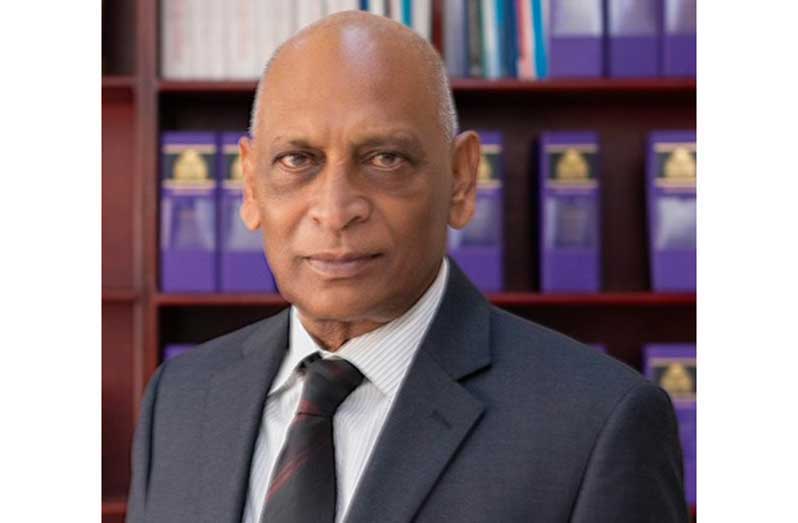
– says VP Jagdeo’s calls for stronger climate commitments backed by tangible action
GUYANA’S Vice-President, Dr Bharrat Jagdeo, has challenged world leaders to move beyond repeated climate commitments and take concrete action to address global warming, deforestation and environmental degradation, warning that the gap between international promises and implementation continues to undermine efforts to protect the planet.
The call was highlighted by Ambassador to the Swiss Confederation and Permanent Representative to the United Nations and other Organizations in Geneva, Switzerland, Dr Leslie Ramsammy, in a public commentary dated November 14, following the 31st Conference of the Parties (COP31), held in Antalya, Türkiye.
Ramsammy said Jagdeo, who led Guyana’s delegation, delivered a strong message to climate negotiators that the international community must prioritise implementation over continued discussions, particularly as vulnerable countries face increasingly severe consequences from climate change.
He argued that Guyana’s experience demonstrates that meaningful climate action is possible, pointing to the Low Carbon Development Strategy (LCDS), conceived and implemented under Jagdeo’s leadership, and the Global Biodiversity Alliance, championed by President Dr Irfaan Ali, as examples of initiatives that could inform international efforts.
According to Ramsammy, while successive climate conferences have generated ambitious declarations and commitments since the first COP in Berlin in 1995, tangible achievements have consistently fallen short of the promises made.
He described the international response as one characterised by repeated assurances, with implementation progressing far too slowly to match the urgency of the climate crisis.
At COP31, Jagdeo urged negotiators not to abandon efforts to secure more ambitious climate commitments, particularly those designed to assist developing and vulnerable countries in adapting to the effects of global warming.
He also emphasised the importance of the United Nations principle of common but differentiated responsibilities and respective capabilities, which recognises that countries have different historical contributions to climate change and varying capacities to address it.
However, the Vice-President maintained that such commitments must translate into practical measures rather than remain on negotiating tables.
A major area of concern was the implementation of the Forest Finance Roadmap, which outlines six financing options intended to support forest-rich countries, including Indigenous Peoples and local communities.
Among the mechanisms highlighted were the Tropical Forests Forever Facility (TFFF) and jurisdictional carbon markets, which allow countries to generate carbon credits based on verified reductions in emissions across defined geographical areas.
Jagdeo called on countries to accelerate the implementation of these financing arrangements, while urging governments to pass legislation supporting the Carbon Offsetting and Reduction Scheme for International Aviation (CORSIA), open compliance carbon markets and operationalise Article 6 of the Paris Agreement.
These measures, he argued, are important to ensuring that countries protecting their forests and reducing emissions can access the financing needed to sustain those efforts.
The Vice-President also addressed the global energy transition, referencing the COP28 agreement to transition away from fossil fuels.
He cautioned that reducing dependence on fossil fuels must go hand in hand with the development and expansion of renewable energy sources, increased electrification and the adoption of emerging technologies.
His proposed approach included reducing fossil fuel production and consumption, expanding renewable energy generation, accelerating electrification and curbing deforestation.
He also highlighted the growing demand for electricity from artificial intelligence and other energy-intensive technologies, warning that their rapid expansion must not undermine global energy security or efforts to decarbonise economies.
Beyond the negotiations, Ramsammy identified the possibility of an exceptionally strong El Niño event during 2026/2027 as a major concern that demands urgent international attention.
He said climate scientists have been warning of the potential for a severe event, with unusually high sea-surface temperatures in the tropical Pacific raising concerns about the possibility of a so-called super El Niño.
The commentary pointed to the Niño 3.4 index, the principal measure used to monitor and classify El Niño and La Niña conditions, which tracks sea-surface temperature anomalies in a designated section of the equatorial Pacific.
An El Niño event is generally declared when the three-month average sea-surface temperature anomaly reaches at least 0.5 degrees Celsius above the established baseline. Events are classified as moderate, strong or very strong as the temperature anomaly increases.
Ramsammy cited historical temperature records showing that some of the strongest El Niño events occurred in 1877–1878 and 2015–2016, when sea-surface temperature anomalies reached approximately 2.73 and 2.75 degrees Celsius, respectively.
He warned that the projections outlined in his commentary point to the possibility of an exceptionally severe 2026/2027 event, with potentially devastating consequences for global temperatures and public health.
The potential effects include prolonged and extreme heat, increased mortality and greater risks of infectious diseases, including dengue and cholera, as climate-related disruptions place additional pressure on public health systems.
Ramsammy also referenced concerns about the possibility of hundreds of thousands of heat-related deaths and argued that the anticipated public health implications warrant urgent international attention, including consideration of whether the World Health Organization should assess the situation under its international health emergency framework.
He further noted that global temperatures typically respond to El Niño conditions with a lag of approximately three to five months, raising the possibility that the warming effects of the 2026 event could contribute to exceptionally high temperatures in 2027.
Against this backdrop, Ramsammy maintained that Guyana’s climate policies and investments have positioned the country to respond more effectively to emerging environmental threats.
He credited the country’s leadership with pursuing practical interventions through forest conservation, low-carbon development and biodiversity protection, rather than relying solely on international declarations.
The commentary concluded with a renewed call for the international community to match its climate commitments with measurable results, arguing that the growing risks associated with global warming leave little room for further delays.
“We need action, not more talk,” Ramsammy stressed, maintaining that Guyana’s approach demonstrates the importance of translating climate ambitions into concrete national policies and programmes.




