






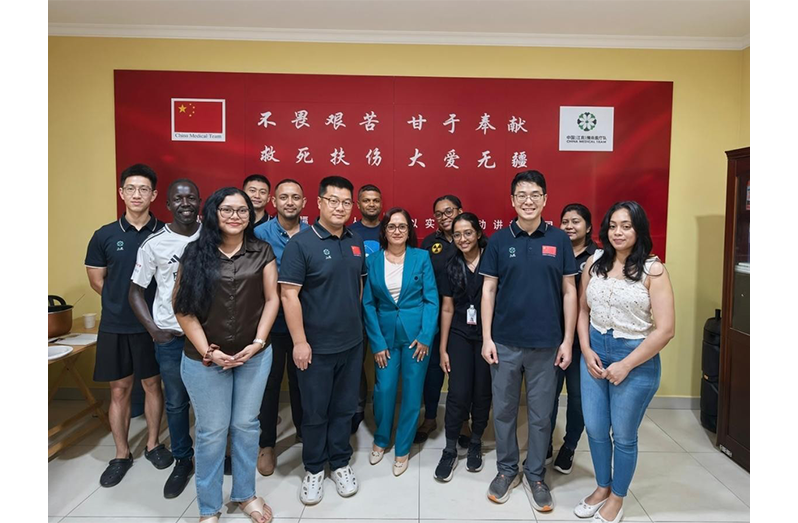
MORE than three decades of medical co-operation between Guyana and China were highlighted on Friday as Chinese medical specialists and Guyanese radiologists came together for an academic and cultural exchange ahead of the International Day of Radiology.
The November 7 gathering brought members of the 22nd Chinese (Jiangsu) Medical Team and radiologists from the Georgetown Public Hospital Corporation (GPHC), along with their families, together for a series of technical presentations, professional discussions and cultural activities.
The event underscored the longstanding collaboration between the two countries in strengthening Guyana’s diagnostic imaging services, particularly through the training and professional development of local medical personnel.
International Day of Radiology is observed annually on November 8, commemorating the discovery of X-rays by German physicist Wilhelm Röntgen in 1895, a breakthrough that transformed medical diagnosis and treatment.
Radiology, often described as the eyes of modern medicine, plays a critical role in detecting and monitoring diseases, guiding treatment decisions and improving patient outcomes.
During the academic sessions, Chinese specialists delivered presentations covering several areas of diagnostic imaging, with topics selected to address local disease patterns and the clinical and technical requirements of the GPHC Radiology Department.
Professor Xing Wei, Chairman of the Radiology Branch of the Jiangsu Medical Association, delivered a video message of greeting, while senior Chinese radiology specialists, Wang Shu and Ji Yugang, also participated in the programme.
Wang Chuanbing delivered online presentations on imaging of bone and joint trauma, the assessment of pulmonary nodules through computed tomography (CT), and the identification and control of imaging artefacts in digital radiography (DR), CT and magnetic resonance imaging (MRI) examinations.
Dr Wu Chenjiang, a member of the Chinese medical team, provided an overview of the Prostate Imaging Reporting and Data System (PI-RADS) version 2.1, which standardises the reporting and assessment of prostate imaging.
The presentations prompted questions and discussions among participants, creating an interactive learning environment for both Chinese and Guyanese medical professionals.
Dr Wu also indicated that further specialised training would be organised in preparation for the expected introduction of GPHC’s first MRI unit. The proposed sessions will cover MRI safety, operating principles, normal anatomical structures and common disease presentations.
The afternoon programme broadened the exchange beyond conventional medical imaging, with acupuncture physician Xu Wanli discussing traditional Chinese medicine concepts of qi and acupoints, while ophthalmologist Miao Jinxin outlined the structure of public hospitals and the public healthcare system in Jiangsu Province.
Participants also had the opportunity to experience Chinese hospitality through traditional tea snacks prepared by the medical team’s chef, Geng Wanjun.
Head of Radiology at GPHC, Dr Tania Aguilera Garcia, used the occasion to reflect on the department’s progress over the past decade, noting that it had evolved from a relatively small unit with limited equipment into a more comprehensive service offering CT, MRI and mammography.
She acknowledged the contribution of successive Chinese medical teams, particularly their role in strengthening the technical capacity of the department and training younger Guyanese doctors.
“Chinese medical team members have played an important role in the development of our department, especially in the training of young doctors,” Dr Aguilera Garcia said.
The collaboration forms part of a wider medical co-operation programme that began in 1993, when the first Chinese medical team arrived in Guyana.
Since then, more than 300 Chinese doctors have served in the country on a voluntary basis, while Chinese medical teams have provided treatment to more than 1.3 million patients.
Radiology has remained an important component of that partnership, with Chinese specialists contributing to the development of diagnostic services and the transfer of technical knowledge to local healthcare professionals.
The November 7 event therefore served not only as an observance of International Day of Radiology but also as a reaffirmation of the value of sustained international co-operation, professional training and cultural exchange in strengthening Guyana’s healthcare system.




