






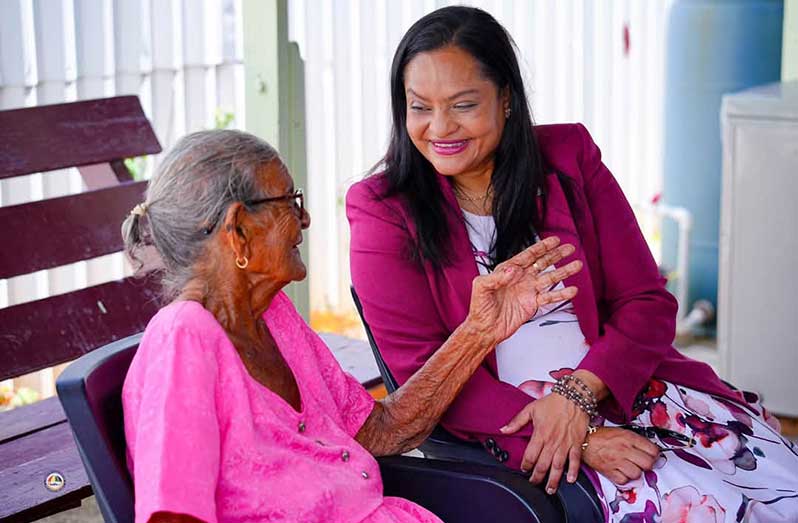
-bank deposits, MMG offer safer, more convenient options, Minister Persaud says
LONG queues, monthly trips to the post office and the risks that come with carrying cash are among the challenges the government is seeking to eliminate as it encourages more pensioners and persons living with permanent disabilities to receive their benefits through digital payment platforms.
Minister of Human Services and Social Security, Dr Vindhya Persaud, made the appeal whike highlighting intensifying efforts to have beneficiaries shift towards bank deposits and Mobile Money Guyana (MMG).
The initiative, which supports efforts being made to digitise the ministry’s operations and establish a national beneficiary management register, includes absorbing transaction fees, providing hands-on assistance to beneficiaries, expanding digital literacy programmes through Golden Generation Hubs and making payment services available through thousands of locations countrywide.
Speaking during an interview on GoMoseley Radio on Monday, Minister Persaud explained that the digitisation process has been part of a wider effort to modernise the ministry’s services and improve how benefits are delivered to people across Guyana.
She said the ministry has developed a beneficiary management register which captures information on recipients of old-age pensions and permanent disability benefits, allowing it to better manage the delivery of those services while introducing alternative payment arrangements.
Under the current system, beneficiaries can choose to have their money deposited directly into a bank account or receive it through almost 2,000 MMG locations, without having to visit a post office or wait in long queues.
“We have spent the last three years working on digitising the Ministry of Human Services and Social Security. We have created a database or what we call a beneficiary management register and with that we are able to capture the beneficiaries across the country for both old age pension and people living with permanent disabilities,” she said.
Recognising that unfamiliarity with new technology remains a major hurdle for some older persons, Dr Persaud said education and continuous engagements are central to encouraging participation. She explained that the ministry has been organising camps at its offices across the country, where MMG representatives demonstrate how to establish accounts and use the service.
She said the MMG wallet provides additional flexibility because beneficiaries can use it to make their own payments, while also reducing the risks associated with carrying cash or keeping a physical pension booklet that could be misplaced. Importantly, she said, beneficiaries who prefer to withdraw their entire pension at once can continue to do so, as this was one of the safeguards she insisted upon when the arrangement was being developed.
“One of the things when we were setting it up that I ensured was that the seniors could withdraw all their money at one time if they want to do it,” Persaud said.
Through the introduction of alternative payment options, including SurePay and Western Union, recipients have more flexibility in deciding where and when to access their money. Dr Persaud said the ministry wants beneficiaries to understand that the digital options are intended to give them greater control over their finances rather than force them into a system they are uncomfortable using.
She acknowledged that some older persons may be reluctant to abandon the traditional arrangements and the social interactions that come with visiting the post office. This is why the ministry is taking a gradual approach, placing greater emphasis on younger pensioners and persons who are newly registering for old-age pensions or permanent disability benefits.
“So, we are looking more at people who are just starting their pension or their permanent disability benefits and people perhaps between the ages of 65 to 75 to use this technology,” she explained.
To further prepare older persons for the transition, the ministry is expanding its Golden Generation Hubs, which provide opportunities for social engagement while introducing seniors to basic digital skills. The hubs, which have been implemneded in a few communities and are slated to be introduced to others, allow seniors to participate in activities such as Tai Chi, yoga, health and wellness discussions and recreational activities, alongside lessons in using mobile phones, applications and online forms.
Dr Persaud noted “A big part of that is digital literacy. So we are going to be teaching them how to use their cell phones, how to use the apps, how to use online forms, things like that. Simple things that make you a lot more digitally inclined,” she said.
The minister also issued a clear warning to payment agents against attempting to charge pensioners additional fees to access their benefits, stressing that all transactions under the arrangement must remain free to beneficiaries.
She said the ministry has agreements with the companies providing the services and is already absorbing the associated costs. Persons who encounter agents demanding additional payments can report the matter through the ministry’s established hotlines, which are available on its Facebook page.
“I want to say very clearly that agents should not be taking advantage of our seniors because we have had an agreement with the companies that provide these services that these services will be free because we are absorbing the cost. So, no one should be paying anything at all,” she said.




