






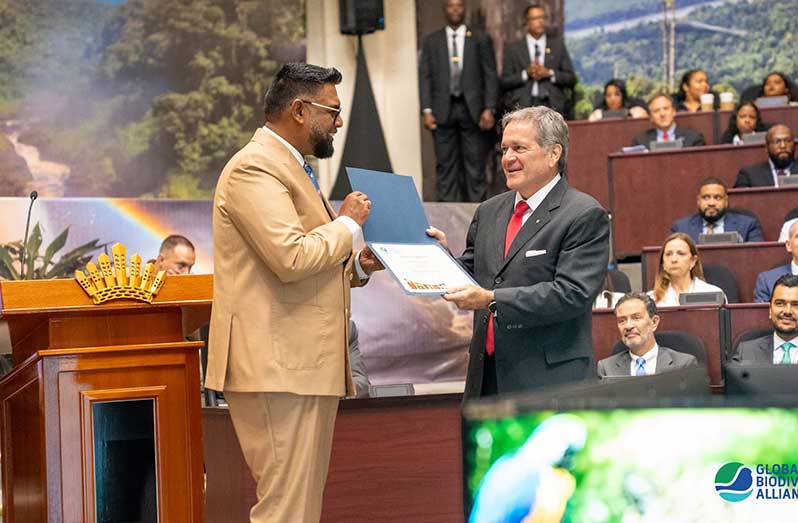
– says political will, strong leadership, practical conservation projects critical to protecting biodiversity
GUYANA’S growing efforts to protect its natural resources are setting an example for other countries, but meaningful progress in conserving biodiversity will depend on governments moving beyond discussions and committing to practical action.
This is according to Panama’s Minister of the Environment, Juan Carlos Navarro, who reinforced this fact during an interview on the Starting Point podcast on the opening day of the Global Biodiversity Alliance conference.
Speaking on the practial biodiversity conservation effort Guyana has made, Navarro praised President Dr Irfaan Ali’s leadership and the country’s commitment to expanding protected areas.
Nararro also emphasied the impact of political will, citing capable people and well-developed projects as vital aspects in securing conservation financing. Moreover, he also highlighted Panama’s efforts to protect the forests surrounding its canal, and plans to establish a US$100 million long-term conservation fund.
His remarks came as Panama formally joined the Global Biodiversity Alliance as a founding member, reeinfocing steps to develop international cooperation and placing greater value on the world’s biodiversity.
Further, Navarro said Panama’s decision to join the alliance followed a meeting between Guyana’s President Ali and Panama’s President José Raúl Mulino, during which the Guyanese Head of State outlined areas in which the two countries could collaborate.
He said that when the proposal to join the biodiversity initiative was raised, he immediately sought and received authorisation from his President to participate as a founding member. A formal diplomatic note was sent to Guyana the following day, completing the process.
Navarro described the decision as an example of what could be achieved when governments share a commitment to advancing their countries while protecting biodversity.
“That is how we do things when both governments have the will to do better for our people. So, we love to be part of this alliance and to work for the conservation of biodiversity with Guyana,” Navarro said.
Highlighting the importance of turning international commitments into tangible results, Navarro was keen to note that financing is not always the greatest obstacle facing biodiversity conservation, but rather cited lack of leadership and political commitment as main challenges in getting projects off the ground.
Sharing insight from more than four decades of experience in conservation, including establishing the National Association for the Conservation of Nature in Panama 41 years ago, Navarro said that governments must first demonstrate a willingness to protect natural areas and then build the institutions required to sustain those efforts.
“In my experience, the problem is never the financing. This may sound out…but I have been doing conservation work for over four decades,” he said adding, “The challenge is having good people, good leadership, good projects, and at least common of the senses, common sense. If you have that, the financing will follow.”
Navarro was particularly critical of the trend of international environmental discussions being primarily lengthy speeches without creating action on the ground. He argued that governments must demonstrate their commitment through measurable conservation efforts.
Referencing Guyana’s decision to expand its protected areas by one million hectares, Navarro described the initiative as the kind of leadership needed to safeguard biodiversity, adding, “We have a bunch of people going to COPs, politicians full of hot air and beautiful speeches.”
He emphaisesd that “By creating new national parks, just like President Ali is doing, [creating] a million hectares of new protected areas. That is how you protect biodiversity, not by talking about it.”
Beyond immediate conservation measures, Navarro said countries must also establish sustainable financial arrangements in funding biodiveristy conservation efforts. He noted that nations must create financing frameowrks that are capable of supporting biodiversity protection over the long term, rather than depending entirely on individual projects or short-term funding inatiatives.
He disclosed that Panama was working with a consortium of United States foundations and organisations such as the World Wildlife Fund and The Nature Conservancy. This initiative is expected to establish a US$100 million trust fund under a Project Finance for Permanence arrangement.
PROTECTING BIODIVERSITY
Explaining how Panama is seeking to balance economic development with environmental protection, Navarro pointed to the forests surrounding the Panama Canal as an example of the direct relationship between healthy ecosystems and national economic security.
He said the primary forests, much of which are protected within national parks, are not only rich in biodiversity but also form the watershed responsible for supplying drinking water to approximately half of Panama’s population, or approximaely two million people, while providing the water needed to operate the canal, which is central to the country’s economy.
However, Navarro said the importance of protecting those ecosystems has become even more apparent as Panama experiences the growing effects of climate change, particularly through changing rainfall patterns and the El Niño phenomenon.
He recalled that during the 2023 El Niño event, Panama lost almost US$1billion in revenue due to low water levels restricting the number of ships that could transit the canal.
With another strong El Niño expected, the country is now pursuing a major reservoir project, investing billions of dollars towards strengthening its water security. The project is intended to guarantee water supplies for the two million people who depend on the canal watershed for drinking water, while also ensuring sufficient water for the canal’s continued operation.
“We are building a new reservoir, a big project for Panama, billions of dollars of investment to guarantee the water supply to Panamanians, two million of us, half our population,” Navarro said.
In warning of the wider consequences of failing to protect biodiversity, Navarro said environmental degradation is affecting countries regardless of their individual conservation efforts or contribution to global emissions.
He noted that Panama is a carbon-negative country, yet continues to experience the effects of climate change driven by emissions from elsewhere.
Citing figures he said were discussed among scientists and researchers at the recent COP17 biodiversity conference, Navarro warned that wildlife populations has declined by 79 per cent over the past 20 to 30 years. “This continued destruction of natural habitats, he noted, threatens wildlife and the ecosystems on which countries depend for drinking water, agriculture and economic activity. “Make no mistake, we are destroying the planet. We are destroying biodiversity,” he said.
Despite the scale of the challenge, Navarro maintained that countries could expand their economies while safeguarding their natural heritage.
Pointing to Panama’s ongoing efforts, he said the country was pursuing both objectives, encouraging other nations to demonstrate the same determination.
“In Panama, we are doing it. Growing our economy and also protecting nature simultaneously under the leadership of President Molino. We have to, we can do it. We have to do it elsewhere. It takes willpower, good projects, capable people,” he said.




